
Rocks and Their Sources in the Upper Paleolithic of the Altai: Relevance to Bifacial Technologies
Journal: Archaeology, Ethnology & Anthropology of Eurasia @journal-aeae-en
Section: Paleoenvironment, the stone age
Article in issue: 4 т.52, 2024.
Free access
On the basis of the analysis of thin leaf-shaped bifacial points, which are very elaborate and sensitive to the quality of rocks, we reconstruct the adaptive strategies of humans at the early stages of the Upper Paleolithic. Mineral raw materials and their exploitation relating to different resource bases of the central (the Ursul River basin) and northwestern (the Anuy River basin) parts of the Altai region are analyzed. To attribute the rock sources for bifaces, we have compiled a comparative database of petrographic and petrochemical characteristics of artifacts and pebbles from nearby rivers. Chemical criteria were proposed for differentiating rocks, including those that are hard to distinguish, and non-destructive techniques were applied to assess the chemical composition of rocks using a portable XRF spectrometer. Findings suggest that rocks available in the Anuy and Ursul basins met the conditions for biface manufacture. Bifaces from the Ursul valley were made of local fine-grained rocks—felsic volcanic tuff and ignimbrite; those from the Anuy valley were also of local rocks, but of lower quality—hornfels transformed (meta-sedimentary) siltstone and finegrained sandstone or felsic volcanic rocks. In the Anuy valley, scarcity of quality raw material was compensated for by imported high silica jasper-like rocks. Results suggest that the Early Upper Paleolithic inhabitants of the region, when implementing technical skills, showed stable behavioral and technological stereotypes despite habitat change and deterioration of the resource base.
Similar articles in the section Prehistory. Prehistoric remains, artefacts, antiquities
Short address: https://sciup.org/145147483
IDS: 145147483 | DOI: 10.17746/1563-0110.2024.52.4.059-074
Text of the scientific article Rocks and Their Sources in the Upper Paleolithic of the Altai: Relevance to Bifacial Technologies
Stone raw materials and their sources are extremely important for studying Paleolithic sites in the Altai (Postnov, Anoikin, Kulik, 2000; Kulik, Postnov, 2001; Kulik, Shunkov, Petrin, 2003; Derevianko et al., 2003, 2015; Rybin et al., 2018; Kulik, Kozlikin, Shunkov,
2023). Most of the Stone Age sites discovered in the Altai are located in a single geological macrostructure— the Anuy-Chuya structural-facies zone (Kuznetsov, 1963; Gosudarstvennaya geologicheskaya karta…, 2019), composed of marine sediments and volcanics of the Vendian-Paleozoic age. This zone is distinguished by a variety of raw mineral resources. The prevalence
This study aimed to reconstruct raw material use and adaptation strategies of people that settled in the Altai at the early stages of the Upper Paleolithic by analyzing the material of thin leaf-shaped bifaces. The main Upper Paleolithic sites are concentrated in the northwest of the region—in the valley of the upper reaches of the Anuy River (Ust-Karakol-1, Anuy-1 and -3 sites, Denisova Cave) or in the central part of the region—in the Elovskaya depression in the Ursul River basin (Kara-Bom and Tyumechin-4 sites). In the Initial and Early Upper Paleolithic, these areas were inhabited by the same groups of people: ca 45,000– 40,000 noncal BP by the creators of the Kara-Bomian cultural tradition, and ca 30,000–35,000 noncal BP by those of the Ust-Karakolian (Belousova, 2018). Natural settings in the Elovskaya depression granted wide access to homogeneous fine-grained high-quality raw materials as opposed to the Anuy valley, where access was limited. The influence that local material resources had on the industries within a single cultural tradition is a fundamental issue. Resolving this issue will not only expand our understanding of cultural dynamics in the Upper Paleolithic, but also shed some light on the background for technological and typological variability of industries. In this study, this issue is addressed by analyzing lithic material that was selected by humans to make thin leaf-shaped bifacial points. These sophisticated artifacts required high quality of rocks. They were manufactured at sites in the Ursul and Anuy valleys; therefore, they can be an important source of information for assessing the lithic resources and the stability of behavioral and production stereotypes among the carriers of bifacial technology.
The materials used for the bifacially processed artifacts and their sources were identified using methods that did not damage the samples and were suitable for working with fine-grained rocks (with individual grain size of 2–15 μm), which were preferred in manufacturing thin bifaces. Identification of such rocks using classic petrographic analysis in transparent thin sections is extremely complicated, since the thickness of the preparation is about 30 μm, which exceeds the size of the single grains. This makes it impossible to measure the optical properties of minerals, and sometimes to determine their shape and nature of intergrowths. In addition, if rocks do not have any specific textural and structural features (layering, flow-banding, spotting, etc.), they cannot be divided into classes and unambiguously identified.
For these reasons, rocks were studied using comprehensive analysis of petrographic and petrochemical features established by non-destructive methods (Vishnevsky et al., 2023). A database of petrographic and petrochemical features of rocks for making bifaces and pebbles from the nearby waterways was created; petrochemical criteria for differential diagnostic assessment of rocks, including hardly-discernible, fine-grained varieties, were elaborated. The research was based on extensive experience in geological and archaeological surveys of recent decades, the data of geological maps, and explanatory notes from them (Gosudarstvennaya geologicheskaya karta…, 2001, 2019), taking into account specific features of the alluvium composition of local waterways and rocks in their original occurrence.
Materials
This study employed archaeological collections from two groups of sites in the Northwestern and Central Altai: the Anuy group in the Anuy River basin and the Ursul group in the Ursul basin, where thin bifacially processed tools of the early stages of the Upper Paleolithic were discovered. In addition to archaeological materials, groups of pebble samples from the Anuy and Ursul rivers were used. These included experimental samples taken from each waterway (encompassing those with high utilitarian features), and petrographic samples from the Anuy, reflecting the diversity of rocks as a whole.
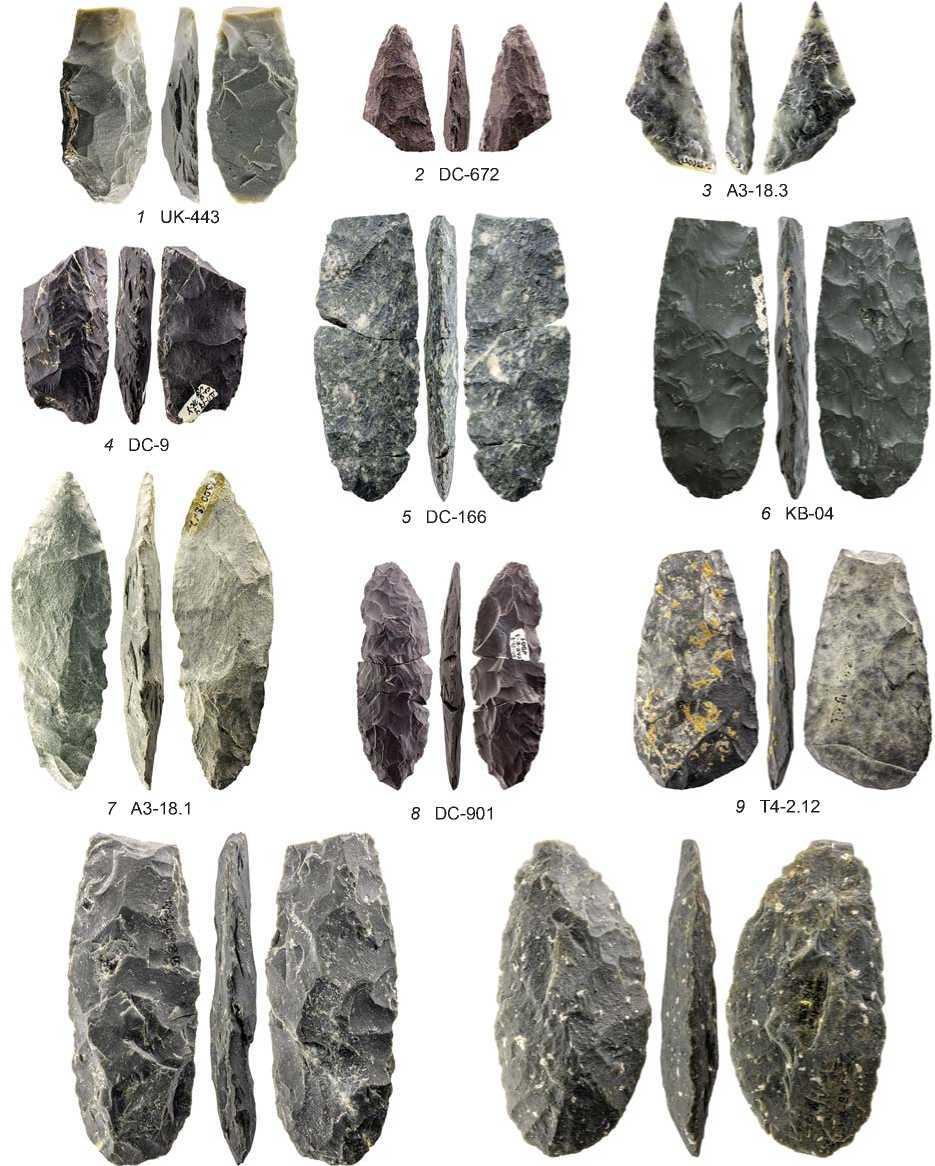
The archaeological collection includes 28 bifacial tools and their blanks (Fig. 1, Table 1), which is about 90 % of the total number of items discovered to date and available for study. The collection comprises artifacts from sites on the Ursul River (Tyumechin-4, n =6; Kara-Bom, n =5) and Anuy River (Denisova Cave, n =9; Ust-Karakol-1, n =4), dated to the Initial and Early Upper Paleolithic, as well as items similar in their morphometry to the Upper Paleolithic artifacts, but requiring clarification of their chronological position (Anuy-3, n =4). The tools were manufactured
4 DC-9
5 DC-166
8 DC-901
7 А3-18.1
UK-443
2 DC-672
3 А3-18.3
Т4-2.12
6 KB-04
10 Т4-321
0 5 cm
11 KB-3982
Fig. 1 . Leaf-shaped bifaces from the sites of Ust-Karakol-1 ( 1 ), Denisova Cave ( 2 , 4 , 5 , 8 ), Anuy-3 ( 3 , 7 ), Tyumechin-4 ( 9 , 10 ), and Kara-Bom ( 6 , 11 ).
1 – felsic volcanic rock of the Anuy type or tuff of the Kara-Bom type; 2 , 5 – felsic volcanic rocks of the Karakol type without phenocrysts; 3 – felsic volcanic rock of the Anuy type; 4 , 8 – highly siliceous rocks; 6 , 10 , 11 – volcanic tuffs and ignimbrites; 7 , 9 – hornfelse (meta-sedimentary) rocks, aleurolite.
Table 1 . Chemical composition of material of the bifaces * from the sites in the Anuy and Ursul river basins, according to pXRF data, wt%
The experimental collection includes 37 samples of rocks with high utilitarian properties, collected in 2020–2022 for the experimental splitting simulation program (Belousova et al., 2022) (Table 2). The sources of the rocks were modern and ancient gravels of the Ursul basin at the mouths of the Altaira and Nizhny Tyumechin rivers ( n =28, Ursul group of sites), and the Anuy River basin ( n =9, Anuy” group of sites).
Petrographic collection. For expanding the range of rocks from the Anuy River basin available for analysis, a collection (n=152) gathered in 1997 by N.A. Kulik was used. It includes samples of pebbles from the modern alluvium of the Anuy and its upstream tributaries (Karakol, Turata, Muta, etc.), as well as samples of the ancient alluvium of the Anuy and Karakol rivers, exposed during gold mining. Twenty-eight samples of volcanic (effusive) rocks (Table 2) are of particular importance to this study. Rocks of this type, widely used by the inhabitants of the local Paleolithic sites, are not found in the experimental collection.
Samples of individual high-siliceous blocks of rocks, similar to that of which several bifaces were made, are
Table 2. Typical composition of rock samples from modern gravels of the Anuy and Ursul rivers, according to pXRF data, wt%
Methods
The study followed a set of geological and mineralogical methods aimed at establishing the petrographic features of rocks and their chemical composition. Standard petrographic thin sections for studying in transmitted light, as well as polished preparations from pieces of rock mounted in epoxy resin for working with a scanning electron microscope, were made from the samples of the experimental and petrographic collections. Scanning electron microscopy (SEM) was used for detailed study of the rock structure and identification of minerals with an integrated energy-dispersive spectrometer (EDS) under standard parameters at the Center for Collective Use of Scientific Equipment for Multi-Element and Isotope Research of the Siberian Branch of the Russian Academy of Sciences, using a Tescan Mira 3 system with Oxford X-Max 50 spectrometer.
A portable X-ray fluorescence (pXRF) analyzer Olympus Vanta M, with a 4 W rhodium anode and silicon drift detector in a modification specialized for studying rocks, was used for establishing the chemical composition. It is non-destructive and does not require sample preparation, which is important when studying archaeological artifacts. For the analysis an area with a relatively flat, homogeneous, and clean surface was sufficient. The device does not require a vacuum or short-term calibration. The built-in camera makes it possible to select the area for analysis.
The device does not measure the content of elements lighter than magnesium. This concerns primarily sodium, the typical content range of which for volcanic and sedimentary rocks is 0.3–3.0 wt%. Sodium plays an important role in the composition of many rocks; therefore, in the absence of data on its content, direct use of petrochemical recalculations and many classification diagrams is impossible.
The Olympus Vanta M has proven to be useful in analytical work at geological sites, and has shown stability of results with multiple measurements (Wawryk, Hancock, 2022). Previous studies have revealed that this analyzer was effective in the diagnostics of rocks, and the obtained values could be used for direct comparison of the chemical composition of material from the flaked surfaces of artifacts and that from modern rock outcrops without grinding the artifact (Vishnevsky et al., 2023).
At least two spectra were obtained for each studied sample. The numerical results of spectra calculations were averaged. The diameter of the excitation spot of the surface was ca 3 mm; the voltage was 10/40 kV; the spectra accumulation time was 15 sec (30 sec in total).
Petrography and mineral composition of samples from the experimental and petrographic collections
Sedimentary and meta-sedimentary rocks from the Anuy alluvium . Nine samples were selected from the river spits near the Ust-Karkol-1 site for the experimental collection (Table 2). Most of the rocks are massive and lumpy-banded siltstones with color ranging from gray and dark gray to black (often with a brownish tint), with grains 20–50 μm in size. Some rocks with grains ~100 μm in size can be described as silty sandstones and fine-grained sandstones. The grains are poorly sorted and weakly rounded (Fig. 2, 1 ), dominated by fragments of magmatic rocks of intermediate and basic composition, as well as quartz and plagioclase grains.
All of the studied rocks manifest traces of recrystallization under temperature (metamorphic) and/or hydrothermal influence of varying degrees, and consequently are meta-sedimentary. Many samples have poor textural and structural features, such as fine-spotted textures typical of hornfels. Albite and epidote are the most common among the newly formed minerals. Epidote forms both small idiomorphic grains and rather large poikilitic crystals up to 100–150 μm in diameter (Fig. 2, 1 , BSE). The structure of the rock shows embayed boundaries of fused grains, which ensures increased strength and homogeneity of the material. In addition to epidote, sericite and chlorite are observed in the intergranular space of some rocks; their share reaches 20 vol%. Previously, such a wide occurrence of neogenic minerals was attributed to low stages of regional metamorphism of sedimentary rocks in the Anuy basin (Gosudarstvennaya geologicheskaya karta…, 2001; Postnov, Anoikin, Kulik, 2000). However, widespread occurrence of hydrothermally transformed rocks and low-temperature contact-metamorphic aureoles in this region (Gosudarstvennaya geologicheskaya karta…, 2001) suggests a connection between the observed changes and magmatism.
Volcanogenic rocks of the Anuy alluvium . Twenty samples were taken. In the Anuy channel near Denisova Cave, two types of effusive rocks occur: the most common are aphyric rhyolites; less common are rare-porphyritic rhyolites and rhyodacites with massive, spotted-banded, and flow-banded (fluidal) texture, and
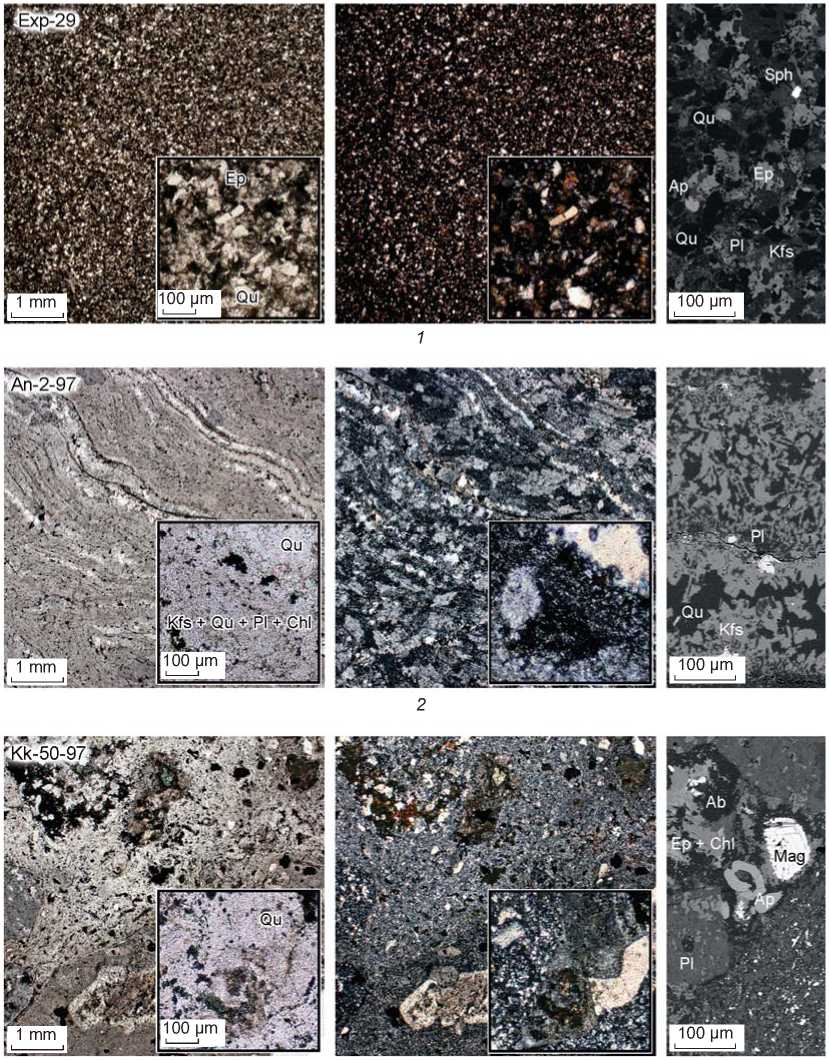
Fig. 2. Petrographic features of meta-sedimentary and volcanic rocks from the Anuy alluvium. The images were taken using an electron microscope: in plane-polarized light (ppl) – left column, in crossed nicols (xpl) – central column, in backscattered electrons (BSE) – right column.
Ap – apatite; Chl – chlorite; Ep – epidote; Kfs – potassium feldspar; Mag – magnetite; Pl – plagioclase; Qu – quartz; Sph – sphalerite. 1 – Exp-29, typical meta-sedimentary rock visually diagnosed as aleurolite. On the left a fine-grained structure with uniform distribution of weakly rounded grains is visible. The BSE-image clearly shows the growth of a newly formed epidote— the development of a hornfels structure; 2 – An-2-97, aphyric rhyolite of the Anuy type with distinctive flow-banding and micropoikilitic texture of the groundmass formed by poikilocrysts of potassium feldspar; 3 – Kk-50-97, porphyritic dacite of the Karakol type with a large number of different-sized phenocrysts of altered feldspars, chloritized grains of dark-colored minerals, magnetite, and apatite.
felsitic, spherulitic, or micropoikilitic groundmass, the so-called felsic volcanic rocks (FVR) of the Anuy type (Fig. 2, 2 ). The groundmass of these rocks consists of closely intergrown very fine grains (1–5 μm) of quartz, plagioclase (albite), and potassium feldspar. Accessory minerals are most often magnetite, apatite, zircon, and less often titanite. In some samples, the rock is strongly altered—albitized and chloritized, but its grain size remains extremely fine. These rocks have a light (beigegray, greenish-gray, yellowish) color, or less often range from a reddish to brown color. Their pebbles are typical of the right tributaries of the Anuy River—the Cherga, Turata, and Khulusta rivers.
Dacites (up to andesites) with porphyritic and glomeroporphyritic texture, usually without pronounced flow-banding—the so-called Karakol type (Fig. 2, 3 )— occur more rarely in the Anuy alluvium. These rocks are dark-colored, gray, greenish-gray or greenish-brown, sometimes with a reddish-violet tint. Phenocrysts include intermediate plagioclase, chloritized darkcolored minerals, such as amphibole or clinopyroxene, as well as magnetite, and ilmenite (Fig. 2, 3 , BSE). Quartz, albite, and potassium feldspar dominate in the main microgranular mass. Accessory minerals (ilmenite, magnetite, apatite, and titanite) are present in much larger quantities than rocks of the Anuy type. Secondary minerals—chlorite and sericite— are widespread. The main supplier of such rocks to the Anuy valley is the Karakol—a large left tributary flowing into the Anuy 2 km upstream from Denisova Cave. However, variability in the composition and textural-structural features of volcanic rocks in this case is rather high: the Anuy pebbles above the confluence of the Karakol also contain porphyritic rocks, and the Karakol alluvium contains rock types almost devoid of phenocrysts.
Volcanogenic-sedimentary rocks of the Ursul basin. For the experimental collection, 28 samples were taken from the alluvium of the Altaira River, 200 m from its mouth, and from the alluvial fan of the Nizhny Tyumechin River, which is eroded by the Ursul in the area of the Tyumechin-1–3 sites (Belousova et al., 2022). These are pyroclastic (volcanogenic-sedimentary) rocks of felsic composition, formed by dispergation of magmatic material during a volcanic eruption and its subsequent deposition, that is, these are compacted fine-grained ash tuffs (Fig. 3, 1, 2) and ignimbrites with massive or poorly banded, discontinuous-linear or unevenly spotted texture caused by fiamme relics (Fig. 3, 3). They are usually completely devitrified and partially recrystallized under the effect of either low-grade regional or contact metamorphism during intrusion of small magmatic bodies that are widespread in this region (Gosudarstvennaya geologicheskaya karta…, 2019). The preserved phenocrysts/fragments of quartz and feldspar grains make it possible to distinguish tuffs as initially vitroclastic (almost free of phenocrysts) (Fig. 3, 1) and crystal-vitroclastic (Fig. 3, 2).
Most of the rock (grain size of 5–25 μm) is composed of an aggregate of quartz, potassium feldspar, acid plagioclase, and biotite (sometimes with chlorite), which gives it a gray or greenish color. Larger grains, mainly of potassium feldspar, usually constitute no more than 5 vol% of the rock, rarely up to 20–25 %. The grains usually have an irregular shape, sometimes in the form of an acute angle. Resorption and recrystallization with decrease in granularity are sometimes visible along their boundaries (Fig. 3, 2 ). Epidote, allanite, and titanite are widespread, forming close intergrowths and individual metacrystals with a diameter of 50–500 μm, rarely up to 1.5 mm (Fig. 3, 1 , BSE), perceived by the naked eye as white spots. Apatite and zircon are noticeably less common. Some samples demonstrate macroscopically noticeable pyrite, forming anhedral grains and clusters, usually up to 200 μm, but sometimes up to several millimeters; small sphalerite and galena grains are much less common.
Chemical composition of the gravels and bifaces
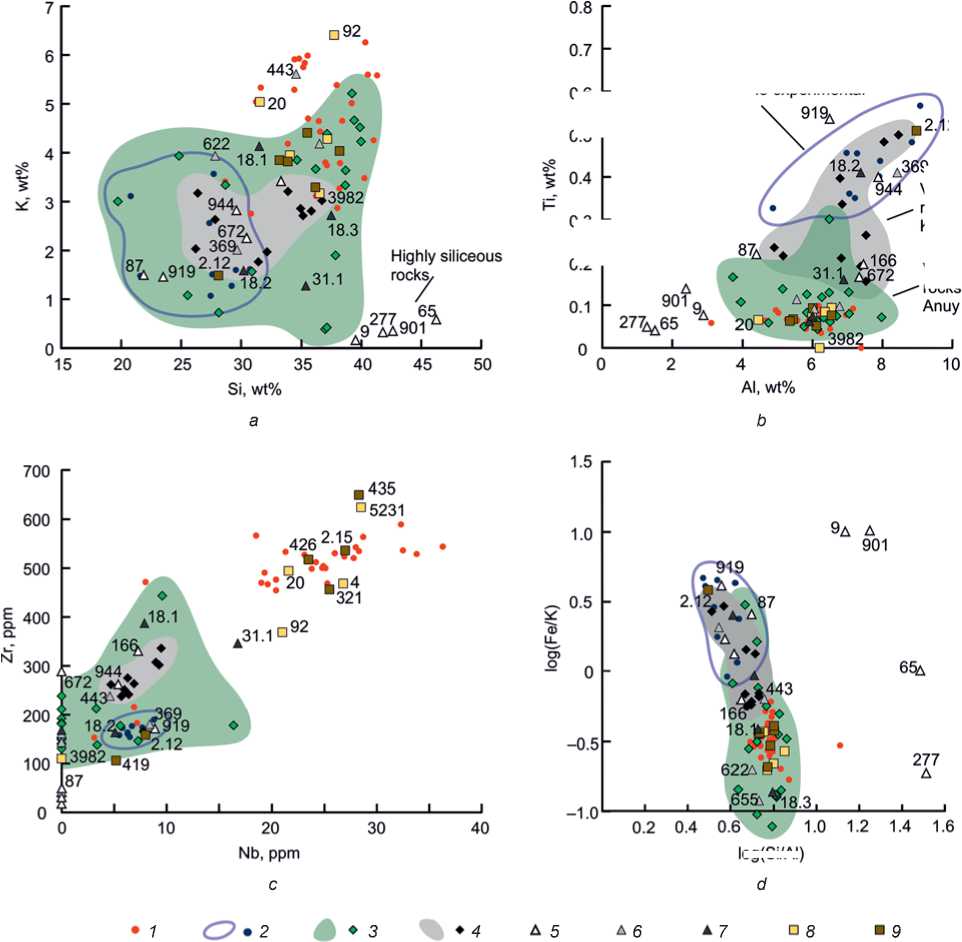
Analysis of the pXRF-derived data on the chemical composition of pebbles and bifaces has revealed compositional groups and established petrochemical criteria for distinguishing between different types of rocks (Fig. 4). The graphs show compositional fields for the rocks from the experimental and petrographic collections (except for the tuffs of the Elovskaya depression), which are compared with the results of the tools material analysis (Fig. 4).
Experimental and petrographic collections . Variability of the shares of minerals and heterogeneous fragments in meta-sedimentary rocks from the Anuy alluvium is confirmed by data on their chemical composition obtained using pXRF and EDS (area scanning over sections of about 400 × 400 μm). These data show good convergence within 1σ. The contents of all petrogenic elements vary. For example, the silicon content ranges from 20.8 to 30.7 wt%, and titanium content from 0.33 to 0.57 wt% (pXRF data; Fig. 4, a , b ; Table 2). Positions of points of these elements on the classification diagrams of clastic sedimentary rocks, for example, log(SiO2/Al2O3) to log(Fe2O3/K2O) (Herron, 1988), make it easy to distinguish them. In this
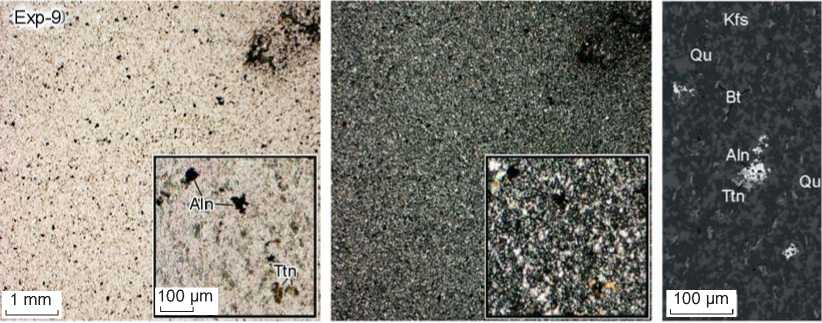
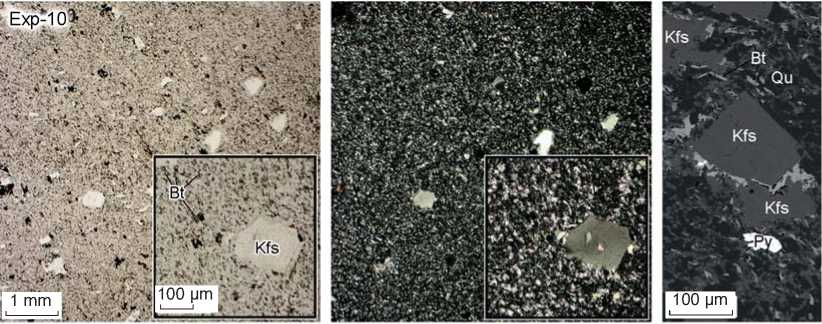
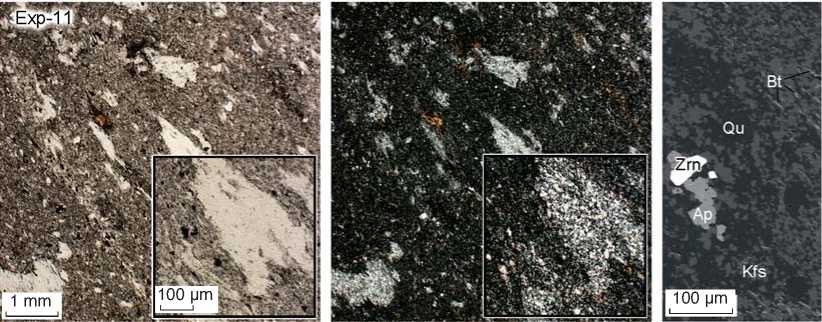
Fig. 3 . Petrographic features of volcanogenic and volcanogenic-sedimentary rocks from the Ursul alluvium. The photographs were taken using an electron microscope: in plane-polarized light (ppl) – left column, in crossed nicols (xpl) – central column, in backscattered electrons (BSE) – right column.
Aln – allanite; Ap – apatite; Bt – biotite; Kfs – potassium feldspar; Py – pyrite; Qu – quartz; Ttn – titanite; Zrn – zircon.
1 – Exp-9, fine-grained small-spotted tuff with massive texture, containing no large (porphyry) crystals nor their fragments— vitroclastic tuff. Intergrowths of grains of newly formed titanite and allanite, as well as regular parallel orientation of biotite flakes, are clearly visible; 2 – Exp-10, rock with cement similar to Exp-9, but containing fragments of quartz crystals and potassium feldspar—crystal-vitroclastic tuff. Newly formed xenomorphic pyrite often occurs along with phenocrysts. Phenocrysts of potassium feldspar are partially recrystallized at the edges into granular aggregate; 3 – Exp-11, ignimbrite with distinctive discontinuous-linear texture resembling that of the flow in lavas, which is caused by flame-like segregations (fiamme). Concordant orientation of fiamme and biotite flakes is visible.
Meta-sedimentary rocks of the experimental collection
logSi/AI
Volcanic rocks Karakol
Fig. 4 . Chemical composition of materials of the bifaces, meta-sedimentary and effusive rocks from the modern channel alluvium of the Anuy River (at the mouth of the Karakol River), as well as volcanogenic-sedimentary rocks from the Ursul River (at the mouth of the Nizhny Tyumechin River), according to pXRF data. The composition fields of meta-sedimentary and felsic volcanic rocks of the Anuy and Karakol types are highlighted. Numbers indicate the points of surface composition of the material of some bifaces.
1 – tuffs and ignimbrites of the Elovskaya depression (Ursul); 2 – meta-sedimentary rocks (Anuy); 3 – volcanic rocks from the Anuy alluvium; 4 – volcanic rocks from the Karakol alluvium; 5 – Denisova Cave; 6 – Ust-Karakol-1; 7 – Anuy-3; 8 – Kara-Bom;
9 – Tyumechin-4.
0.6 г
0.5 Н
0.3 Г
0.2 -
Volcanic rocks
study, a modified version of the diagram in log(Si/Al) – log(Fe/K) coordinates was used for illustrating the compositional features of rocks (Fig. 4, d ). The content of zirconium in meta-sedimentary rocks of the Anuy varies within the narrow range of 150–200 ppm; the niobium content is within 5–10 ppm (Fig. 4, c ; Table 2).
The content of silicon in the volcanogenic-sedimentary rocks from the alluvium of the Ursul River basin on average is 36.4 wt%, while the potassium is 4.65 wt% (Fig. 4, a). No significant regularities in compositional deviations that would correlate with the textural features of rocks (vitroclastic, crystal-vitroclastic tuffs and ignimbrites) are observed in the available sample. As compared to metasediments, the rocks show lower contents of calcium, iron, and titanium (Fig. 4, b; Table 2), which corresponds to FVR of the
Anuy type. Some samples demonstrate an increased concentration of sulfur due to pyrite and other sulfides. In the log(Si/Al) to log(Fe/K) diagram, the points form a compact field in the range of values from -0.25 to -0.75 log(Fe/K) and from 0.7 to 0.85 log(Si/Al). Only the composition of sample Exp-25 (Fig. 4, d ), which has an atypical spotted texture, stands out in the high value of log(Si/Al) > 1. The two groups are clearly distinguished by the zirconium content: the main group ( n =24) with concentration values >400 ppm, and a small group ( n =3) with concentration values in the range of 150–250 ppm (Fig. 4, c ). The niobium content generally shows a close connection with zirconium; in most rocks, this indicator is in the range of 20–35 ppm, and in the group with low zirconium contents it is 3–8 ppm (Fig. 4, c ; see Table 1).
FVR from the Anuy alluvium demonstrate the widest variation in their composition, caused not so much by their original nature, but rather by later secondary processes. Nevertheless, a specific set of features usually distinguishes the composition of these rocks from the felsic tuffs of the Elovskaya depression, in spite of their similarity of appearance. The Anuy-type rocks have low calcium content, up to 0.66 wt% (mean 0.2 wt%), while the average value for the Karakol type is 1.5 wt%. The difference is also manifested in a titanium content of 0.05–0.3 (mean 0.1) wt% for the Anuy and 0.16–0.5 (mean 0.3) wt% for the Karakol type; it results in the appearance of a significant amount of ilmenite, which gives a darker color to the rock. The differences of other components are not particularly significant— the wider composition values for the Anuy type completely encompass the Karakol ones (Fig. 4, a , c ; see Table 1). The log(Fe/K) values vary from 0.47 to -0.25 (mean 0) for the Karakol rocks, and from 0.48 to -1.11 (mean -0.5) for the Anuy rocks.
The sharp drop to 0.3–0.7 wt% as opposed to an average of 3.5 wt% is observed in the potassium content in some samples of the Anuy type FVR. The SEM study has shown that this was caused by albitization— replacement of the original aggregate of albite, quartz, and potassium feldspar by very fine-grained secondary albite. In this case the hardness of the rock and pattern of fracture do not change significantly.
An important criterion for differential diagnostics is the niobium content, which does not exceed 20 ppm in the vulcanics from the Anuy alluvium, and does not fall below this value in the main group of the studied tuffs from the Elovskaya depression (Fig. 4, c). The average values of the zirconium content are also indicative. They are 185 ppm for the Anuy rocks, 265 ppm for the Karakol rocks, and 480 ppm for the main group of tuffs. These criteria help to identify the rocks brought to the Anuy River valley with a high degree of reliability.
Rocks used for bifaces . The surfaces of artifacts exposed to groundwater and other exogenous factors for a long time may change in color and chemical composition, since weathering causes uneven destruction of minerals constituting the rock. The processes of oxidation and depositing of minerals from the groundwater have a large effect, resulting in formation of films of iron and manganese oxides, calcite crusts, etc. on the surfaces. Previous analysis of statistical data on the materials from open-air sites has revealed a slight shift in the concentrations of these elements under the influence of external factors (Vishnevsky et al., 2023). In some areas of Denisova Cave, such an important factor was migration of pore solutions through layers enriched by waste products of bats, which caused changes in the surfaces of artifacts and formation of various phosphates (Sokol et al., 2022). Among the items of this study, only one artifact DC-87 bears traces of such changes.
Most of the points in the composition of materials of the bifaces made of rocks macroscopically identified as sedimentary (despite wide variations in the concentrations of petrogenic elements (see Table 1)) are located predominantly in the composition field of meta-sedimentary rocks of the experimental collection selected from the alluvium of the Anuy valley (Fig. 4, b). The most typical composition, gravitating toward the central part of the field, is revealed in the material of items from the sites of Anuy-3, Ust-Karakol-1, and Denisova Cave—A3-18.1 (see Fig. 1, 7), UK-369, and DC-919, respectively (see Fig. 4, c), although the latter item shows a slightly increased concentration of titanium. Biface DC-944 has a lower content of calcium and a higher content of aluminum, which is not compensated for by potassium (forming potassium feldspar). This can be explained by the wide albitization process with introduction of sodium, which is not identified by pXRF. Artifact DC-87 from the Anuy valley, made of meta-sedimentary rock, demonstrates distinctive traces of secondary phosphate mineralization and low concentrations of most components except for iron, calcium, and phosphorus. The share of phosphorus exceeds 5 wt%, which is due to the transformation of its surface by phosphorus-rich solutions (Ibid.). Such data are not very suitable for direct comparison, since in the binary diagrams (Fig. 4, a–c), the composition point of sample DC-87 shifts diagonally to the lower left corner, with values closer to zero. However, in general, the proportions of the components continue to be consistent. In the diagram of logarithmic ratios, the point of the composition of sample DC-87 is in the field of meta-sedimentary rocks. Notably, samples with such pronounced surface changes require not only careful petrographic control, but also a technique for identifying the trend of compositional transformation, which is worth creating.
The compositional field of meta-sedimentary rocks from the experimental collection also includes the material of biface T4-2.12 (see Fig. 1, 9 ) from the Tyumechin-4 site—the only one not made of tuff (9.1 %) among the artifacts discovered at the sites of the Ursul group. The upper reaches of the Elo River, as well as tributaries of the Anuy River, including the Karakol, erode complexes of Cambro-Ordovician and Silurian sedimentary rocks; therefore, the use of such rocks from the gravels of the Elo and Ursul rivers is quite possible.
The petrochemical indices in most (63.6 %, n =7) of the bifaces from the Ursul River in the diagram are overlapped by the main area of those of rocks from the experimental collection gathered in that valley (tuffs and ignimbrites) in all components, including the samples KB-20, KB-04 (see Fig. 1, 6 ), KB-5231, T4-426, T4-321, T4-2.15, and T4-435. The increased utilitarian features of individual rock samples (e.g., KB-04) are determined not by variations in the chemical composition, but by structural features of the mineral aggregate.
The material of the bifaces KB-3982 (see Fig. 1, 11 ) and T4-419 has lower zirconium concentration in comparison with other items of that type from the Ursul River. According to this indicator, the material gravitates toward a separate small group of tuff compositions. It also has a lower iron content (two times lower than average) and titanium content (in KB-3982, below the pXRF detection limit). The sample KB-92 occupies an intermediate position in zirconium concentration between the two groups of the experimental collection; furthermore, it corresponds to a maximum potassium content of 6.4 wt%.
Thus, the material of eight out of ten bifaces from Kara-Bom and Tyumechin-4 differs significantly in its petrochemical criteria from FVR the Anuy River basin, which are often quite similar in appearance.
Half of the bifaces discovered at the sites of the Anuy group (50 %, n=8) are made of FVR. The material of items UK-622, UK-655, A3-18.3 (see Fig. 1, 3), and A3-18.1 (see Fig. 1, 7) in all their characteristics corresponds to typical rhyolites and rhyodacites of the Anuy type. Another subtype of Anuy rocks is represented by tool A3-31.1, distinguished by significant depletion of potassium, which, taking into account the amount of aluminum, can be compensated for by albitization. This is also evidenced by white flake-like inclusions in the rock, which are most often greenish-gray. Noteworthy are the increased concentrations of niobium and zirconium (17 and 367 ppm), which are at the limit of values obtained for the samples of corresponding rocks from the petrographic collection.
The material of bifaces DC-166 (see Fig. 1, 5 ) and DC-672 (see Fig. 1, 2 ) is unusual in its chemical composition: it demonstrates higher concentrations of iron, aluminum, titanium, and zirconium (see Fig. 4, b , c ) than most of the FVR of the Anuy type; thus, its features are similar to the FVR of the Karakol type, with the exception of a low calcium content. However, in the Karakol rocks, calcium is concentrated mainly in plagioclase phenocrysts, which are absent from DC-166 and DC-672. It can be assumed that the raw material for them was Karakol-type rock without phenocrysts. This is quite likely, considering the variability of structure and composition of rocks of the Kuyagan Formation, which was the source of the material.
The material of biface UK-443 (see Fig. 1, 1 ) should be considered questionable, since it shows high potassium content (5.61 wt%), typical of tuffs from the Elovskaya depression, and relatively low concentrations of niobium and zirconium (see Fig. 4, c ; see Table 1). However, the same raw material is distinguished by a high iron content (4.82 wt%), common to meta-sedimentary rocks and FVR of the Karakol type, and low titanium content, which is uncommon for them. The material has a greenish-gray color and a spotted texture; phenocrysts are absent. Thus, it can either be a metasomatized (ferruginized and K-feldspathized) FVR of the Anuy type or a ferruginized tuff of the Kara-Bom type. Unfortunately, it is not possible to reliably establish this without using destructive methods.
A separate group consists of highly siliceous rocks of bifaces from Denisova Cave—DC-65, DC-901 (see Fig. 1, 8), DC-9 (see Fig. 1, 4), and DC-277. These show the highest silicon content, reaching 46.3, 42.6, 39.5, and 41.7 wt%, respectively. These rocks are distinguished by consistently low concentrations of all other elements, in comparison with sedimentary rocks (see Table 1). These features are clearly visible in the diagrams. In particular, the log(Si/Al) values for them are two times higher than for rocks of other types (see Fig. 4, d). In addition, a distinctive feature of the high-siliceous rocks is very low zirconium concentrations—18, 41, 31, and 67 ppm, respectively, which is almost an order of magnitude less than that typical of both sedimentary rocks and vulcanites (see Fig. 4, c). The ratio of the concentration of chemical elements for such rocks usually gives little information, since the error in determination becomes greater, while the rocks could have undergone significant metasomatic transformation with introduction and (or) removal of various components. Their initial origin can be established only using a comprehensive approach involving destructive methods.
Sources of rocks
The geological structure of the central and northwestern parts of the Russian Altai is based mostly on volcanogenic and volcanogenic-sedimentary rocks of the Devonian period, represented in the areas under study by the Kuyagan (Anuy River basin) and Kurata (Ursul River basin) formations (Gosudarstvennaya geologicheskaya karta…, 2001, 2019). Together with other series of that age, these overlie earlier, mainly sedimentary, rocks that were deposited on the continental slope and later on the shelf of the ancient oceanic basin, where the strata of marl and limestone accumulated (Yolkin et al., 1994). The latter contributed to the formation of many karst caves of the Altai in the Quaternary. All of these sedimentary, volcanogenic- sedimentary, and volcanogenic strata were breached by numerous magmatic intrusions of various ages, including both small vein-like bodies and volcanic feeder channels, and huge granite massifs measuring tens of square kilometers. Such large magma intrusions led to the heating of surrounding sediments, and caused hydrothermal activity and metamorphism, which was expressed in changes in the structure and mineral composition of rocks. As a result of these processes, metamorphic aureoles (Fig. 5) (Gosudarstvennaya geologicheskaya karta…, 2001, 2019), represented by hornfels of various mineral composition and structure, depending on the heating temperature and chemical composition of the original rocks, emerged around many large magmatic bodies.
Most of the bifaces ( n =10) from the sites of the Ursul group were manufactured from local rocks of the Middle Devonian volcanogenic-sedimentary Kurata Formation, exposed on the western slopes of Mount Aptyrga, and widely present in the alluvium of the Altaira and Nizhny Tyumechin rivers. These rocks include dark greenish-gray to greenish-black dense volcanic tuffs of felsic composition and ignimbrites with massive or discontinuously banded
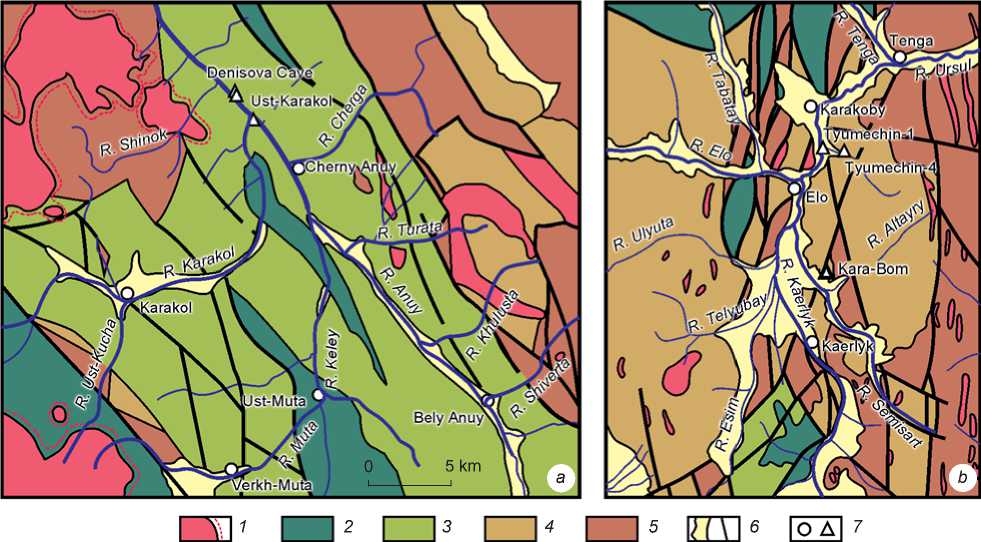
Fig. 5 . Geological maps of the areas in the upper part of the Anuy basin (Denisova Cave, Ust-Karakol-1, and Anuy-3) ( a ) and Elovskaya depression in the Ursul valley (Kara-Bom, Tyumechin-4) ( b ). Compiled after (Gosudarstvennaya geologicheskaya karta…, 2001, 2019).
1 – magmatic intrusive bodies and contact metamorphic (hornfels) aureoles around them; 2 – Cambrian-Ordovician sedimentary formations; 3 – Ordovician-Silurian sedimentary formations, including those with carbonate rocks; 4 – Devonian Kuyagan and Kurata formations, including felsic volcanic and volcanogenic-sedimentary rocks; 5 – other Devonian sedimentary and volcanogenic-sedimentary formations;
6 – Quaternary alluvial deposits and major tectonic faults; 7 – settlements and Paleolithic sites.
texture, which were previously considered hornfels (Derevianko et al., 1998), felsic effusive rocks (Kulik, Shunkov, Petrin, 2003), or silicites (Rybin et al., 2018). According to the type of material, tools KB-92, KB-3982 (see Fig. 1, 11 ), and T4-419 correspond to the range of variations in the composition of Kurata rocks (Gosudarstvennaya geologicheskaya karta…, 2019). Notably, the material of some bifaces from the Kara-Bom site, for example, KB-04 (see Fig. 1, 6 ), which was initially identified as silicified siltstone (Belousova et al., 2019), upon closer examination turned out to be tuff. One of the artifacts from Tyumechin-4 (see Fig. 1, 9 ) was made of local Ursul siltstone, whose composition is also typical of the alluvium from the Anuy River valley.
Thin leaf-shaped bifaces discovered at the sites in the Anuy valley were made of three types of raw materials: meta-sedimentary rocks ( n =5, including sample DC-87), felsic volcanic rocks ( n =8), and highly siliceous rocks ( n =4). All of the rocks, except for the highly siliceous ones, can be found in local gravels of modern waterways. Post-sedimentation metamorphism of the rocks and hornfels aureoles have been described in detail during mapping works (Gosudarstvennaya geologicheskaya karta…, 2001). Traces of metamorphic or hydrothermal alteration in all samples that were included in our experimental collection suggest that many rocks of this type used for manufacturing Paleolithic tools were metasomatites or hornfelses of varying degrees of heating. Rivers ensure natural “enrichment” of rocks: less durable varieties in the form of large pebbles, unaffected by these processes, are practically absent from the alluvium, since mineral grains in them do not grow together into a common framework and the rocks are softer and anisotropic in their physical properties.
Volcanic rocks in the Anuy alluvium are represented by two types. The first type, lighter in color, is low-calcium and low-ferrous (the Anuy type), originating from the Kuyagan Formation— a formational equivalent of the Kurata Formation, exposed in the upper reaches of the right tributaries of the river. The second type is darker, with more high-calcium and titanium rocks of the Karakol type, coming to the surface in the upper reaches of the left tributaries of the Karakol and Muta rivers. Despite the relationship and sometimes visual similarity to the material of the Kara-Bom industry, these rocks differ in the ratio of most chemical elements.
It can be assumed that some of the artifacts from the Paleolithic sites of the Northwestern Altai, the material of which was previously identified as aphyric acid/felsic effusive/volcanic rock or even as porphyritic rock, were made of tuffs and ignimbrites. In this case, their fine grain size and, accordingly, good utilitarian features may be explained not by rapid solidification of the erupted rocks, but by formation of ash particles from this melt, which was accompanied by crushing of phenocrysts and partial differentiation of particles according to size during stratification. This suggests the presence of other sources of such rocks for the Paleolithic industry.
Conclusions
The non-destructive method of research using modern portable X-ray fluorescence spectrometers, designed for rock analysis, does not require special sample preparation. It has proven to be a highly productive tool, together with macro- and microscopic study of the surface, which has made it possible to reliably typify fine-grained raw materials of Paleolithic industries. As a result of study using pXRF analyzers, out of 24 initial petrographic definitions of bifaces, the following were confirmed: completely – 16, clarified – 3, and transferred to another group of raw materials (from sedimentary to volcanogenic-sedimentary) – 5, of which 4 were initially questionable.
It was established that thin leaf-shaped tools from the sites in the Elovskaya depression were made of local rocks mainly of volcanogenic origin, which widely occur in the alluvium of the tributaries of the Ursul—the Altaira and Nizhniy Tyumechin. These are dark greenish volcanic tuffs and ignimbrites of felsic composition; previously, scholars considered them hornfels, silicites, or felsic volcanic rocks. Bifaces from the sites in the Anuy valley were made of other material mainly of local origin, with lower utilitarian features than the tools from the sites in the Elovskaya depression. Most of the tools were made of FVR, and some were produced of meta-sedimentary, possibly hornfelsed, rocks. The sites on the upper reaches of the Anuy River also yielded isolated relatively small and often asymmetric bifacial tools made of high-quality, highly siliceous material—jasper-like rocks and microquartzites, which are absent from the alluvium and bedrock deposits. Indirect signs give reason to suggest that such rocks belonged to siliceous formations of the Zasurye (Marcheta) Formation, expanding to the west of this region, in the basin of the Charysh River, or the Kaim, Kayancha, and Eskongo formations, or the Peschanaya Series, which come to the surface to the east of the Anuy River valley, along the tributaries of the Peschanaya River, in the basins of the Sarasa, Sema, and Katun rivers.
Our findings show that thin and symmetrical bilaterally processed tools both in the central and northwestern parts of the Altai were manufactured mainly from local pebbles collected in the immediate vicinity of the sites. Mineral resources of the Anuy or Ursul were probably sufficient to satisfy the basic peoples’ need for raw materials suitable for manufacturing high-quality artifacts. The collection of bifaces suggests that in the Ursul and Anuy river valleys Paleolithic humans, using local rocks, were able to reproduce points of the needed shape, proportions, and sizes (Belousova et al., 2022). However, in the Anuy river valley, where homogeneous fine-grained individual blocks were extremely rare (and ones like those in the Ursul valley were completely absent), it was necessary to engage in labor-intensive selection of rocks to make bifaces, and sometimes imported material was used. In solving sophisticated technological problems in new areas of habitation with resources of inferior quality as compared to previously inhabited territories, the early Upper Paleolithic inhabitants of the region demonstrated high stability of behavioral and manufacturing stereotypes. The data obtained suggest that raw materials most likely did not make a significant impact on the typological appearance of lithic industries, but undoubtedly determined their structure.
Acknowledgments
This study was supported by the Russian Science Foundation, Grant No. 20-78-10125. The authors express their gratitude to P.A. Nevolko, the Head of the Laboratory of Ore-Forming Systems at the Sobolev Institute of Geology and Mineralogy SB RAS for the opportunity to identify the composition of rocks using the portable XRF-analyzer Olympus Vanta M.
