
Сравнительный анализ связи уровня развития исполнительных функций как параметров когнитивного контроля и уровня сформированности внутренней картины здоровья учащихся разных возрастов
Журнал: Science for Education Today @sciforedu
Рубрика: Педагогика и психология для образования
Статья в выпуске: 6 т.10, 2020 года.
Бесплатный доступ
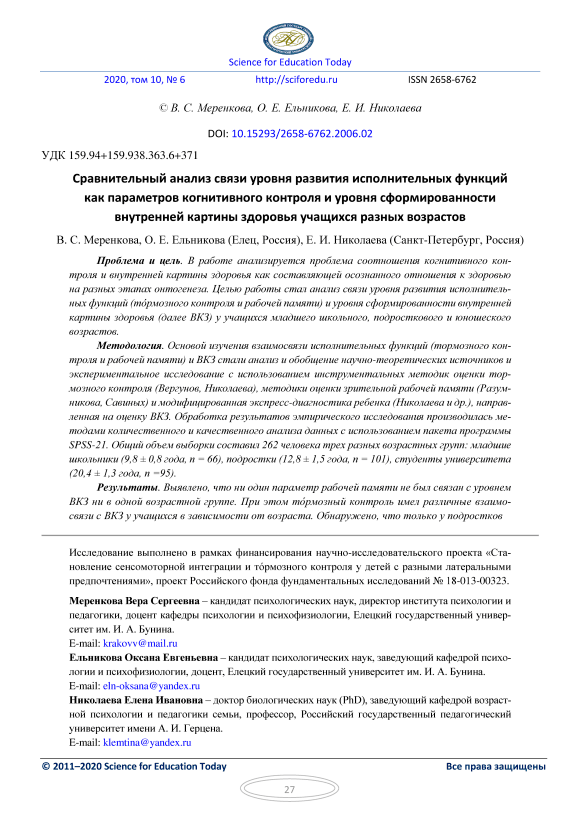
Проблема и цель. В работе анализируется проблема соотношения когнитивного контроля и внутренней картины здоровья как составляющей осознанного отношения к здоровью на разных этапах онтогенеза. Целью работы стал анализ связи уровня развития исполнительных функций (то́рмозного контроля и рабочей памяти) и уровня сформированности внутренней картины здоровья (далее ВКЗ) у учащихся младшего школьного, подросткового и юношеского возрастов. Методология. Основой изучения взаимосвязи исполнительных функций (тормозного контроля и рабочей памяти) и ВКЗ стали анализ и обобщение научно-теоретических источников и экспериментальное исследование с использованием инструментальных методик оценки тормозного контроля (Вергунов, Николаева), методики оценки зрительной рабочей памяти (Разумникова, Савиных) и модифицированная экспресс-диагностика ребенка (Николаева и др.), направленная на оценку ВКЗ. Обработка результатов эмпирического исследования производилась методами количественного и качественного анализа данных с использованием пакета программы SPSS-21. Общий объем выборки составил 262 человека трех разных возрастных групп: младшие школьники (9,8 ± 0,8 года, n = 66), подростки (12,8 ± 1,5 года, n = 101), студенты университета (20,4 ± 1,3 года, n =95). Результаты. Выявлено, что ни один параметр рабочей памяти не был связан с уровнем ВКЗ ни в одной возрастной группе. При этом то́рмозный контроль имел различные взаимосвязи с ВКЗ у учащихся в зависимости от возраста. Обнаружено, что только у подростков то́рмозный контроль тесно связан с ВКЗ, что свидетельствует о самостоятельном принятии решения в отношении собственного здоровья и здорового образа жизни в этом возрасте. Эта связь уменьшается в юношеском возрасте, что может свидетельствовать о появлении дополнительных факторов, влияющих как на ВКЗ, так и на тормозный контроль. Заключение. Связи исполнительных функций с ВКЗ зависят от возраста испытуемых: максимальная связь тормозного контроля с ВКЗ отмечается у подростков.
Похожие статьи в разделе Моторные функции
Короткий адрес: https://sciup.org/147230582
IDS: 147230582 | УДК: 159.94+159.938.363.6+371 | DOI: 10.15293/2658-6762.2006.02
A comparative analysis of the interrelation between the level of executive functions, which are viewed as cognitive control parameters, and the level of the inner picture of health in students of different ages
Introduction. The paper analyses the interrelation between a person's cognitive control and their inner picture of health, which is a component of the person's conscious attitude to one's health, at different stages of ontogenesis. The purpose of the research is to analyze the relationships between the level of one's executive functions development (inhibitory control and working memory) and the level of the internal picture of health (hereinafter IPH) in primary school age, adolescence and early adulthood. Materials and Methods. The research into how executive functions (inhibitory control and working memory) and the IPH are interrelated was based upon the analysis and study of scholarly literature and the experimental work which involved methods of inhibitory control assessment (Vergunov, Nikolaeva), a technique for assessing visual working memory (Rasumnikova, Savinykh) and a quick modified child's diagnostic technique (Nikolaeva et al.) used for assessing the IPH. The obtained data were processed by means of the quantitative and qualitative data analyses methods and the SPSS-21 programme pack. The total number of the experiment participants was 262 people, among them primary schoolchildren (9.8 ± 0.8 years, n = 66), adolescents (12.8 ± 1.5 years, n = 101) and university students (20.4 ± 1.3 years, n = 95). Results. It was found that neither of the working memory parameters was associated with the IPH level in any of the three groups. The inhibitory control, however, had different interconnections with the students' IPH at different age stages. It was found that only in adolescents the inhibitory control is closely associated with the IPH, which is proved by their independent decision-making regarding their behaviour and attitude to health at this age. The found interconnection decreases in early adulthood, which may indicate the presence of some additional factors affecting both the IPH and inhibitory control. Conclusions. The connection between the IPH and the person's executive functions depends on the person's age and it is most evident in adolescence.
Список литературы Сравнительный анализ связи уровня развития исполнительных функций как параметров когнитивного контроля и уровня сформированности внутренней картины здоровья учащихся разных возрастов
- Zelazo P. D. Executive function: Reflection, iterative reprocessing, complexity, and the developing brain // Developmental Review. - 2015. - Vol. 38. - P. 55-68. DOI: http://doi.org/ 10.1016/j .dr.2015.07.001
- Roell M., Viarouge A., Houde O., Borst G. Inhibitory control and decimal number comparison in schoolaged children // PLoS ONE. - 2017. - Vol. 12 (11). - P. e0188276. DOI: https://doi.org/ 10.1371/j ournal .pone.0188276
- Diamond A. Executive functions // Annual Review of Psychology. - 2013. - Vol. 64 (1). - P. 135168. DOI: https://doi.org/10.1146/annurev-psych-113011-143750
- Luna B., Marek S., Larsen B., Tervo-Clemmens B., Chahal R. An integrative model of the maturation of cognitive control // Annual Review Neuroscience. - 2015. - Vol. 38 (1). - P. 151-170. DOI: https://doi.org/10.1146/annurev-neuro-171714-034054
- Friedman N. P., Miyake A., Robinson J. L., Hewitt J. K. Developmental trajectories in toddlers' self-restraint predict individual differences in executive functions 14 years later: A behavioral genetic analysis // Developmental Psychology. - 2011. - Vol. 47 (5). - P. 1410-1430. DOI: https://doi.org/10.1037/a0023750
- Friedman N. P., Miyake A. Unity and diversity of executive functions: Individual differences as a window on cognitive structure // Cortex. - 2017. - Vol. 86. - P. 186-204. DOI: https://doi.org/10.1016/j.cortex.2016.04.023
- Brydges C. R., Fox A. M., Reid C. L., Anderson M. The differentiation of executive functions in middle and late childhood: A longitudinal latent-variable analysis // Intelligence. - 2014. -Vol. 47. - P. 34-43. https://doi.org/10.1016/j.intell.2014.08.010
- McKenna R., Rushe T., Woodcock K. A. Informing the structure of executive function in children: A meta-analysis of functional neuroimaging data // Frontiers in Human Neuroscience. - 2017. -Vol. 11. - P. 154. DOI: https://doi.org/10.3389/fnhum.2017.00154
- Nikolaeva E. I., Merenkova V. S. The effect of a mother's level of attachment and her emotional intelligence on a child's health during its first year of life // Psychology. - 2013. - Vol. 28 (S1). -Р. 483-487. DOI: https://doi.org/110.4236/psych.2013.45068 URL: https://eli-brary.ru/item.asp?id=43049743
- Nikolaeva E. I., Merenkova V. S. An inner picture of health as a factor in changing a child's behavior to health-promoting behavior // Psychology in Russia: State of the Art. - 2017. -Vol. 10 (4). - P. 162-171. DOI: https://doi.org/10.11621/pir.2017.0414 URL: https://eli-brary.ru/item.asp?id=32484718
- Вергунов Е. Г., Николаева Е. И., Балиоз Н. В., Кривощёков С. Г. Латеральные предпочтения как возможные фенотипические предикторы резервов сердечно-сосудистой системы и особенности сенсомоторной интеграции у альпинистов // Физиология человека. - 2018. - Т. 44, № 3. - С. 97-108. DOI: https://doi.org/10.7868/S0131164618030116 URL: https://eli-brary.ru/item.asp?id=35237679
- Николаева Е. И., Яворович К. Н. Характеристики сенсомоторной реакции у юношей и девушек с разной выраженностью латеральных признаков // Вопросы психологии. - 2013. -№ 5. - С. 133-141. URL: https://elibrary.ru/item.asp?id=21195796
- Разумникова О. М., Николаева Е. И. Тормозные функции мозга и возрастные особенности организации когнитивной деятельности // Успехи физиологических наук. - 2019. - Т. 50, № 1. - С. 75-89. DOI: https://doi.org/10.1134/S0301179819010090 URL: https://eli-brary.ru/item.asp?id=37068888
- Gärtner K. A., Vetter V. C., Schäferling M., Reuner G., Hertel S. Inhibitory control in toddler-hood - The role of parental co-regulation and self-efficacy beliefs // Metacognition and Learning. - 2018. - Vol. 13 (3). - P. 241-264. DOI: https://doi.org/110.1007/s11409-018-9184-7
- Разумникова О. М., Николаева Е. И. Возрастные особенности тормозного контроля и проак-тивная интерференция при запоминании зрительной информации // Вопросы психологии. -2019. - № 2. - С. 124-132. URL: https://elibrary.ru/item.asp?id=38533324
- Широкова И. В., Буркова С. А. Особенности тормозного контроля у детей младшего школьного возраста с различным уровнем сформированности внутренней картины здоровья // Вестник психофизиологии. - 2018. - № 4. - C. 95-103. URL: https://elibrary.ru/item.asp?id=37098284
- Park J., Ellis W. S., Kaushanskaya M. Changes in executive function over time in bilingual and monolingual school-aged children // Developmental Psychology. - 2018. - Vol. 54 (10). - P. 18421853. DOI: https://doi.org/10.1037/dev0000562
- Lee K., Bull R., Ho R. M. Developmental changes in executive functioning // Child Development. - 2013. - Vol. 84 (6). - Р. 1933-1953. DOI: https://doi.org/10.1111/cdev.12096
- Nelson T. D., Nelson J. M., Mason W. A., Tomaso C. C., Kozikowski Ch., Espy K.A. Executive Control and Adolescent Health: Toward A Conceptual Framework // Adolescent Research Review. - 2019. - Vol. 4 (1). - Р. 31-43. DOI: https://doi.org/10.1007/s40894-018-0094-3
- Constantinidis C., Luna B. Neural Substrates of Inhibitory Control Maturation in Adolescence // Trends in Neurosciences. - 2019. - Vol. 42 (9). - P. 604-616. DOI: https://doi.org/ 10.1016/j .tins.2019.07.004
- Ekerim M., Selcuk B. Longitudinal predictors of vocabulary knowledge in Turkish children: The role of maternal warmth, inductive reasoning, and children's inhibitory control // Early Education Science for Education Today and Development. - 2018. - Vol. 29 (3). - P. 324-341. DOI: https://doi.org/10.1080/10409289.2017.1407607
- Luna B., Marek S., Larsen B., Tervo-Clemmens B., Chahal R. An integrative model of the maturation of cognitive control // Annual Review Neuroscience. - 2015. - Vol. 38 (1). - P. 151-170. DOI: http://dx.doi.org/10.1146/annurev-neuro-071714-034054
- Tamm L., Menon V., Reiss A. L. Maturation of Brain Function Associated With Response Inhibition // Journal of the American Academy of Child & Adolescent Psychiatry. - 2002. -Vol. 41 (10). - P. 1231-1238. DOI: https://doi.org/10.1097/00004583-200210000-00013
- Tamnes Ch. K., Ostby Y., Walhovd K. B. Neuroanatomical Correlates of Executive Functions in Children and Adolescents: A Magnetic Resonance Imaging (MRI) Study of Cortical Thickness // Neuropsychologia. - 2010. - Vol. 48 (9). - P. 2496-2508. DOI: https://doi.org/10.1016/j.neuro-psychologia.2010.04.024
- Николаева Е. И. Исполнительные функции в раннем детстве. Обзор иностранных источников // Комплексные исследования детства. - 2019. - Т. 1, № 4. - С. 330-337. DOI: http://dx.doi.org/10.33910/2687-0223-2019-1-4-330-337 URL: https://eli-brary.ru/item.asp?id=43047890
