
The World of Migrants from Ryazan in the Post-Reform Period: Methods of Studying Migration and Local Adaptation in the Altai
Journal: Archaeology, Ethnology & Anthropology of Eurasia @journal-aeae-en
Section: Ethnology
Article in issue: 4 т.52, 2024.
Free access
The study describes a new method of integrating field and archival sources relevant to the migration of peasant families from the Ryazan Governorate to the Altai in the 1880s. Late 19th to early 20th century documents from the archives of the Ryazan and Tomsk regions were used. A new comparative method was applied to analyze the findings of ethnographic surveys in places of the original (Ryazan) and subsequent (Shubinka Volost, Biysk Uyezd, Altai) residence of migrants. Based on interviews with their descendants, adaptation to the new areas of residence was explored. Both before and after the 1917 Revolution, the migrants retained their two basiс distinctions—Orthodoxy and the Southern Russian dialect. Adaptation processes included development of the new habitat and marriages not only with members of their group but also with Siberian old residents. These adaptive strategies opposed migrants from Ryazan to those from other Southern Russian Governorates such as Kursk, Voronezh, etc., who maintained ties mostly with migrants from Poltava, Chernigov, and other southern regions.
Similar articles in the section Demography. Population studies


Short address: https://sciup.org/145147478
IDS: 145147478 | DOI: 10.17746/1563-0110.2024.52.4.131-140
Text of the scientific article The World of Migrants from Ryazan in the Post-Reform Period: Methods of Studying Migration and Local Adaptation in the Altai
Resettlement and adaptation of newcomers to new places were discussed in several works, including some studies using Siberian evidence, yet not all problems have been completely resolved. These are particularly relevant in our days of rapid changes in social and ethnic aspects not only in Russia, but also in the entire world. The historical experience of adapting by the Eastern Slavic peasant settlers from European Russia to Siberia in the second half of the 19th to early 20th centuries and their interaction with the local Russian old-resident population have attracted and continue to attract attention of historians and ethnologists. N.M. Lebedeva considered “successful adaptation” as the adjustment to new conditions according to the model of integration or adopting the skills of an unfamiliar culture until achieving complete social adequacy in it; she called adaptation “unsuccessful” in case of the model of psychological defense or even isolation (1993: 34). The opinion that the host community should also adapt to newcomers in order to restore the balance of security disrupted by their appearance, has been repeatedly voiced in historical literature (Sibirskiye pereseleniya, 2006: 8). In terms of interpersonal relations, the ideas about preferential rights of the first settlers prevailed. This was precisely the situation encountered by the migrants from Ryazan Governorate in the late 19th to early 20th centuries in Siberia.
Sustainability of any historical and cultural entities is known to depend on the degree of their adequacy to new living conditions (Ibid.). If traditional “life forms” correspond to new realities, regional colonization will seamlessly evolve in line with preservation of traditions in economic and spatial aspects. On the contrary,
contradictions between old, proven experience and new living conditions result in some changes in traditional economic systems and material culture, manners, beliefs, and ideas, affecting the realm of spiritual culture.
In this study, we used interviewing as ethnographic method of gathering information in the form of formal and (to a greater extent) informal interviews, the so-called “life stories”. We followed the method of mutual complementation of archival and ethnographic data, which can be called the method of integration of archival and ethnographic sources . This made it possible to supplement the observed ethnographic facts and information obtained during interviewing, with historical and archival evidence, as well as statistical data. The method of integration of archival and ethnographic sources has made it possible to confirm the informants’ reports about the places where their ancestors came from, in our case, areas in the Ryazan Governorate.
The author’s method of comparative field research , which can be considered a variety of comparative historical method, was used in the study. A specific aspect of this methodology is that ethnographic evidence is gathered not only in the places where representatives of ethnographic/ethnic and cultural groups currently live, but also in the presumed or reliable ancestral homeland of their great-grandfathers at the level of one time slice. In our case, field evidence was not compared to archival or published data, but to field evidence gathered in the places from where the settlers departed.
This study attempts to identify specific aspects of the resettlement and adaptation strategies among one of the many migrant groups from the Ryazan Governorate to analyze the ethnic and cultural structure of the Eastern Slavic population of Siberia in the 20th century at a new conceptual level.
Reasons for resettling: Need or urge for changing place?
When studying the Russian experience of settling in new territories, new historical approaches should be followed. For example, B.N. Mironov pointed out that resettlements were induced by the shortage of available lands in the presence of lands suitable for arable farming, and noted the emergence of migration paradigm in the mass consciousness of the Russian peasantry of the 18th–19th centuries, which made agriculturalists psychologically prepared for resettlement (2003: 27– 28). In A.V. Golovnev’s “anthropology of movement”, colonization is viewed a mechanism for appropriating space and social interactions: what is important in it, are not so much the results of appropriating new territories, but the origins of movement—situational impulses that triggered the motive, and then the technology and tradition of colonization (2015: 9). Golovnev was also interested in analyzing the processes and practices of “recoding” the culture of “wanderers” in the Siberian “frontier”.
Resettlement to Siberia was thoroughly and comprehensively studied by the statistician and publicist V.N. Grigoriev, who used the evidence from the Ryazan Governorate in the 1880s*. Analysis of the interviews that were taken using the technique of “ethnography of a neighbor”, as well as Grigoriev’s own observations and letters, allowed him to conclude that the desire to change the place of residence was expressed by former state peasants**, although they were in a more advantageous economic position than landowner peasants, since they owned larger land plots (1885: 5–6, 10, 41). Thus, according to Grigoriev, the situation was not limited to resettlement of mainly land-poor families. The resettlement movement of former landowner peasants began immediately after their liberation from serfdom. Grigoriev was surprised by the low participation of peasants from the northern uyezds of the Ryazan Governorate, although their conditions for farming were significantly worse than those of the peasants from the southern black earth uyezds (Ibid.: 5, 12, 41). Note that such situation was possibly typical of the 1870–1880s, while it changed in a later period of late 19th to early 20th century. There are documents on the movement of peasants from the northern Kasimov and Pronsk Uyezds of the Ryazan Governorate to the Tomsk Governorate (1900) (State Archive of the Ryazan Region (hereafter, GARO). F. 129, Inv. 386, No. 367, Fl. 17; No. 402, Fl. 19; No. 421, Fl. 20).
Grigoriev believed that the main reasons for the movement were the supposed “migration urge” and “restlessness” inherent in Russian peasants (Ibid.: 42). The residents of the Ryazan Governorate who sought to migrate were called “samara”, and the process of migration was called “to go to samara”***. The envoys sent by communities to search for places of settlement were called “ssadchiki” (Ibid.: 3, 16). Since the late 1880s, when resettlements to the east became predominant, the designation “samaras” or “samarians” was replaced by “tomenians”—this was how those leaving for the Tomsk Governorate were called (Ibid.: 38). Interviews of peasant settlers or their neighbors allowed Grigoriev to draw a conclusion about the reasons for the move: “…Poverty in its various manifestations drives peasants to distant but spacious lands. Either there is an inconvenient location of the plot, or rent on difficult terms, or lack of fuel…” (Ibid.: 41–43). Indeed, as the information from the State Archive of the Ryazan Region showed, in the Ryazan villages, even in the presence of forests, houses were often heated with brushwood and deadwood. For example, the “Community Forms” of the Ryazan Governorate’s Statistical Committee for 1886– 1893 regarding the village of Ryazanovo in Kasimov Uyezd, state: “…The residents have little timber, which is why they mostly have to buy it” (GARO. F. 7, Inv. 1, No. 145, fol. 88). A statistics worker thus wrote about the fuel situation in the village of Argamakova in Spassk Uyezd: “People heat with purchased brushwood. Firewood is relatively inexpensive: on average, it costs about 8 rubles per house… <…> There is almost no forest for fuel nearby. For firewood, peasants go to the left side of the Oka River, to Meshchera, 20 or 30 versts away. They heat with shvyrkoviye [‘unchopped’ – E.F.] firewood and branches” (GARO. F. 7, Inv. 1, No. 145, fols. 59–130). “In the village of Zykovo in Kasimov Uyezd, village of Ivanokovo in Spassk Uyezd, and some other villages, although they had their own small forest, it was not enough for fuel, so they had to buy firewood in the state forest” (GARO. F. 7, Inv. 1, No. 145, fol. 83). Hoping for better life (“it won’t get worse”), poor people went to Siberia, for example, a peasant from the village of Podkidyshevo to Biysk Okrug, or a family from the village of Topil of Skopino Uyezd, who in their home village “in winter would spend nights in the stove with their children” due to the lack of fuel (Ibid.: 44).
The “Community Forms” for 1886 reflect the assessments of land quality, given by residents of the villages of Eraltur, Shostie, Zykovo, Ryazanovo, Gavrino, Davydovo, Rubetskoye, Sharanino, etc. in Kasimov Uyezd, and Argamakovo (Rudneva), Ivanokovo, Degtyany, Stary Kistrus, Golovskoye, etc. in Spassk Uyezd (GARO. F. 7, Inv. 1, No. 145, fols. 20, 34–35v, 38– 40, 43–46v, 124, 234v, etc.). Many records indicate low or poor land quality (GARO. F. 7, Inv. 1, No. 145, fol. 196). The peasants from the village of Zykovo in Kasimov Uyezd reported: “…The land is almost all sandy loam, and some is clay loam. Hayfields are low-lying, partly even in water; grass in the hayfields is feather grass, partly moss” (GARO. F. 7, Inv. 1, No. 145, fol. 83). It was thus reported about the lands of the village of Ryazanovo in Kasimov Uyezd: “The land belonging to peasant settlements is not distinguished by good quality; overall, in the words of a villager, it is bad. The soil is sandy loam. Arable lands, hayfields, and pastures are not convenient owing to their distance from the village” (GARO. F. 7, Inv. 1,
No. 145, fol. 88). There were also comments that “the soil is of mediocre quality, loamy” (GARO. F. 7, Inv. 1, No. 145, fol. 59). To grain crops to grow well on such soil, it was necessary to use a large amount of fertilizer (GARO. F. 7, Inv. 1, No. 145, fol. 88).
Large number of people and “lack of lands” was another important reason for peasant migration. Although it was not as critical as in the black earth regions of the Russian Empire (cf.: (Churkin, 2006: 4; Fursova, 2022: 123)), this also forced people to move intensely to the east. The number of households in almost all villages of the Ryazan Governorate of the post-reform period at the time of compilation of information (1861–1886) grew rapidly, often doubling and tripling (GARO. F. 7, Inv. 1, No. 145, fols. 196v, 202v, 216v, 227v). According to the Statistical Committee of the Ryazan Governorate (report for the Chancellery of the Ryazan Governor for 1883), in all uyezds, especially in Ryazan, Egorievsk, Spassk, Kasimov, Skopin, and Mikhailov, there was an increase in the population (GARO. F. 7, Inv. 1, No. 72, fols. 2v–3).
The reason for resettlement, for example, of the Ryazan Governorate residents who usually had many children was their concern that “the children would not have enough land”. Grigoriev cited the following information obtained during interviews with peasants: “A peasant from the village of Bukhovoye is leaving for the Tomsk Governorate. His family consists of 10 people. They took 500 rubles with them. People say about him: ‘He is a creditworthy man, but he only has enough land for one person, so he is leaving’” (1885: 42); “A family with three working members is going to samara. Their land is two dessiatines and a quarter; they explain the reason for departure that there is not enough land; the guys run wild on the side (that is, have occasional jobs outside of their home). This is why they are leaving” (Ibid.: 43). There were settlers who responded to invitations of relatives who left for Siberia, to unite and have a good life. For instance, a peasant who moved to the village of Shubinka in Biysk Uyezd, calling on relatives, wrote: “…I eat wheat, but back home I did not have enough rye”. Poor peasants from the agricultural areas of the Ryazan Governorate, who were forced to do seasonal work, strove to leave in order to become “real land owner-tillers” in a new place (Ibid.).
Information on migration from the Ryazan Governorate according to the data from the State Archive of the Ryazan Region and expedition to the Meshchery Region
“The Cases of the Ryazan Treasury Chamber” reveal that in 1873–1913, peasants from Dankov, Ranenburg, Sapozhok, and Kasimov uyezds, and other places, actively submitted petitions for resettlement to Siberia (GARO. F. 129, Inv. 386, No. 241, 242, etc.). Local peasants planned to resettle to Yenisei and Tomsk governorates, and the city of Vladivostok (GARO. F. 129, Inv. 386, No. 333, 337, 339, 359, 367, 402, 416, 421, etc.).
In 1899, large families of peasants from the village of Berezovka in Eropkino Volost of Dankov Uyezd moved to the old-resident village of Prokudskoye in Krivoshchekovo Volost of Tomsk Uyezd*, which, judging by the ethnographic evidence, was notorious for brigandry of the local Chaldons, and became registered there. Several families from the village of Nikolskoye from Dolgoye Volost in Dankov Uyezd were registered in the village of Srostkinskoye in Srostinskaya Volost of Biysk Uyezd**, and peasants from the villages of Izbishche and Arkhangelskoye in Dankov Uyezd became registered in the village of Kosikhinskoye in Kosikhinskaya Volost of Barnaul Okrug (GARO. F. 129, Inv. 386, No. 242, fols. 2–35). Peasants from the village of Dubrovka in Kochury Volost of Dankov Uyezd, who had previously belonged to a Georgian princess, moved to Kosikhinskaya Volost in 1899 (GARO. F. 129, Inv. 386, No. 242, fol. 2). The Ryazan migrants from the village of Yagodnoye in Yagodnoye Volost of Dankov Uyezd, became registered in the village of Khairuzovskoye in Biysk Volost of Biysk Uyezd*** (GARO. F. 129, Inv. 386, No. 241, Fl. 10, fols. 1, 2, etc.). Documents from 1899 mention “the transfer with discharge certificates” of peasants from Dankov Uyezd of the Ryazan Governorate to become “the peasants of Kaily Volost of Tomsk Uyezd and Governorate4*, Smolenskoye Volost of Biysk Uyezd5*” (GARO. F. 129, Inv. 386, No. 242, fols. 1–35). There are only few documents on returning of peasants to their homeland. For example, Mikhail Ivanov Kuznetsov—the head of the Kuznetsov family from the village of Kazansky in Kazatkul Volost of Kainsk Okrug—explained his decision that “he does not belong to schismatic sects” (GARO. F. 129, Inv. 386, No. 242, fol. 35). Apparently, the migrants did not want to live next to the followers of other religious currents, possibly Old Believers or Baptists.
A request from the Tomsk Treasury Chamber to the Ryazan Treasury Chamber mentions the persons “who moved without proper permission6*” to the community of landless peasants of Novo-Chemrovka in Shubinka Volost of Biysk Uyezd*. The list included the families of Ivan Afanasyev Budaev, widow Matrona Vladimirova Tretyakova with two young children from the village of Malinok in Kudryavshchino Volost of Dankov Uyezd; Fedor Kozmin Koshelev from the village of Lovpunovka (?) in Zenkino Volost of Ranenburg Uyezd; Vasily Sidorov Toropchev (Toropchiy) from the village of Bukovoye in Baevo Volost of Ranenburg Uyezd; Login Nikitin Basmanov from the village of Demkino in Putyatino Volost of Ranenburg Uyezd; Ivan Petrov Panfilov from the village of Ryazhskoye in Troitse-Lesunovo Volost and Uyezd from state peasants (GARO. F. 129, Inv. 386, No. 241, Fl. 10, fols. 1–2v). In 1899– 1901, seven families (the Ionovs, Markovs, Stignyaevs, Vasilievs, Akimkins, Fedosovs, and Demins) from Dankov and Ranenburg Uyezds also moved to Shubinka Volost (GARO. F. 129, Inv. 386, No. 242, fols. 1–35).
Unlike settlers from the Russian Black Earth Region, who formed large groups, residents of the Ryazan Governorate more often united in small groups, which included several families. The State Archive of the Ryazan Region has little information about such groups. One of them included 13 families of peasants ready to be transferred to the Tomsk Governorate in 1899 from Dankov, Ranenburg, and Sapozhok Uyezds (GARO. F. 129, Inv. 386, No. 241, Fl. 10, fols. 2–4). This group of 13 families united several related families of brothers, probably the sons of the widow Varvara Andreeva** Gorodentseva (58 years of age at the time of resettlement)***. Varvara from the village of Malinki in Kudryavshchino Volost of the Ryazan Governorate with her two children, stepson Vasily, his wife and five children, was transferred to the Tomsk Governorate (GARO. F. 129, Inv. 386, No. 241, Fl. 10, fols. 2–4). From the same village, the list also included two families of the Gorodentsevs (“Trofim Vladimirov, 42 years of age” and “Nikita Vladimirov, 32 years of age”) with the same patronymic names of the householders of the corresponding age, presumably three brothers. One of these families was fraternal: Trofim and his wife united with his younger brother Petr (37 years of age) and his wife; their two young sons (four years of age each) were also listed. Apparently, Nikita was the middle brother in the family and was included in the resettlement group only with his family consisting of parents and two young children. The list included four undivided fraternal families (the Gorodentsevs, Peresypkins, Naidins, and Veselkins), three three-generation families of “grandparents – parents – children/grandchildren”, and three two-generation families of “parents – children”. In addition to children and parents, the Dymov family from the village of Trebunkovo (Trebunok) in Bigilden Volost of Dankov Uyezd* included husband’s mother, as well as male cousins—uncle and his son. Commonly, if the family was headed by a representative of the older generation, this was a widower or widow who, together with children and grandchildren, was ready to move. It seems that elderly couples that lived together did not try to change their place of residence. The statistical worker recorded 93 adults and children in these families, but only 12 “census souls” were mentioned**; 41 non-census persons and 40 females were recorded separately.
Population groups, which had not previously known each other, came into contact and interacted during the development of new territories in the Tomsk Governorate. Notably, the original territories were “geopolitical crossroads” where migration waves rolled in different directions (Golovnev, 2015: 330). Field materials of the author, revealing a mosaic of family records from these areas, also confirm this. When working with documents of the State Archive of the Ryazan Region, the diversity of last names in the lists of peasants for resettlement strikes the eye. Last names of local peasants are almost never the same. There are no family nests, as, for example, in the Kursk Black Earth Region or Western Siberia. The conclusion about significant diversity of last names in the 19th–early 20th centuries is confirmed by the author’s observations made during a visit to the Old Cemetery on Kokorin Street in Kasimov (formerly, Gorodets Meshchersky).
During the field work in the Ryazan Region, convincing evidence was collected, which indicates that not only Russians and Cossacks, but also russified Kasimov Tatars, and Meshchera people, the memory of whom has survived in the Ryazan Region only in toponymy, migrated from Ryazan to Western Siberia and the Altai. The core motif of local residents’ statements about the ethnic composition of population from the Meshchera area was the following: “The locals are all considered Russian, regardless of whether they used to be Tatars in the past or not” (FMA, 2021).
-
*A legend about the origin of the village of Trebunok has been preserved among the peasants. In ancient times, “12 Cossack families” came from the lower reaches of the Don River. They seized a lot of land, settled on the riverbank, and founded a Cossack settlement. Over time, feeling “tightness in lands”, the Cossacks moved 7 versts further, and founded the village of Trebunok.
-
**“Census soul” was a unit of accounting for the male population in the Russian Empire in the 18th–19th centuries.
Information about Ryazan settlers in Siberian archives
Siberian archives contain data on Ryazan settlers, who constituted insignificant, or large, or even predominant share of population in the settlements. For example, in 1916, in the village of Skalinskoye in Chaus Volost of Tomsk Uyezd, half of the population was old residents (51 %); settlers from the Tambov Governorate were in the second place (30.6 %), and settlers from the Ryazan, Oryol, Penza, Vyatka governorates and other places were in the third place. The following Ryazan last names appeared in archival documents: Aleshins (1 household), Afonins (1 h/h), and Tarasovs (1 h/h) (State Archive of the Tomsk Region (GATO. F. 239, Inv. 16, D. 131, No. 38, without numbering).
As mentioned above, according to the documents of 1899, “peasants of Dankov Uyezd of the Ryazan Governorate moved to the Kaily Volost of Tomsk Uyezd and Governorate”*. The State Archive of the Tomsk Region has preserved information about resettlement of Ryazan peasants to the village of Kaily in Kaily Volost. In 1916, the Ryazan migrants constituted 25 % of the village population (63 h/h) with the proportion of old residents equal to 16 %, and proportion of Chernigov migrants reaching 19 %. The proportion of the Poltava, Mogilev, Kursk, and Kharkov settlers taken together (28.2 %) was commensurate with that of the “Ryazans”; the remaining settlers (from Kharkov and Nizhny Novgorod governorates) constituted less than 5 % of the population. The last names of migrants who arrived in 1881–1914 from the Ryazan Governorate were the following: Bykov (4 h/h)**, Dmitriev (1 h/h), Dubrovitsky (2 h/h), Evseev (5 h/h)***, Fedosov (8 h/h), Granov (1 h/h), Gromov (1 h/h), Karatay (1 h/h), Kiselev (1 h/h), Kornilov (1 h/h), Kurlay (1 h/h), Kuznetsov (10 h/h), Lobuzanov (2 h/h), Maksimenko (1 h/h), Markov (1 h/h), Onufriev (1 h/h), Pometov (1 h/h), Popetov (1 h/h), Rapapashin (3 h/h), Sevostyanov (2 h/h), Sorokin (7 h/h), Stepanenko (1 h/h), Subbotin (1 h/h), Shchegolikhin (2 h/h), Zelenin (2 h/h), and Zorin (1 h/h) (GATO. F. 239, Inv. 16, D. 131, No. 26, without numbering, 248 households).
Since the 1870s, Shubinka Volost of Biysk Uyezd stood out as a place for settlement of new migrants owing to the abundance of fertile lands and proximity of timber (Fig. 1). This volost differed from a number of other (primarily steppe) volosts of Altai Okrug in that both old residents and migrant population were Russians. According to statistical data, there were only five families
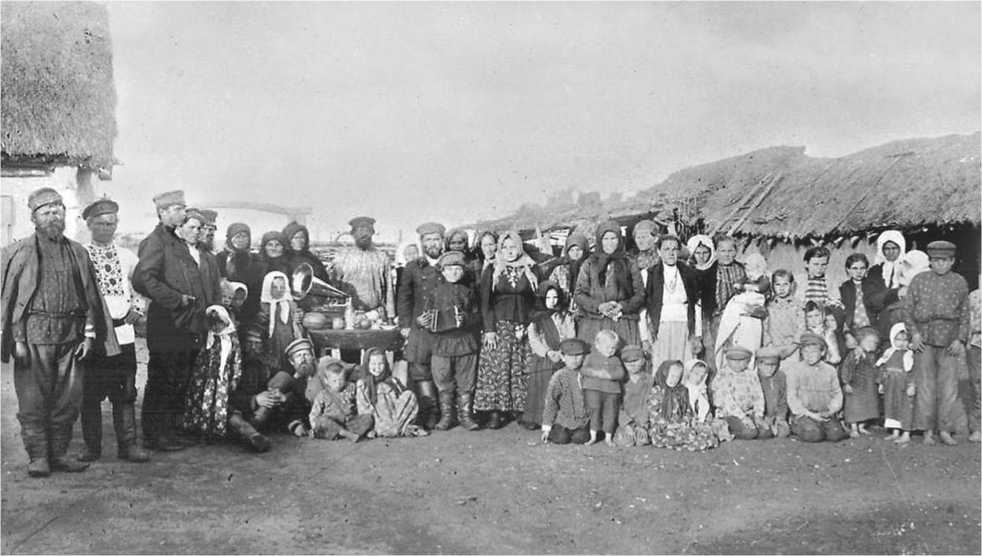
Fig. 1 . Siberianized newcomers from the Great Russia. Photo and caption by M.A. Krukovsky, 1910–1912. Archive of the MAE RAS .
of migrants from the Little Russian governorates among the residents of Shubinka Volost (Materialy…, 1899: 3, 9). Participation of settlers in the economic development of Shubinka Volost of Biysk Uyezd was very noticeable: according to the data of the household census of 1898, only 33 % were households of local villages. The remaining 67 % of households were recorded as newcomers (Ibid.: 6). Migrants from European Russia dominated among the new settlers in Shubinka Volost; 5/6 of them were natives of agricultural governorates: Ryazan gave the Volost 687 households, Tambov – 332 households, Voronezh – 187 households (Ibid.: 7), as well as Perm and Vyatka governorates – 149 households (Ibid.: 8).
Because of a large number of Ryazan settlers, Shubinka Volost (now, Zonalny District of the Altai Territory) was chosen by the author of this study for ethnographic field research. In the 1980s and 1990s, seven interviews were taken from a representative of the descendants of Ryazan migrants from the former Shubinka Volost. In her childhood, she lived in the village of Shubinka. A record of the family of these settlers has been preserved in the files of the Statistical Committee at the Local Government of the Altai Governorate (State Archive of the Altai Territory/The Altai Territory Archival Fund Storage Center (GAAK/TKAFAK). F. 233, Inv. 1a, No. 854, Fl. 66). The questionnaires of 1917 population census for Shubinka Volost in Biysk Uyezd mention a householder listed as a “peasant of Great Russia” Tolmachev Fedor Agapovich (48 years of age), followed by the male members of the family: sons Gavrila (30 years of age), Vasily (27 years of age), Ivan (25 years of age), grandchildren Andrei (13 years of age), Pavel (12 years of age), Yakov (9 years of age), Dmitry (4 years of age), and Sergei (11 years of age). The female members of the family included the householder’s wife Fedora, daughters Anna (17 years of age), Ulyana (16 years of age), Avdotya (13 years of age), Agrafena (12 years of age), three daughters-in-law—Irina (30 years of age), Avdotya (27 years of age), Zinoviya (24 years of age), and granddaughter Agrafena (7 years of age). During interviews with the descendants of the family, in particular with Tatyana Ivanovna Tolmacheva born in 1910 (Shadrina by marriage), it became clear that not all archival data reflected the real situation. For example, daughter-in-law Irina was Ivan’s wife*, but, according to the census, she was about the same age as Gavrila and was possibly married to him, while Fedor’s granddaughter Agrafena, 7 years of age, listed as such apparently by mistake, was in fact Tatiana, our informant (FMA, 1991). Thus, the data from field research have helped to clarify the information of archival sources.
In the questionnaire, the family of F.A. Tolmachev was listed as migrant, “assigned to the volost, with allotment”, moved to the Altai from the Ryazan Governorate in
1881, that is, at the time when the flow from the southern regions prevailed. In 1917, after 36 years of residence in the Altai, the family sowed 15.7 dessiatines of wheat, oats, buckwheat, millet, flax, hemp, and potatoes. Taking into account 8 dessiatines left for fallow, the family had only 23.7 dessiatines of arable land. The peasants had a self-dumping reaper, winnowing machine, and three wooden-wheeled carts as agricultural implements. The census questionnaires mentioned 23 heads of livestock, including 7 horses, 2 cows, calf, 8 sheep, 2 lambs, and 3 pigs. The commercial activities of the housekeeper Fedor Agapovich, who was a carpenter, apparently brought additional monetary income to the family (GAAK/ TKAFAK. F. 233, Inv. 1a, No. 854, Fl. 66, fols. 48, 66v).
An older brother of Fedor Agapovich, Vasily Agapovich Tolmachev (52 years of age), whom Tatyana Ivanovna called “uncle”, probably lived nearby. The family did not have any allotments per capita, but rented 3 dessiatines of land in the village of Verkh-Shubinka, and a total of 7.3 dessiatines were registered, including the fallow land. The “Population Census Questionnaires” mentioned that Vasily Agapovich kept 19 heads of livestock, including 5 horses, 3 cows, 7 sheep, and 4 pigs. The following persons were listed as male household members: two sons—Alexei (11 years of age) and Nikolai (6 years of age), and a grandson 1.5 years of age. The following persons were listed as female members of the family: wife Akulina (46 years of age), daughter Maria (24 years of age), daughter Maria (17 years of age), and daughter Ksenia (17 years of age). The following children who died in 1917 were also listed—Peter (2.5 years of age) and Anna (10 months of age).
Field materials about the “Ryazanias” from Shubinka Volost of Biysk Uyezd
Our key informant T.I. Tolmacheva (1910–2001) belonged to the second generation born in the village of Shubinka in Shubinka Volost. Her mother Arina Prokhorovna Bogomolova (Tolmacheva by marriage) was born in the same village in 1887, and her grandparents came to Siberia from the Ryazan Governorate in 1880 (information about the uyezd or volost of exit has not survived. FMA, 1988). In the mid-1920s, T.I. Tolmacheva married Shadrin from a family of Ryazan settlers (FMA, 1988, 1991, 1992). The Shadrin families from the village of Shubinka were recorded in the archive as both Ryazan and old residents, which is how the Ryazan residents who had arrived there before the 1880s could have been called.
The informant recalled her childhood, spent in individual peasant household, with joyful warmth, as a “heavenly time” of her life. According to E.A. Yartseva, a representative of the older generation, for those who came from the places with neither forest nor hay, with houses were covered with straw and people washing in stoves, who experienced poverty, the village of Shubinka in Biysk Uyezd seemed a blessed place (FMA, 1992).
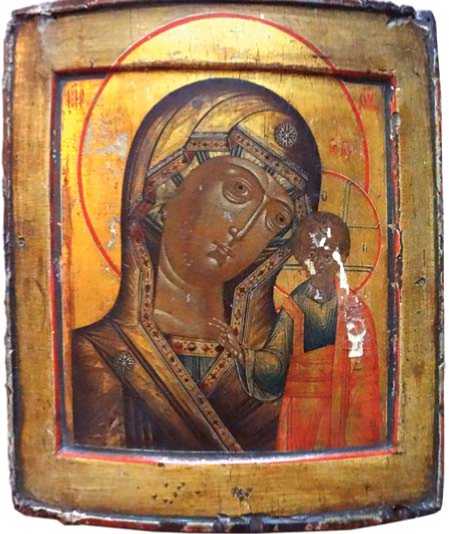
Families of that time typically had many children, and children and grandchildren of a similar age lived together. “In our Shubinka family, 45 persons lived. Then they built their own houses for eight sons… There were so many children back then” (FMA, 1990: fol. 59v). The informant Tatyana grew up in Orthodox families of the Bogomolovs (relatives on her mother’s side) and Tolmachevs (relatives on her father’s side). The older members of the family observed all fasts (“The Lord only keeps us because of fasts”, they taught their children since the age of seven or eight) and feastdays, prayed three times a day before eating; on Wednesdays and Fridays, following the prohibition, they did not do dirty, dusty work (“did not spin, did not weave”), read the Bible and “spiritually beneficial” literature. The informant recounted about her relatives as Orthodox people who regularly attended services at the local church of Intercession of the Mother of God. The surviving family recollections mentioned the icons of the Kazan Mother of God brought to Siberia (Fig. 2), as well as pilgrimages on foot to the holy places of the Kiev-Cave Lavra, Solovetsky Monastery, and even to Jerusalem during their stay in European Russia. V.N. Grigoriev also wrote about the popularity of such pilgrimages among the dwellers of the Ryazan Governorate (1885: 10). The men of the Tolmachev family graduated from church parish schools, and were literate. The brother of grandfather Fedor Agapovich, Vasily Agapovich (born around 1867) served in the Tsar’s army and later “went over to the Reds”.
In Tatyana Ivanovna’s speech, one could clearly hear the akanye and yakanye vowel reduction, and the fricative pronunciation of “g” typical of the southern regions of Russia (Russkiye, 1997: 82). Periodically, softened endings of third-person verbs slipped into her speech (“on sidit’, ony vidyat’”). As a witness to the life of a pre-revolutionary Altai village, the informant was familiar with customs and norms of behavior of her contemporaries, spoke in a dialect that was common to her, and knew the terminology of that time and environment.
According to recollections of Tatyana Ivanovna, her relatives and fellow people from the Ryazan Governorate lived not only in the volost old-resident village of Shubinka, but also in the nearby villages of Bezrukova, “Chamrovki” (official name Chemrovka), or in the newly founded villages. They took brides from the “cluster of villages” where people with similar way of life lived, usually from their own people from the Ryazan Governorate. People gathered for the feasts of church’s dedication. The informant recalled: “In Shubinka, the church of the Intercession had the dedication feast of the Intercession of the Mother of God. Everyone came to us from Bezrukova, Chamrovka; various relatives and acquaintances came. Aunt Zinoviya
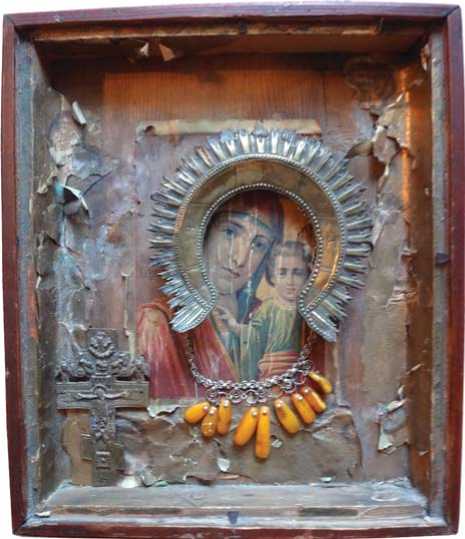
Fig. 2 . Family icons of the Kazan Mother of God brought by the settlers Tolmachevs to Siberia in 1881.
was taken to marriage from Chamrovka; nanny Anyutka got married to live in Chamrovka… You see, how many relatives by marriage we have! And when St. Elias’ Day approached, our people went there to Chamrovka. It was St. Michael’s Day in Bezrukova; everyone went there. Kinship relations were strong”.
Tatyana Ivanovna remembered almost all family members listed in the 1917 “Census Questionnaires for Biysk Uyezd, Shubinka Volost, village of Shubinskoye” (GAAK. F. 233, Inv. 1a, No. 854, Fl. 66). The informant called Fedor Agapovich’s daughters Avdotya, Anna, Ulyana, and Agrafena nyanki (‘nannies’)* (“nyanka Ulyashka”, “nyanka Dunka”), because they played with her. The nyanki were brought up in the spirit of love, which was especially evident in relation to children. “I was the only little child, and they played with me. Then the aunts started arguing and fighting over me. When Mom was sheafing or mowing far away, and it was time to run and feed me, I was lying in a cradle—that’s how everyone did it then. And the girls were arguing who would carry me to Mom. Then it was decided that they would do this as a duty for a week…”.
The state was interested in the quickest possible settlement of the migrants in their new places and provided financial assistance to the families. For this purpose, the Siberian Railway Committee was organized (Sibirskiye pereseleniya, 2006: 30). However, the new settlers were also householdly and handy people. For example, the Bogomolov family was engaged in agriculture and arable farming. In addition, “grandpa Prokhor”, according to the informant, did some commercial works—he made bricks, especially in the fall. He usually returned home not only with money, but also with goods: “If he stays there in the city of Biysk for two weeks, he goes home and people stuff a whole bag with goods for him for free. And he has a family of seven. He goes back, happy…”. Children ran to meet him, and he brought gifts for everyone, mainly shirts. Generally, they were kind and responsive people, as our informant believed; “town people respected villagers”, they liked peasants. “They came to visit us… In Biysk, one old woman Pastukhova came to visit us. Many times, when I was still little, I went to visit her in Biysk. This house has survived not far from the local history museum, it is not far from there”.
The Tolmachev family also did commercial works: its head Fedor Agapovich was a carpenter. For the initial time in Siberia, F.A. Tolmachev built a small house. Later, when the family began to grow rapidly, three sons got married, and grandchildren were born, a new house was built. Tatyana Ivanovna thus told about this stage of her life and customs of moving to a new house: “Then a new house was built, and it was time to move in. Moreover, the old house was still standing; later it was sold. We, children, ran into the new house, and the domovoy
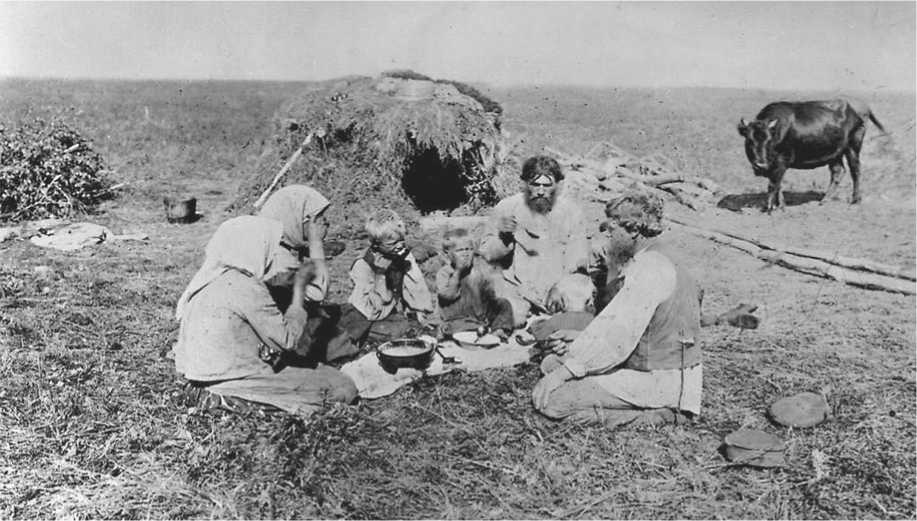
Fig. 3 . Lunch during fieldwork. Booth ( balagan ). Photo and caption by M.A. Krukovsky, 1910–1912. Archive of the MAE RAS .
started throwing clay, throwing-hurling clay at us, and we wondered and ran away… And there was no one there, and when we went in, he threw it from nobody knows where. Then we told this to grandpa. Grandpa brought him a badik (‘stick’) and a hat, so that he would come to the new house. People said: ‘My dear, let’s go home’. They left everything for him, and he came. For some reason, whoever was building always said: ‘Oh, we need to call the owner’. …They, as spirits, are invisible, live in every house; not people are the owners, but they”. The informant also recalled that owing to liking or disliking of the “master”, the cattle would multiply or, on the contrary, not multiply. “Whatever cattle he likes, it will live. Some of the locals had horses, which would not multiply, would die when they were little. Then people told them what the master’s name was, and they started to have cattle”.
When developing new lands and building new houses, the Ryazan migrants had to prove their right to life and interact not only with neighbors, local residents, but also with the inhabitants of the “unearthly world”. Among the neighbors, as Tatyana Ivanovna noted, there were people who were unable to live in a newly built house. “They stayed there, went to bed, and closed themselves up [lit. zakidayut ‘fling the door closed (latch the door) with a hook’ – E.F. ]. In the morning, they got up, and there was clay and stuff. That’s what was going on! Then they were taught to hold a prayer service and buy an icon of Archangel Michael. And since then he stopped, because Archangel Michael is the victor, everyone is afraid of him”.
The informant remembered a little story from the Shubinka people about meetings at a new place of residence, judging by the story, with the “masters of the area”. In one of the gardens* of the Shadrinovs, which was considered very large, “three persons lived”. “Many times people saw how they came out wearing all black. Our men went out, searched and searched, but there was no one. And then they saw how three people came out from there, wearing all black. And the same happened also in some other family. Everyone said that these were some kind of masters…”.
Unlike other residents, for example, of the Anuy Volost**, the Shubinka dwellers did not have a tradition of building “field huts”, where families lived in the field since the beginning of summer (Fig. 3). “They had something like a village there. They brought out poultry and cattle there, and lived there till winter. Take Aksenova, Lugovskaya, Staraya Chemrovka, Novaya Chemrovka— they all had huts. They dug them a little into the ground, and that’s how they slept; they didn’t close the doors, nothing like that” (FMA, 1990: fol. 54). These settlements were considered old residents’ or, as Tatyana Ivanovna said, “Siberians lived” there.
Back in the 1990s, specific hodonyms, that is, street names of populated areas (from Old Greek ὁδός ‘path’,
‘street’, ‘channel’), associated with the ethnic and cultural affiliation of the population, were recorded in the village of Shubinka. Even today, the names of streets and also individual districts ( kraya , okolki , kolki ) indicate the residence of local cultural groups. The village of Shubinka was divided into the Sibir and Ryazan districts, where old-resident Siberians and Ryazan settlers lived, and their descendants live until this day.
Conclusions
Expeditions to the places of origin of settlers in different regions of European Russia and further comparison of the information obtained with ethnic and cultural heritage of the descendants of these people in Siberia have proven the usefulness of the modern method of comparative field research in the study of Siberian migrant masses, in our case, from the Ryazan Governorate. The validity of the author’s method of integrating ethnographic and archival data was convincingly demonstrated by the example of the Ryazan families of the Tolmachevs – Bogomolovs – Shadrins from Shubinka Volost in Biysk Uyezd of the Tomsk Governorate. A research chain from archival data of the late 19th to early 20th centuries to the field evidence of the late 20th century was made, and specific features of local cultural adaptation of the settlers were identified. Field data suggest that the second generation of settlers born in the Altai before the 1917 Revolution retained the Southern Russian dialect (distinctive akanye and yakanye , pronunciation of the voiced “kh” (ɣ), soft “t” in the endings of the 3rd person singular and plural, etc.). Both in the places of exit in the Ryazan Governorate and in the Altai, a variety of last names was observed, which distinguished the Ryazan migrants from some other Southern Russian (Kursk) peasants and old residents of Siberia, among whom “decks” of last names have been recorded (Fursova, 2022: 125).
Ryazan settlers—residents of pre-revolutionary villages of Shubinka Volost—retained specific aspects of spiritual and material life even after almost 40 years from the time of settlement in Siberia. The Ryazan peasants, firmly adhering to Orthodox faith and the respective religious traditions, stood out from other southern Russian peasants in the depth of their ethnic and cultural memory both on the personal and collective levels. The Ryazan peasant migrants most often settled in the places where Russian old residents or settlers lived, and in this aspect, they differed, for example, from the Kursk migrants, who often chose to settle near people from Little Russia (Ukrainians). Thus, until the social and economic transformations of the first third of the 20th century, this environment sustained the cultural core as a focus of values and beliefs, which “is not recognized by either members of the group or external observers, but is manifested in a reflexive sense of their difference from everyone else” (Sökefeld, 1999: 417). The adaptation process was associated with appropriation of space and establishment of sacred connections with the local inhabitants of the “other world”, and in earthly reality— with marriages not only to the fellow Ryazan people, but also to the Siberian old residents, which was considered prestigious.
Acknowledgments
