
Theoretical framework for an AI-enhanced pedagogical technology to develop self-editing skills of doctoral students
Journal: Bulletin of South Ural State University. Series: Education. Pedagogical Sciences @vestnik-susu-ped
Section: Цифровая трансформация и искусственный интеллект в образовании
Article in issue: 1 т.18, 2026.
Free access
Self-editing skills are crucial for academic career of a future researcher though doctoral students frequently lack proficient self-editing skills as these skills are at the periphery of academic writing courses. The rapid integration of AI-enhanced writing tools into academia presents both transformative potential and significant risks highlighting a gap in theoretical frameworks for their responsible use. This study aims to design a theoretical framework for an AI-enhanced pedagogical technology specifically targeted at developing the self-editing skills of doctoral students, ensuring a balance between leveraging AI's efficiency and preserving critical academic rigor and authorship. Using integrative literature review the authors defined core self-editing subskills and assessment criteria. A systematic evaluation of over 70 AI writing tools was conducted using a rubric based on efficiency, accessibility, and feedback features. The pedagogical framework was constructed by synthesizing system and activity-based methodologies with reflective, collaborative, and self-directed learning approaches. The authors defined three stages of self-editing skills training with corresponding skills, knowledge criteria, and proficiency levels. The study mapped 15 selected AI tools to each editing stage based on functional alignment. The core outcome is a structured AI-enhanced pedagogical technology, defined by key principles (learner autonomy, optimal AI support, critical reflection, personalized feedback) and implemented through four operational stages: preparatory, information, training, and reflexive. This work provides a novel, reproducible theoretical framework that systematically integrates AI-enhanced writing tools into doctoral education. It moves beyond tool-centric adoption by embedding AI within a pedagogical structure that promotes critical generative artificial intelligence (GAI) literacy. The framework can be used for higher education institutions and doctoral training programs.
Similar articles in the section Higher education. Universities. Academic study
Short address: https://sciup.org/147254106
IDS: 147254106 | UDC: 378.44:004.8 | DOI: 10.14529/ped260108
Теоретические основы педагогической технологии с использованием ИИ для развития навыков саморедактирования у аспирантов
Умения самостоятельного редактирования научных статей имеют важное значение для академической карьеры будущего исследователя. К сожалению, аспиранты демонстрируют недостаточный уровень владения умениями самостоятельного редактирования научных статей, поскольку в традиционных курсах по академическому письму данным умениям уделяется недостаточно внимания. Стремительное распространение и внедрение ИИ-инструментов в академическое письмо обладает как преобразующим потенциалом, так и значительными рисками, что указывает на пробел в теоретических рамках для их ответственного использования. Цель данного исследования - разработать теоретическую основу для педагогической технологии на основе ИИ, направленной на развитие умений самостоятельного редактирования научных статей аспирантами, обеспечивая баланс между продуктивным использованием ИИ-инструментов и сохранением академической строгости и авторской автономии. С помощью анализа литературы авторы определили ключевые навыки самостоятельного редактирования научных статей и критерии их оценки. Была проведена систематическая оценка более 70 ИИ-инструментов для письма с использованием критериев эффективности, доступности и качества обратной связи. Теоретическую основу педагогической технологии составил синтез системного, деятельностного, рефлексивного, коллаборативного подходов и самонаправленного обучения. Авторы определили три этапа обучения умениям самостоятельного редактирования научных текстов, соответствующие им умения, критерии, показатели и уровни владения. На основе функционального соответствия авторы соотнесли 15 отобранных ИИ-инструментов с каждым этапом редактирования. Авторы сформулировали основные принципы педагогической технологии (автономия обучающегося, оптимальная поддержка ИИ, критическая рефлексия, персонализированная обратная связь) и определили четыре операционных этапа: подготовительный, информационный, тренировочный и рефлексивный. Разработанная педагогическая технология представляет воспроизводимую теоретическую основу, в которой авторы на системной основе интегрируют ИИ-инструменты для редактирования научных текстов в образование аспирантов. ИИ-инструменты встраиваются в образовательный процесс, способствующий развитию критической грамотности в области генеративного искусственного интеллекта (ГИИ). Данная теоретическая основа педагогической технологии может быть использована в университетах на образовательных программах подготовки аспирантов.
Text of the scientific article Theoretical framework for an AI-enhanced pedagogical technology to develop self-editing skills of doctoral students
К.Н. Волченкова, , Р.A. Алхато, othmanalhatow1@gmail.comЮжно-Уральский государственный университет, Челябинск, Россия
For doctoral students, mastery of academic writing is a core competency critical to their academic career [11], where the ultimate goal is to become an autonomous scholar able to disseminate the research results in oral and written forms. However, the complexities of English for Academic Writing (EAW) and institutional shortcomings in training pose significant challenges, thereby necessitating measures to be taken to improve the competency of doctoral students in EAW. Moreover, though the courses on research paper writing have been successfully developed and implemented at the universities worldwide, less attention is paid to the final stage of the scholarly writing, that is, editing a research paper. For PhD students, high level of self-editing skills is crucial for producing clear, rigorous, and impactful research, ensuring their work follows the conventions of scholarly communication [17].
Self-editing skills are a set of abilities to use editing strategies that contribute to understanding the elements of an effective paper and help the writer to review his work before submitting it for publication [3]. Self-editing has many benefits, as it helps PhD students to critically review a research paper; to identify strengths and weak- nesses to address them in the future; to refine text for clarity and cohesion; to focus one’s narrative to increase the impact of writing; to identify points of expansion or points of modification in one’s text; and, finally, to express one’s academic voice on the problem of the research. However, many doctoral candidates have limited self-editing skills and are unable to produce high-quality academic reports independently [6].
Existing solutions to develop self-editing skills of PhD students, like collaborative peer groups, Centers of Academic Writing (CAWs), and Massive Open Online Courses (MOOCs) have some disadvantages. In peer learning, valuable peer and supervisor time is often diverted to correcting minor mechanical errors, which delays substantive, critical dialogue on content and structure. CAWs do not provide training to improve peer-reviewing and self-editing skills. MOOC formats struggle to address individual PhD students’ needs, which is necessary for their learning [14].
The introduction of generative AI and AI-enhanced writing tools revolutionized the landscape of academic writing and higher education. AI-enhanced writing tools can enrich conventional self-editing practices by improving writing quality and acting as a bridge to professional scholarly writing, especially for non-native speakers [12, 26]. Nevertheless, these tools should be integrated into doctoral education under teacher guidance. This necessity arises because PhD students may lack the expertise to evaluate AI-generated content and the critical thinking to detect fabricated claims, risking their scholarly voice and academic integrity. Guidelines, such as those from Cornell University, caution that less experienced writers might struggle to make AI-assisted writing appear natural, potentially leading to ethical accusations [22]. Monitored use will pave the way for a responsible and ethical use of AI in writing development [7]. Therefore, a critical gap remains in creating educational models to develop self-editing skills that leverage AI's benefits while safeguarding original scholarship.
This study aims to design a theoretical framework for an AI-enhanced pedagogical technology for developing doctoral students' selfediting skills. To achieve this goal, the research focuses on the objectives:
-
• to define the core self-editing skills and assessment criteria;
-
• to identify and map existing AI-enhanced writing tools to develop self-editing skills;
-
• to define the methodology for the AI-enhanced pedagogical technology;
-
• to describe the model's operational stages and principles for implementation.
Literature Review
Self-editing is a foundational metacognitive practice that enables PhD students to critically evaluate and refine their academic writing. It is an iterative process, moving from global concerns of argument and structure to localized issues of language and mechanics [30]. Scholars have modeled this process through various frameworks. Day and Gastel [8] distinguish between “big-picture” revisions, which assess argument coherence and genre conventions, and localized edits targeting grammar and syntax. A more comprehensive hierarchical model is offered by Bond [4], who organizes editing into four levels: 1) global revision (thesis, audience, genre); 2) substantive editing (content organization and logic); 3) copyediting (style and sentence coherence); and 4) proofreading (mechanical correctness).
For this study, Bond’s [4] framework has been adapted into a targeted three-stage model focusing on core competencies essential for manuscript refinement. This adaptation consolidates his first two levels and excludes preliminary global revisions, as these are typically addressed in broader writing instruction. The resulting stages are substantive editing (content, argument logic, structural organization); copyediting (language accuracy, terminology, citation verification); and proofreading (final correctness, convention adherence, readability). This streamlined model prioritizes critical intervention points for PhD students as they prepare their research for submission (Table 1).
Effective development of self-editing skills in doctoral education is underpinned by three key pedagogical approaches: the reflective approach, the collaborative approach, and self-directed learning (SDL). Integrating these methods addresses the multifaceted nature of self-editing, which requires internal metacognition, external feedback, and autonomous skill application.
The reflective approach, rooted in the work of Dewey [9], cultivates the metacognitive awareness necessary for critical distance from one’s own writing. This practice of self-inquiry enables students to monitor and assess their work against academic standards, making sense of uncertain or complex writing situations through reflection-inaction. In contrast, the collaborative approach, informed by social constructivism [27, 29] transforms the isolated act of writing into a social endeavor. Peer feedback is crucial for mastering technical mechanics and structural consistency [31]. Collaboration introduces multiple perspectives, enhances critical evaluation skills, and provides embedded feedback that reinforces reflective practice and ensures quality assurance [15]. Structured collaboration can also foster indivi-
Table 1
Stages of Editing
|
Editing stage |
Focus |
|
|
1 |
Substantive Editing |
Content, argument logic, and overall structural organization |
|
2 |
Copyediting |
Language accuracy, including grammar, punctuation, spelling, consistency in terminology and formatting, and verification of facts and citations |
|
3 |
Proofreading |
Final correctness, adherence to academic conventions and submission guidelines, and overall readability |
dual accountability through intergroup dynamics, motivating deep engagement with proofreading strategies [13]. Self-directed learning (SDL) empowers doctoral students to take responsibility for diagnosing their learning needs, setting goals, and evaluating outcomes [5]. When applied to self-editing, SDL fosters the self-regulation skills required for planning, reviewing, and evaluating writing. It prepares learners for professional adaptability and cultivates the autonomous competence necessary to produce high-quality, submission-ready research papers.
A synergistic integration of these three approaches provides a comprehensive pedagogical foundation for developing the integrated selfawareness, external quality checks, and autonomous problem-solving required for effective self-editing.
Generative artificial intelligence (GAI) presents both transformative potential and significant challenges for academic writing pedagogy. AI-enhanced writing tools can function as powerful supplementary agents within the aforementioned pedagogical frameworks, particularly for self-editing. These tools can significantly enhance efficiency by automating mundane linguistic and grammatical checks, allowing students to dedicate more cognitive effort to substantive intellectual work. They offer real-time feedback on grammar, style, and structure, which is especially valuable for non-native English speakers in overcoming linguistic barriers and improving overall writing quality [12]. Furthermore, the process of using and evaluating AI-generated suggestions can foster metacognitive awareness and build confidence, promoting independent learning [21].
However, these benefits are only realized when an instructor provides guidance, because the benefits of AI-enhanced writing tools are accompanied by a number of concerns. A primary concern is the risk of over-reliance, which can undermine the development of critical thinking essential for original scholarship [1]. PhD students may lack the expertise to accurately evaluate AI outputs, potentially failing to detect fabricated claims or uncritically accepting substandard suggestions [23]. There are also sociocultural risks, including the potential erosion of the writer’s authentic voice and scholarly identity. Moreover, less experienced writers might struggle to integrate “synthetic language” naturally, risking accusations of unethical behavior [22].
Therefore, a critical gap persists in higher education regarding standardized models for in- tegrating AI into writing development. Effective use requires moving beyond the tool itself to cultivate what has been termed critical GAI literacy [22] which is the ability to use AI judiciously, evaluate its outputs critically, and maintain authorial agency. This underlines the necessity for teacher-guided integration, where AI-enhanced writing tools are introduced not as autonomous solutions but as instruments within a pedagogy that prioritizes reflective practice, collaborative critique, and self-directed learning goals.
Methodology
To define the self-editing subskills of PhD students and AI-enhanced writing tools, an integrative literature review (ILR) was used. “An Integrative Literature Review (ILR) allows researchers to go beyond an analysis and synthesis of primary research findings and provides new insights and summarized knowledge about a specific topic” [16, p. 308]. The systematic nature of the ILR established the necessary credibility and scope for defining the required skills and AI-enhanced writing tools. The authors searched for research papers across academic databases, namely, Google Scholar, ResearchGate, Science-Direct using keywords including “academic writing,” “editing”, “editing skills” to identify relevant self-editing subskills, knowledge, and abilities needed for mastering the editing process. Non-academic writing and studies that lack methodological and empirical evidence were removed. The authors analyzed 120 articles but only 20 research papers of leading scholars in the field were included in the reference list.
To identify AI-enhanced writing tools suitable for developing self-editing skills, the authors assessed over 70 existing AI-enhanced writing tools from the website AIxploria [2]. AIxploria is a Belgium-based online guide that helps scholars find, assess, and use top free AI tools across a wide range of categories. The selection process was formalized into an evaluation rubric that assessed each tool against three stringent criteria: efficiency, accessibility, and the presence of student feedback features. The evaluation led to the selection of 15 AI-enhanced writing tools – QuillBot, ProWritingAid, Thesify, Retext.ai, Scribbr AI, Slick Write, EndNote, Mendeley, Zotero, Ginger Software, Turnitin, Copy Leaks, ZeroGPT, and the Hemingway App , suitable for the needs of the three self-editing stages.
To create an AI-enhanced pedagogical technology, the authors used system and activitybased approaches. The system approach allowed to design the education process as an integrated system, with its goals, principles, methods, teacherstudent interaction, and outcomes all mutually reinforcing each other. An activity-based approach was used to immerse PhD students in the authentic, iterative practice of scholarly writing, fostering the critical metacognition and independent judgment essential for research autonomy. Through peer-review workshops, iterative revisions, reflection, and argument-mapping PhD students developed higher-order skills of argument building, research paper evaluation, and style within a safe, collaborative environment that mitigates the high-stakes pressure of the supervisor relationship. The system approach provides the macro-structure of the AI-enhanced pedagogical technology, while the activity-based approach defines the micro-level tool-mediated actions guided by an instructor.
Furthermore, the combined reflective, collaborative, and self-directed learning (SDL) approaches provided justification for the technology's practical components, as effective selfediting requires integrating internal self-awareness, external quality control, and autonomous self-management. These combined approaches guaranteed the development of an intervention that is systematic, internally consistent, and psychologically aligned with the goal of fostering autonomous scholarly editing.
The reflective approach is realized in the instructor’s intervention by engaging students in cycles of reflection across planning, action, and evaluation stages, thus helping them in monitoring their progress and, subsequently, refining present and future writing works [19]. This reflection involves systematic thinking where instructors (or students, as editors) use evidence from past experience, knowledge, or beliefs to make decisions, rather than relying on mere routine. Moreover, PhD student engagement in reflective writing enables them to critique their own work, to ensure the aligning tone with the audience, and to evaluate the structure and organization of their research paper by questioning their aims and giving rationale for the chosen arguments and framework [28].
One of the key methods developed within the reflective approach is structured collaborative discussions. PhD students act as critical mirrors that force self-scrutiny [24]. Collaborative discussions encourage students to exchange ideas and actively reflect on research papers written through discussion forums or seminar groups, where PhD students are required to explain and defend their key arguments in a group setting. These activities help PhD students to strengthen their skills of assessing the structure and organization of a research paper, evaluating the validity of arguments, and checking for the research paper’s coherence and logic. Thus, the reflective approach provides PhD students with an opportunity to reflect on the content and structure of their research papers by asking and answering specific questions that make them consider their written works from a different perspective via self-assessment.
The collaborative approach is realized via peer response groups that enhance the ability to spot grammar, punctuation, and spelling mistakes [10]. This method involves students exchanging written drafts to provide oral or written feedback to each other. PhD students learn to match the tone to the audience. This team approach builds self-editing skills and results in the enhancement of the researcher's ability to refine work across multiple drafts [6].
The SDL approach is realized through selfassessment, which requires students to independently evaluate their writing performance against established criteria and quality benchmarks, facilitating the autonomous mastery of procedural editing skills [20]. Self-assessment utilizes selfcheck worksheets or customized checklists that guide students to check for and correct errors across content, organization, mechanics, grammar, and sentence structure. By actively monitoring errors and performance against standards, students master proofreading strategies and develop the ability to eliminate typographical errors and surface mistakes [18]. Furthermore, this iterative checking for adherence to submission guidelines ensures that PhD students pay close attention to the journal requirements and style guides for authors.
The proposed model
Core Self-Editing Skills Framework and Assessment criteria
The authors offer to structure the process of self-editing skills training according to the stages of the editing process: substantive editing, copyediting, and proofreading. Substantive editing focuses on the content of the article, evaluating its logical flow, ideas’ relevance, and argument validity. In other words, at this level of editing the author or editor analyzes and comments on an article's content, namely its ideas, arguments, and overall structure. Therefore, at this editing stage the author should be able to assess the structure and organization of a research paper, to check if the tone is aligned with the audience, and to assess the degree of research paper coherence and argument validity.
Copy editing addresses the linguistic correctness of a research paper in terms of grammar, spelling, punctuation, terminology, and formatting at the paragraph and sentence levels. Moreover, copy editing includes checking headings and footnotes. Copy editors must ensure consistency in language and style while correcting any factual discrepancies. Thus, copy editing skills comprise spotting grammar, punctuation, and spelling mistakes; providing consistency in terminology, formatting, and citation system; checking for accuracy of facts, figures, and references.
Finally, proofreading focuses on surfacelevel mistakes and minor details that affect the readability and professional look of a research paper. Proofreading involves making only minor changes or deletions to a document, but no major rewriting. Proofreading requires great concentration to find all the errors. PhD students should know effective proofreading strategies that include avoiding over-reliance on spelling and grammar checkers; focusing on one type of error at a time to maintain concentration; reading text aloud to catch mistakes through auditory feedback; breaking the text into smaller sections to prevent overwhelm; circling punctuation marks to scrutinize each one; reading backwards to isolate spelling and grammatical errors; and keeping track of frequent mistakes to improve future writing. Thus, the key self-editing skills for this stage of editing are knowledge of proofreading strategies, abilities to check for typographical errors and surface mistakes, for adherence to the submission guidelines of a chosen journal. The summary for each stage of the self-editing skills is presented in Table 2.
The identified self-editing skills require par- ticular knowledge and abilities that doctoral students should master. To identify the knowledge and abilities the authors studied the essence of the identified self-editing skills and described the components of self-editing skills needed to be developed in the education process presented in Table 3. The knowledge of self-editing skills will become the information criterion for defining the level of self-editing skills of PhD students and the subskills will comprise the activity criterion for assessing the level of PhD students’ selfediting skills.
The criteria developed can be used to evaluate the initial and post-training levels of PhD students’ self-editing skills proficiency. The information criteria can be assessed through written tests, while activity criteria can be evaluated via artifacts: editing projects, submitted checklists, style sheets, and revised drafts of research papers that provide visible evidence of structural revision, systematic correction, and meticulous polishing. Thus, the framework developed allows for a holistic assessment that clearly separates the student's understanding of editing principles from their ability to execute effective editing processes, providing a clear picture of their autonomous self-editing capability.
Mapping AI Tools to Editing Stages
AI-enhanced writing tools (Table 4) can be strategically distributed according to the level of research paper editing, taking into account the cognitive and practical demands of each stage. This distribution aligns with the tools' designed functionalities to provide targeted support, transforming them from generic aids into essential components of a structured self-editing pedagogy.
The mapping of AI-enhanced writing tools to specific self-editing stages is guided by each tool’s core functionality and its alignment with the cognitive and practical demands of that stage.
Table 2
Editing stages and corresponding self-editing skills
|
Editing Stages |
Self-Editing Skills |
|
Substantive Editing |
Ability to assess research paper structure & organization |
|
Ability to align tone with the audience |
|
|
Ability to check coherence and logic of a research paper |
|
|
Copy Editing |
Ability to spot grammar, punctuation, and spelling mistakes |
|
Ability to provide consistency in terminology, formatting, and citation system |
|
|
Ability to check for accuracy of facts, figures, and references |
|
|
Proofreading |
Knowledge of proofreading strategies |
|
Ability to check for typographical errors and surface mistakes |
Criteria and indicators for self-editing skills assessment
Table 3
|
Editing Level & Indicators |
Information Criteria |
Activity Criteria |
|
Substantive Editing Indicators: Argument rigor, Logic, Academic style |
Knowledge of how to build a scholarly argument and structure a manuscript for a target audience; knowledge of principles for maintaining an objective, authoritative academic tone and style; knowledge of how to trim the draft efficiently |
Annotating drafts to assess tone and clarity, and rewriting passages to align with disciplinary discourse conventions. Creating reverse outlines, restructuring sections, and rewriting to ensure logical flow and persuasive narrative |
|
Copy Editing Indicators: Language accuracy, Consistency |
Knowledge of paragraph-level coherence devices and transitional logic; knowledge of grammar rules, citation styles, and ethical standards for originality and sourcing; knowledge of the mechanical consistency required in a scholarly document (e.g., numbering, labels) |
Using checklists/style sheets to verify consistency; correcting grammar; formatting citations; conducting originality/accuracy audits. Refining topic sentences and transitions to ensure clear connections between ideas at the micro-level. Systematically checking and correcting the consistency of all technical elements (figure labels, terminology, abbreviations) |
|
Proofreading Indicators: Formatting conventions, Absence of language errors and typos |
Knowledge of proofreading strategies, common surface error types (homophones, subject-verb agreement) |
Executing final, focused passes to catch and correct typographical and minor grammatical errors |
AI-Enhanced Writing Tools Mapped to Self-Editing Stages
Table 4
|
Self-Editing Stage |
Core Skill & Objective |
AI-Enhanced Writing Tools |
Primary Function in This Stage |
|
Substantive Editing |
Evaluating argument coherence, logical flow, and structural integrity for the scholarly audience |
QuillBot, Hemingway App, Slick Write, Writefull, Thesify, DeepL Write, ProWritingAid |
Paraphrasing to rephrase and reorganize ideas; highlighting complex/passive sentences to improve clarity and directness; suggesting structural flow; aligning tone with an academic audience |
|
Copy Editing |
Ensuring linguistic correctness, technical consistency, ethical rigor, and citation accuracy |
ProWritingAid, Retext.ai, Ginger Software, EndNote, Mendeley, Zotero, Turnitin, Copyleaks, ZeroGPT |
Providing real-time grammar and style checks; automating citation management and formatting; verifying originality and detecting plagiarism/AI-generated content |
|
Proofreading |
Performing a final mechanical sweep for surface-level errors and ensuring adherence to submission guidelines |
Retext.ai, ProWritingAid |
Catching typographical errors and surface mistakes via NLP; performing fullstyle checks for formatting consistency (headers, page layout, etc.) |
Substantive editing ocuses on macro-level concerns such as argument coherence, logical flow, and structural organization. Tools like QuillBot and Hemingway App are mapped here because they support high-level revision: Quill-
Bot aids in paraphrasing and reorganizing ideas, while Hemingway highlights complex sentences and passive voice, encouraging clarity and directness. Slick Write and Writefull provide feedback on narrative flow and academic tone, helping students refine their argumentative structure and audience alignment. These tools engage users in critical thinking about meaning and persuasion rather than surface corrections.
Copy editing requires attention to linguistic accuracy, consistency, ethical rigor. ProWritingAid and Ginger Software are selected for their strong grammar, style, and terminology-checking capabilities, which address sentence- and paragraphlevel issues. Citation managers like EndNote, Mendeley, and Zotero automate reference formatting and consistency, while Turnitin, Copyleaks, and ZeroGPT help verify originality and detect AI-generated content, which is key for maintaining ethical standards. This combination supports the detailed, technical, and ethical scrutiny required at this stage.
Proofreading is the final revision for surface errors and submission readiness. Tools like ProWritingAid are reused here in a focused capacity: their NLP-driven detection of typographical errors, formatting inconsistencies, and minor grammatical mistakes aligns with the proofreading goal of polishing a final draft. These tools automate meticulous checks that are time-intensive and prone to human fatigue, ensuring adherence to submission guidelines with high efficiency.
This staged mapping ensures that AI tools are used not as generic aids, but as targeted supports that mirror the evolving priorities of the self-editing process – from macro-structural reasoning to micro-mechanical precision.
Architecture of the AI-Enhanced
Pedagogical Technology
To describe an AI-enhanced pedagogical technology the authors have to define the concept of a pedagogical technology. The research is based on the definition of G.K. Selevko who defines a pedagogical technology as a system including all the components of a pedagogical process, built on a scientific basis, and programmed to reach the required results [25, p. 54].
The created AI-enhanced pedagogical technology is guided by core principles derived from reflective, collaborative, and self-directed learning approaches:
– the principle of learner autonomy explains that pedagogical technology must promote a student as an independent learner when he is fully capable of exercising choice, self-actualization, and responsibility for his own learning. AI-enhanced writing tools empower students by enabling them to perform self-study, planning, organization, self-monitoring, and self-assess- ment of their actions, which are features of modular and self-directed learning;
-
– the principle of optimal AI support indicates that AI-enhanced writing tools are used in situations where they can be more efficient than instructor’s intervention or can substitute instructor and give instant feedback, namely, improving content structuring, handling technical and mechanical tasks, such as grammar and spelling checks, proofreading, which ease the academic process and save time and effort. However, this principle requires constant commitment to a balance between AI utility and human insight; the principle of cooperation states that learning is a constructed process achieved through communication and networking in the academic field. AI-enhanced writing tools help in collaboration process by creating a supportive learning environment that enables the sharing of drafts and automating checks like grammar and citation formatting. This essential pre-editing frees up the valuable time of peers and supervisors to focus on substantive critical dialogue concerning content, ethical compliance, and complex structural refinement, rather than minor mechanical errors. The development of collaboration skills through interaction is linked to the development of selfediting skills of PhD students;
-
– the principle of critical reflection requires that the use of AI-enhanced writing tools actively promotes metacognitive awareness and critical engagement, which are outcomes of reflexive pedagogy. The AI-enhanced writing tools support this by providing objective data and detailed analyses of writing weaknesses and style, they also offer help for students to build their reflection and refine their work. To maintain academic integrity and strictness, this principle requires students to evaluate all the AI tools outputs, detect biases, verify sources, and use the tool to refine prompts, which will enhance their critical thinking skills;
– the principle of personalized feedback means that students get quick and custom support for their own needs, speed, and writing style. AI writing tools can study students’ writing and give personal feedback based on the prompt, which improves writing quality. These tools also make the feedback process easier for teachers and help them send more personal and fast comments. However, even if AI feedback is fast and useful, many students still prefer their teachers’ comments, because teachers can give clear explanations and deeper analysis.
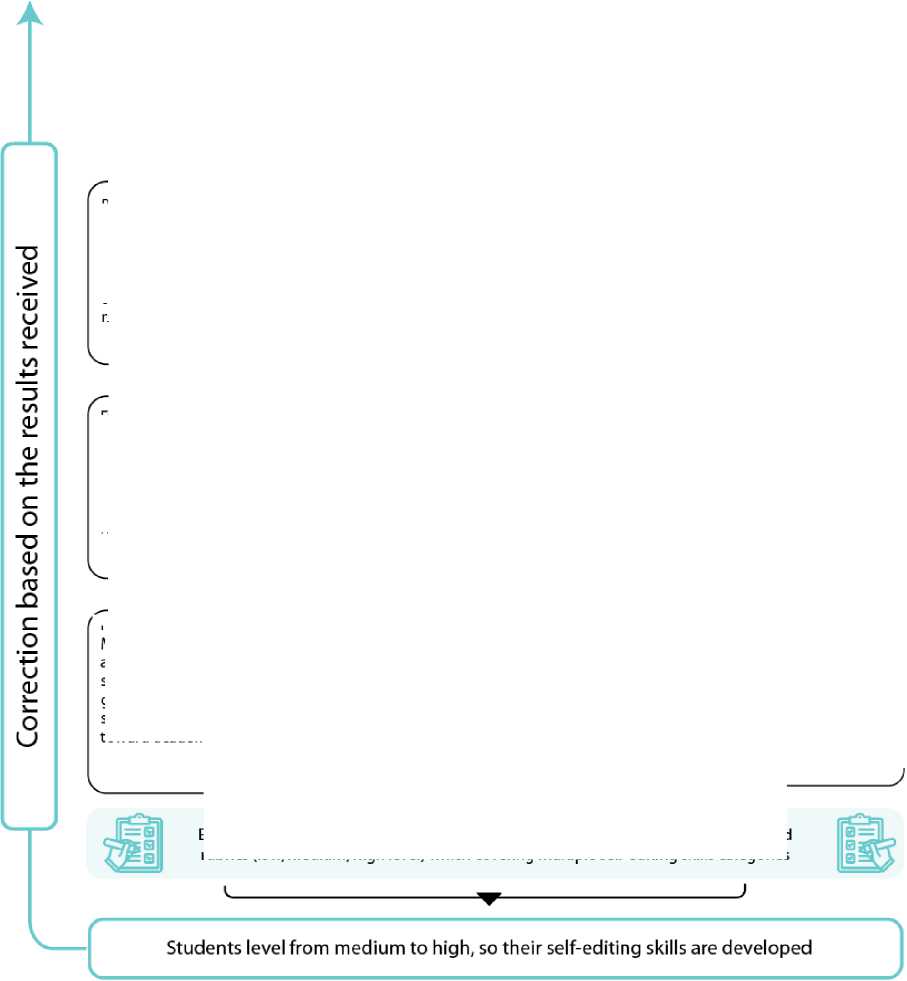
The offered AI-enhanced pedagogical technology to develop self-editing skills of doctoral students (Fig. 1) presents a system including all the components of an education process: the aim; criteria and indicators to evaluate the level of self-editing skills’ development; the proficiency levels of doctoral students’ self-editing skills; the educational content and student-teacher interaction.
The pedagogical technology aims to develop self-editing skills of PhD students using AI-enhanced writing tools’ support.
Two criteria (information and activity) and indicators for each criterion were created in order to assess the degree of self-editing proficiency of PhD candidates. Table 5 describes the developmental stages of PhD students' self-editing abilities. Tests on the knowledge of editing techniques and individual projects on editing the drafts of PhD students' research papers are used to assess the proficiency of PhD students' selfediting skills.
The educational content of the training will focus on the development of knowledge and skills required for enhancing three editing stages; substantive editing, copy editing and proofreading.
To develop self-editing skills of PhD students, a training course on editing a research paper in English will be developed. It will be based on the textbook “English for researchers: research paper editing” created by K.N. Volchenkova and E.G. Korotkova as the main source of information. The training course will be organized on a digital platform, MOODLE. It will comprise the textbook, handout materials and self-editing sheets, workshop presentations on the usage of AI tools in the editing process, and the tasks that integrate the usage of AI in the editing process.
Let us describe all the elements of the education content in detail. The textbook “English for researchers: research paper editing” consists of ten units. Its aim is to guide PhD students through the stages of the research paper editing and the skills needed to edit scientific articles for submission to English-language peer-reviewed journals.
The training course on the MOODLE platform comprises the textbook “English for researchers: research paper editing”, additional materials in the form of websites’ links to relevant information on self-editing skills, professional guides on editing, videos, infographics, interactive training exercises and tests, handout materials designed to activate creative engagement. To guide independent correction during cycles of self-editing practice instructors use self-editing sheets (utilizing standard editing symbols) and self-assessment checklists.
Workshop presentations on the usage of AI tools in the editing process will present the AI-enhanced writing tools mapped to the stage of the editing process, describe the possibilities of AI-enhanced writing tools in research paper editing, with a focus on the critical usage of the AI outcomes.
The integrative tasks will present the successive steps of research paper draft editing, where PhD students use specific tools at each level of editing, reflect on the changes to be accepted or rejected, discuss the feedback with peers and instructor, and evaluate each other's corrections. All the PhD students will work on individual projects of editing their research paper drafts, write reflective essays on their concurrent errors, and self-assess their progress in the development of self-editing skills.
Implementation Stages and Student-Instructor Interaction
The AI-enhanced pedagogical technology is implemented in four stages: preparatory stage, information stage, training stage, and reflexive stage. The preparatory stage is focused on planning, preparing, and identifying the initial level of the development of self-editing skills of PhD students. At the information stage the foundational knowledge of the three key editing levels (substantive editing, copyediting, and proofreading) is studied and the ethical framework necessary for utilizing AI-enhanced writing tools responsibly is introduced. At the training stage the PhD students apply newly acquired knowledge using different AI tools and editing strategies. At the reflexive stage the focus shifts entirely to the student’s self-regulated learning (SRL) and the readiness of the paper for external submission.
The educational content presented will be delivered through face-to-face communication in the classroom. The instructor acts as an ethical authority and mentor, guiding students into the information stage of the AI-enhanced pedagogical technology. The teacher explains that the primary goal is for students to develop their scholarly identity by internalizing a three-stage selfediting framework: substantive editing, copyediting, and proofreading. Students ask how they can maintain the balance between human writing and AI-enhanced writing tools. The teacher answered by telling them to evaluate AI output independently, detect biases, and verify sources.

Methodological base: system, activity-based, collaborative, reflective, self-directed learning, process approach
Self-Editing
Discussions: collaborative
Approach: Discussions; Collaborative Co-authoring
Human Expertise: Students value human guidance for deep analysis and explanation over Al feedback.
Continuous
Technology
Evaluation procedures (precourse survey to measure the level of self-editing skills) and rubrics (low,medium, high level) which covering multiple self-editing skills categories
Strategies: Facilitating Self-Directed Learning (SDL); Modeling Writing Strategies; Modeling Monitoring and Reflection; Structuring Discussions; Feedback and Supervision; Utilizing
Modeling Writing Craft: Teachers model writing strategies and skills through collaborative research.
teacher-student engagement, vital for ethical and independent research.
Substantive Content: Al handles technical corrections, freeing teacher time for advanced critical discussion.
Reflective Approach: Journaling; Metacognitive Modelling and Critical Evaluation of Al Output
Connection: fosters ongoing
Meathods: from SDL Modelling Writing Strategies; Facilitating the Process; Modelling Monitoring and Reflection and Al-Enhanced Self-Assessment From Collaborative
Aids; Collaborative Instruction utilizes discussions; Peer
Observations; Using Collaborative Platforms; Collaborative Research and Focus on Substantive Dialogue; Outline Generation and Structural Critique.
Collaborative
Peer Critiquing;
Platforms and
Research. From
Materials: Course textbook English for Researchers: Research Paper Editing with special hand-out materials for creative engagement; Guidelines for checking surface mistakes; Self-editing sheets using standard editing symbols and Self-assessment checklists and Al-enhanced writing tools


TEACHER’S INTERVENTION
STUDENT-TEACHER INTERACTION
Pedagogical Designer and Guide: Instructors facilitate student self-directed learning, modeling feedback and reflective thinking. They guide doctoral candidates in developing learning strategies and monitoring progress.
Ethical Authority and Trainer: The instructor upholds academic integrity by setting clear Al policies, training students on ethical use of writing tools. This ensures proper citation, maximizes utility, and maintains transparency.
^Professional Researcher and Role' Model: Instructors model successful academic behavior and inspire students' personal and research growth. Their experiences shape students' approaches and attitudes toward academic professionalism.
Stages of the Technology Development
Diagnostic and
Preparatory:
Identifying initial skill levels (via precourse survey) and curriculum planning.
Information: Building foundational knowledge of the three editing levels and introducing Al ethical frameworks.
Practical and Training: Application of skills in a task-oriented environment using Project-Based Learning (PBL) and peer response groups.
Reflexive: Final self-evaluation, independent editing, and originality verification.
Fig. 1. AI-enhanced pedagogical technology to develop PhD students’ self-editing skills
Table 5
Conclusion
This study was designed to develop a theoretical framework for an AI-enhanced pedagogical technology to improve self-editing skills of doctoral students. The research addressed the low proficiency levels of PhD students’ self-editing skills and the lack of reproducible pedagogical technology for responsible integration of AI-enhanced writing tools into academic training.
The study offers an AI-enhanced pedagogical technology by defining the stages of selfediting skills development, namely, substantive editing, copyediting, and proofreading, and mapping selected AI-enhanced writing tools to each stage within a pedagogical system based on reflective approach, collaborative approach, and self-directed learning. The theoretical framework to develop self-editing skills of PhD students is
to develop self-editing skills of doctoral students adaptable across disciplines, aiming to enhance research dissemination and prepare autonomous scholars for the evolving digital academic landscape.
The proposed framework, however, has certain limitations that should be acknowledged. First, the pedagogical technology is presented as a theoretical model and has not yet been empirically validated through implementation in a doctoral training context. Second, the selection of AI-enhanced writing tools was based on an analysis of their published features and functionalities, not on comparative efficacy studies or longitudinal data on their educational impact.
Future research is needed to test the framework's effectiveness in real educational settings, measuring its impact on the quality of students' academic writing, their self-editing proficiency, and their development of autonomous scholarly habits; to investigate how the integration of this technology influences the dynamics between doctoral students and their supervisors, particularly regarding feedback practices, authorship, and the development of critical GAI literacy.
