
Укрепления дьяковского городища Власьево: результаты комплексных исследований
Журнал: Краткие сообщения Института археологии @ksia-iaran
Рубрика: Железный век и античность
Статья в выпуске: 282, 2026 года.
Бесплатный доступ
В статье приводятся первые результаты комплексного исследования валов дьяковского городища Власьево (Московская область, Зарайский район, правый берег р. Осётр). Установлено, что оба вала городища возведены в одно время и по одной схеме, что нетипично для дьяковских укреплений. В насыпях фиксируется только две фазы подсыпки. Результаты анализа фитолитов позволяют оценить временной зазор между двумя этапами ремонта насыпи – «не более 30–40 лет». Приемы возведения укреплений, оставляющие в насыпях уголь и прокаленную глину, соответствуют дьяковским строительным традициям и могут быть отнесены к периоду II в. до н. э. – II в. н. э. Культурный слой под насыпью содержит керамический материал так называемой каширской культуры и значительно древнее самих укреплений (рис. 3: в). Палинологический анализ и анализ фитолитов показали несущественную разницу в микробиоморфных комплексах из слоя под валом и временно открытыми поверхностями дьяковского периода (рис. 3: а, б). Ландшафты, окружающие городище, оставались неизменными в период функционирования памятника – в начале, а затем в конце I тыс. до н. э.
Похожие статьи в разделе Археология
Короткий адрес: https://sciup.org/143185738
IDS: 143185738 | DOI: 10.25681/IARAS.0130-2620.282.137-148
The Fortifications of the Dyakovo Hillfort of Vlasiyevo: Results of the Comprehensive Studies
The paper provides the first results of the study conducted to examine ramparts around the Vlasiyevo hillfort attributed to the Dyakovo culture (Moscow region, Zaraisk district, right bank of the Osetr river). According the study, both earthen ramparts were constructed at the same time using the same method which is not typical of the Dyakovo fortifications. Only two stages of repair were recorded in the ramparts. The phytolith analysis provides an opportunity to estimate the time gap between the two stages of these earthen walls repairs which is ‘not more than 30–40 years’. The methods employed to construct these fortifications that left charcoal and calcined clay in the ramparts are consistent with the Dyakovo construction traditions and can be dated to the time span from the II century BC to the II century AD. The occupation layer under the rampart contains ceramic material of the so called Kashira culture, it is much older than the fortifications themselves (Fig. 3: c). The palynological and phytolith analyses did not show substantial differences between the layer under the rampart and the layers from the Dyakovo period temporarily left without topsoil (Fig. 3: a, b). The landscapes surrounding the hillfort did not change during the site occupation, i. e. the beginning and the end of the I millennium BC.
Текст научной статьи Укрепления дьяковского городища Власьево: результаты комплексных исследований
Работы на городище Власьево являются частью единой программы по изучению городищ в окрестностях г. Зарайска (рис. 1). Эта территория, чрезвычайно насыщенная памятниками РЖВ, остается практически не исследованной. Городище находится всего в 2,5 км от городища Аргуново, на котором
1 Исследования выполнены при поддержке гранта Минобрнауки России (соглашение № 075-15-2024-554 от 24.04.2024).
Рис. 1. Городище Власьево с указанием мест зачистки валов. Топосьемка 2023–2024 гг.
укрепления были исследованы параллельно с Власьево, а результаты этих исследований опубликованы ( Сыроватко , 2024). Городище впервые упоминается в сведениях, собранных рязанским краеведом А. А. Мансуровым в 1930-е гг. (АКР. Московская область. С. 106). Первое обследование памятника состоялось в 2023 г., результаты тех работ, включая коллекцию подъемного материала, опубликованы ( Сыроватко , 2024).
Геоархеологическая информация
Городище находится в системе оврагов, в 130 м к ЮВ от окраины д. Власьево г. о. Луховицы Московской области, на левом берегу безымянного ручья – правого притока р. Осётр, правого притока р. Оки. От русла Оки удалено на 4,2 км (рис. 1). Городище сохранилось фрагментарно – с восточной стороны оно обрезано почти вертикальным бортом оврага с ручьем – правым притоком р. Осётр (рис. 1); с северной стороны укрепления и часть площадки нарушены отвершком оврага. Таким образом, от первоначального городища сохранились только фрагмент укреплений с юга и запада и западная часть площадки. Укрепления представляют собой внутренний вал по краю площадки, внутренний ров, внешний вал и внешний ров (рис. 1). С южной стороны укреплений, у самого края обрыва, во рвах читаются проходы в виде останцов. Проходов в валах нет. Размеры площадки без валов – 40 х 65 м, общие размеры городища с валами и рвами – 60 × 115 м. Оба вала и рвы близки друг другу по размерам: ширина валов – ок. 9–10 м, высота – 0,8–1,1 м, глубина рвов – 0,8–1,0 м при ширине 4–5 м. Протяженность сохранившихся участков валов – ок. 77 м.
Объекты и методы
Для изучения состава насыпей валов было принято решение выполнить зачистку на краю оврага с восточной стороны памятника (рис. 1). Склон зарос крупными деревьями, и выполнить единый разрез для обоих валов и рвов не получилось. Однако центральные части насыпей валов удалось исследовать, для этого одна зачистка выполнена на валу 2 и две – на валу 1 (рис. 1: 1–3 ). Сразу отметим, что насыпи имели во многом схожую стратиграфию, и все образцы для исследований и датирования отбирались только из внутреннего вала, № 1, из зачистки 1.
Были определены основные химические свойства – кислотность почвенных растворов (рН), содержание органического углерода (С, %), валового фосфора (Р2О5, %), проведены микробиоморфный и спорово-пыльцевой анализы.
В микробиоморфном анализе основное внимание уделялось фитолитному составу, поскольку при работе с почвами и культурными слоями данный вид анализа бывает наиболее информативным. Морфологическое описание и обозначения фитолитов основывались на Международном своде номенклатуры фитолитов (ICPN) 2.0 ( Neumann et al. , 2019), а их биоценотические характеристики определялись согласно методике, многократно описанной в литературе ( Голье-ва , 2008). Корреляция между морфотипами фитолитов и их биоценотической характеристикой опубликована ранее ( Гольева , 2023).
Результаты и обсуждения
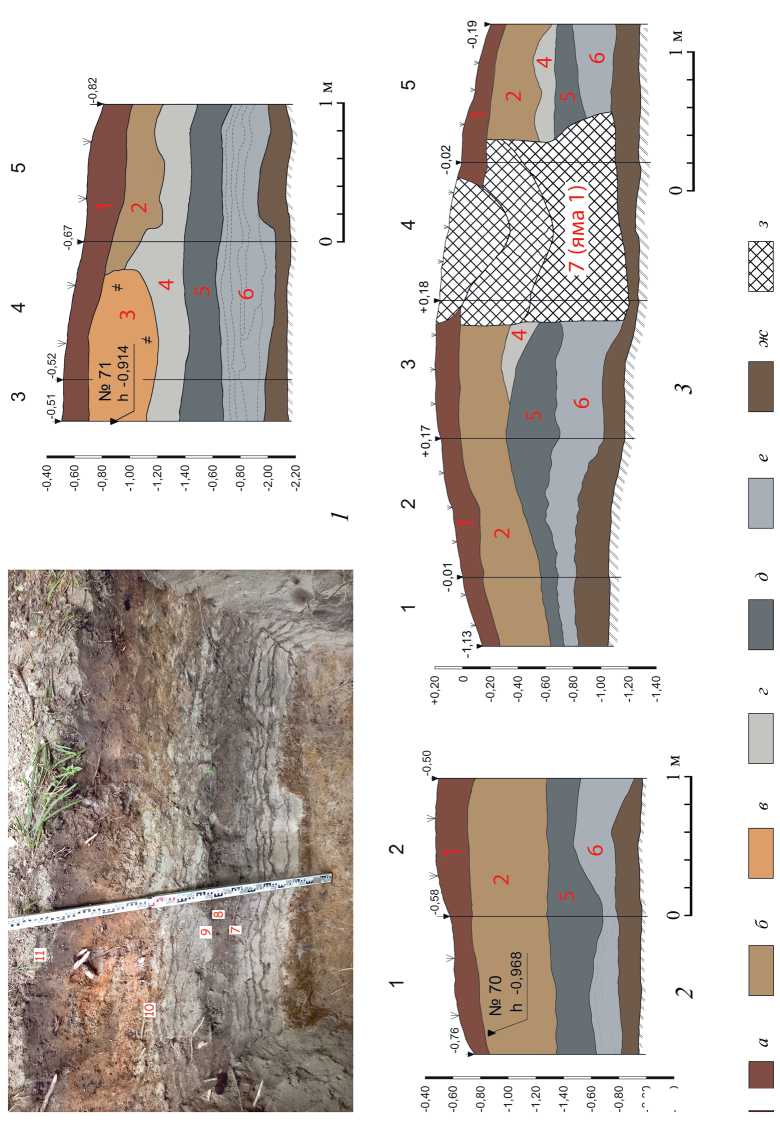
Стратиграфия укреплений. Вал 1. Вал исследован двумя зачистками с зазором в 0,4 м (образованным крупными деревьями на краю обрыва), стратиграфия их схожа. Протяженность зачистки 1 – 2,5 м (рис. 2: 1 ; кв. 3–5), зачистки 2 – 2 м (рис. 2: 2 ; кв. 1–2). Отбор образцов осуществлялся из зачистки 1. Верхний слой – темно-серая супесь, современная почва толщиной до 20 см (рис. 1: 1, 2 ; 2: 1 , слой 1), перекрывавшая насыпь вала. В насыпи встречено всего два горизонта. Верхний – коричневый суглинок толщиной от 25 см до 57 см (рис. 2: 1 , слой 2). В кв. 3–4 этот слой суглинка был прокален, толщина линзы прокала достигала 50 см (на рис. 2: 1 показан оранжевым цветом, слой 3). Под этой линзой находилось сравнительно небольшое количество угля, сама линза прокала
-2,00
выглядела монолитом, прокалившимся на месте. Линзы прокаленной глины в насыпях валов, равно как и включения отдельных комков печины, – обычное явление для дьяковских укреплений (подробнее: Сыроватко , 2009. С. 78). Нижний горизонт насыпи – слой белесой супеси, слоистой структуры, с тонкими, нитевидными коричневыми прослойками толщиной в среднем 20 см (рис. 2: 1 , слой 4). Еще ниже, на всем протяжении профиля, залегал слой коричневой плотной супеси, содержащий керамику (рис. 2: 1 , слой 5). Вероятно, это погребенный под валом культурный слой раннего поселения, толщина его – 20–30 см. Ниже, на всем протяжении профиля, прослежена белая супесь, также разделенная тонкими коричневыми прослойками толщиной 30–40 см (рис. 2: 1 , слой 6). Материк – коричнево-желтая плотная супесь.
Стратиграфия укреплений. Вал 2. Стратиграфия вала в целом аналогична валу 1 (рис. 2: 3 ). Отличия заключались только в наличии глубокого средневекового перекопа в центре профиля, в кв. 4 (рис. 2: 3 , слой 7) (в котором найден развал средневекового сосуда с клеймом на донце «круг в квадрате»), а также отсутствии в неповрежденной части профиля слоя прокаленной глины. Насыпь также состоит из коричневого суглинка толщиной ок. 30–35 см (рис. 2: 3 , слои 2–4), под ней прослежен слой коричневой плотной супеси, содержащий керамику, – слой поселения, толщина его – 32–37см (рис. 2: 3 , слой 5). Ниже прослежена белая супесь, разделенная тонкими коричневыми прослойками толщиной ок. 30 см.
Отметим, что в стратиграфии обоих разрезов есть минимум две детали, которые мы не можем интерпретировать: слоистая структура под культурным слоем (рис. 2: 1 , слой 6) и наличие прослоек суглинка в насыпи, хотя все остальные слои и слой на жилой площадке в основе своей представляют плотную супесь.
Культурный слой под насыпью. Сразу отметим, что состав керамики в насыпях, довольно немногочисленной, ничем не отличается от керамики из слоя под насыпями (табл. 1). Керамика попала в валы при их сооружении и рытье рвов. Состав керамики из валов и слоя под ними также необычен. Если шур-фовка городища 2023 г. выявила вполне дьяковский керамический материал, то работы 2024 г. выявили радикально иную картину: достоверно сетчатой керамики не выявлено вообще. Керамика из более качественного, чем в РЖВ, теста с мелкими примесями в основном гладкостенная. На части фрагментов присутствует штриховка и гребенчатый штамп, иногда в сочетании с круглыми ямками (рис. 3: в: 1, 3, 4, 6, 7 ). Облик керамики в целом указывает на эпоху бронзы, но три признака – высокая доля гладкостенной посуды, наличие штрихованной поверхности на части фрагментов и гребенчатый штамп – позволяют
Рис. 2 (с. 140). Профили зачисток валов городища Власьево. Цифрами на фото отмечены места отбора образцов, нумерация их соответствует тексту; цифрами на чертежах – стратиграфические прослойки, соответствующие описанию в тексте
1 – зачистка 1 вала 1; 2 – зачистка 2 вала 1; 3 – зачистка вала 2 ( а – темно-серая супесь, современная почва; б – серый суглинок; в – прокаленный суглинок; г – светло-серая супесь; д – темно-серая супесь, культурный слой; е – светло-серая плотная супесь слоистой структуры с нитевидными коричневыми прослойками; ж – коричневая супесь; з – перекоп)
предположить, что выявленный слой под валами скорее раннедьяковского периода и оставлен населением, близким к так называемому каширскому варианту дьяковской культуры, его ранним слоям, отнесенным В. В. Сидоровым к VIII–VII вв. до н. э. ( Сидоров , 2006. С. 9).
Таблица 1. Керамика из зачистки валов городища Власьево
|
Адрес |
Рогожная |
Штрихованная или «нитчатая» со слабым кручением |
Гладкая / с орнаментом |
Неопределимая |
|
Вал 1 просейка слоя |
1? |
12 |
||
|
Вал 1 слой под насыпью |
2 |
17 / 8 с ямками |
||
|
Вал 1 слой суглинка в насыпи |
4 + 1 с орнаментом |
|||
|
Вал 2 просейка слоя |
2 |
15 |
||
|
Вал 2 светло-серый слой насыпи |
3 |
1 |
||
|
Вал 2 слой под насыпью |
5 |
1 |
||
|
Всего: |
1? |
12 |
44 |
5 |
Ранее, в ходе первого обследования памятника ( Сыроватко , 2024. Табл. 1), на жилой площадке была найдена керамика обычных для дьяковского городища типов – с «нитчатыми», рогожными отпечатками и «крупноячеистыми рябчатыми» (ППТК). Обнаруженные тогда же ювелирные украшения относятся к рубежу эр – первым векам н. э., что полностью соответствует керамике с площадки памятника (Там же. Рис. 4: 12–14 ). Расхождение облика керамики из-под валов и с площадки дает все основания предположить довольно значительный – в несколько столетий – разрыв в заселении городища. Наличие прокаленной глины в насыпи, а также наличие на памятнике «нитчатой» керамики в сочетании с рогожной указывают на наиболее вероятное время возведения валов – II в. до н. э. – II в. н. э., поскольку пик оборонительного строительства на «коломенских» городищах приходится именно на время распространения этого типа отпечатков на керамике2.
Сложный и неоднозначный генезис горизонтов, расположенных под культурным слоем, погребенным валом, потребовал отбора новых образцов, поэтому в данной статье приводятся результаты лишь для насыпи внутреннего вала 1 и культурного слоя под ним (образцы № 7–11).
Химические свойства. Кислотность почвенных растворов – слабокислая в верхней части, постепенно переходящая в нейтральную в нижней (рис. 3: б ). Это типично для естественных почв региона. Содержание органического углерода в целом невелико, что нормально для почв на легких по гранулометрическому составу породах. Максимальные значения (1 %) у современного дернового горизонта. Сразу под дерниной фиксируется резкое падение значений, но ниже, в слоях, связанных с культурным слоем, количество органического углерода вновь возрастает до 0,52 % в центральной части слоя, что, учитывая минерализацию органических соединений со временем, является довольно значительной величиной. Ниже содержание органики вновь уменьшается.
Валовый фосфор имеет два максимума количественного распределения – в современном поверхностном горизонте и в образце из центральной части культурного слоя (рис. 3: б ). В обоих случаях полученные значения превышают норму для естественных почв и характеризуют культурные слои.
Микробиоморфный анализ (рис. 3: б ) .
Образец 11 – современная дернина. Образец обогащен древесным и травянистым детритом, много грибных гифов, тонких корней трав, встречаются фрагменты коры деревьев. Есть кутикулярные слепки трав, колонии почвенных микроорганизмов. Фитолиты единичны, состав комплекса – лугово-лесной. Вывод по образцу – состав микробиоморфного комплекса типичен для дерновых горизонтов.
Образец 10 – насыпь вала под слоем прокала. В образце много детрита, фрагментов корней, грибных гифов, т. е. это типичный почвенный горизонт, открытая поверхность под слоем прокала. Фитолитов много, состав преимущественно лугового разнотравья. Примерно четверть всех форм – лесные, среди которых половину составляют морфотипы хвойных пород растений. В небольшом количестве встречены фитолиты тростника и культурных злаков. Интересно присутствие цист золотистых водорослей – диагносты разложившейся древесины в антропогенно преобразованных слоях.
Вывод по образцу – состав микробиоморфного комплекса характерен для культурных слоев: много фитолитов, многокомпонентный состав фитолитного комплекса, большое количество цист водорослей. Но при этом есть диагносты процессов почвообразования – грибные гифы, фрагменты корней трав. Можно предположить, что основа слоя создана за счет материала культурного слоя, который некоторое время был поверхностным, и начали идти процессы почвообразования.
Образец 9 . Контакт культурного слоя и нижней части насыпи вала. Большое количество древесного детрита, много грибных гифов. Фитолитов много, хотя и несколько меньше, чем в предыдущем слое 10. Состав фитолитного комплекса преимущественно луговой, но доля древесной флоры составляет треть от всего количества частиц (33 %). Есть в небольшом количестве формы, характерные для осок и тростника, но, в отличие от вышележащего слоя, отсутствуют фитолиты культурных злаков.
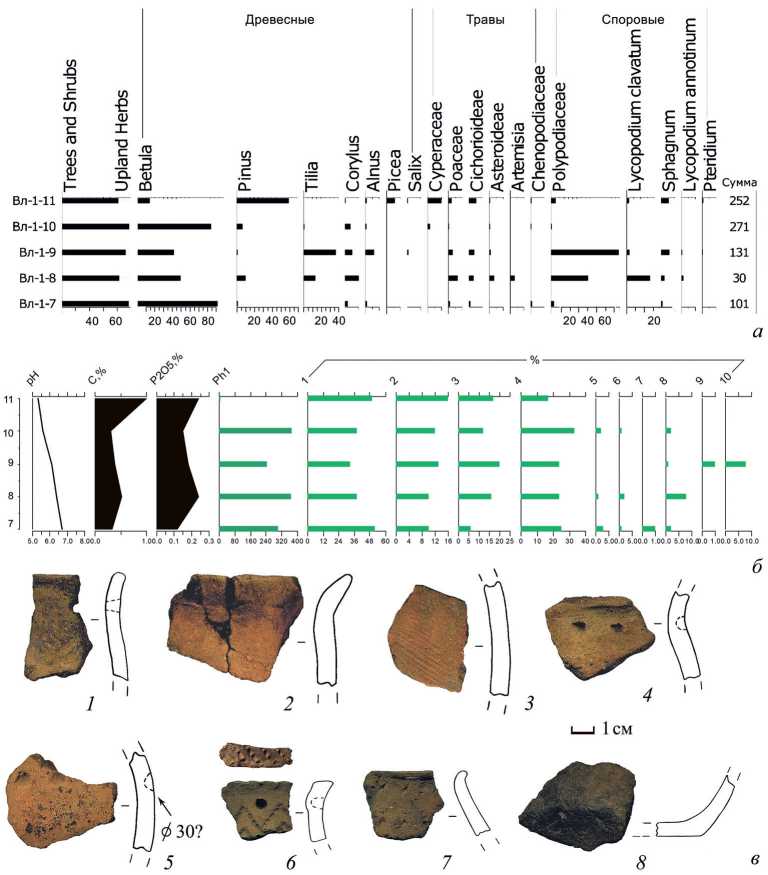
Рис. 3. Результаты микробиоморфного анализа насыпи вала а – гистограмма состава пыльцы в насыпи вала 1; б – химические свойства, общее количество фитолитов и состав фитолитных комплексов (по вертикали даны номера проб. Цифрами показаны следующие биоценотические группы фитолитов: 1 – ELO_ENT (двудольные и некоторые однодольные травы); 2 – BLO_RES, BLO_VEL (иглы хвойных); 3 – ACU_BUL_L (лесные злаки и осоки); 4 – ACU_BUL_S, BIL, ELO_SIN, POL (луговые злаки); 5 – RON_ CON, RON_TRZ (ксерофитная флора); 6 – ELO-DEN (культурные злаки); 7 – ACU_BUL_XL (сорная флора (конопля, крапива)); 8 – BUL_FLA (тростник/камыш); 9 – SPH_PSI (мхи); 10 – недиагностируемые обломки); в – образцы керамики из культурного слоя под валом 1
Вывод по образцу – слой также можно охарактеризовать как культурный слой, преобразованный процессами почвообразования. Состав фитолитных спектров имеет скорее природный, чем антропогенный генезис. Это позволяет считать, что длительность процессов почвообразования в период функционирования данного слоя была больше, чем отмечено для образца 2.
Образец 8 . Середина линзы погребенного культурного слоя. Образец выделяется обилием крупного древесного детрита, много корней, грибных гифов, фитолитов. Фитолитный комплекс, как и в предыдущих образцах, преимущественно луговой. Доля лесной флоры составляет 26 %, что меньше, чем в вышележащем образце 7. Основным отличием этого образца от предыдущего является наличие фитолитов культурных злаков (2 % от общего количества).
Вывод по образцу – большое количество фитолитов, наличие форм, характерных для культурных злаков, обилие древесного детрита – весь этот комплекс позволяет считать образец культурным слоем.
Образец 7 . Низ культурного слоя, контакт с нижележащим горизонтом слоистой структуры. Образец характеризует крупный древесный детрит, кутикулярные слепки трав, обилие грибных гифов – показатели погребенной дернины. Фитолитов много, хотя и несколько меньше по сравнению с вышележащим слоем. В фитолитном комплексе абсолютно преобладают формы, характерные для лугового разнотравья. Доля лесной флоры составляет 16 % – минимальная среди всех рассмотренных образцов. В целом по составу фитолитного комплекса слой похож на предыдущий слой 8 – также есть фитолиты культурных злаков и тростника, что невозможно в автоморфных естественно развитых почвах региона работ.
Вывод по образцу – слой имеет двойную природу, естественную (природную) и антропогенную. Возможно, это дернина, сформированная на поверхности какого-то культурного слоя.
Нами не выявлены какие-либо значительные отличия между разными горизонтами. Во всех образцах доля лесных растений меньше, чем луговых, везде есть фитолиты хвойных пород деревьев. В составе обоих хронологически разных слоев (погребенного слоя и насыпи) есть фитолиты культурных злаков и тростника примерно в одинаковых соотношениях по сравнению с остальными формами. Из сказанного следует, что за период формирования культурного слоя и насыпи вала каких-либо значимых изменений в составе природной среды и окружающих антропогенных ландшафтов существенных изменений не было, хотя культурный слой следует относить к началу, а насыпи – к концу I тыс. до н. э. или даже к первым векам н. э.
Результаты – спорово-пыльцевой анализ (рис. 3: а). Всего из вала было проанализировано 11 образцов, однако только в пяти из них были обнаружены пыльцевые зерна и споры. Пыльцевая диаграмма представлена на рис. 3: а. Образцы формируют 3 основные группы. Первая группа включает образцы 7 (основание культурного слоя под валом) и 10 (граница двух порций насыпи вала под слоем прокаленной глины) с доминированием пыльцы березы (Betula), ее доля достигает 95 % в спектрах. Они очень похожи по составу, хотя по стратиграфии и по предполагаемым датировкам они разнесены максимально. Вторая группа объединяет образцы 8 и 9 с более комплексным составом спектров – это середина и верх культурного слоя под валом, образец 9 – на контакте с насыпью. Среди древесных здесь также доминирует пыльца березы, но ее участие ниже (35–40 %). Высока доля пыльцы липы (Tilia), орешника (Corylus) и ольхи (Alnus). Среди трав доминирует пыльца сорных и луговых видов. Это дикие злаки (Poaceae), цикориевые (Cichorioideae), астровые (Asteroideae) и полынь (Artemisia). Высока доля споровых, таких как папоротники (Polypodiaceae), плауны (Lycopodium) и сфагновые мхи (Sphagnum). Образец 11 отражает современную ситуацию довольно точно и был взят для контроля.
Спорово-пыльцевой анализ свидетельствует, что либо слои, откуда были взяты образцы 7 и 10, формировались в сходных условиях, либо в насыпь попал переотложенный культурный слой раннего поселения. По всей видимости, в этот период городище окружали молодые леса из березы, которые сформировались после сведения коренного леса. Слои 8 и 9 являются культурным слоем, что объясняет увеличение доли пыльцы рудеральных растений, а также растений, используемых в хозяйстве (липа, дикие злаки).
Заключение
Стратиграфия валов однозначно свидетельствует о том, что насыпи возведены одновременно и по одной схеме. Небольшое количество керамики в насыпях не позволяет понять, является ли двухпорционность валов результатом их двукратной подсыпки с перерывом или же они возведены в короткий промежуток времени сразу на заданную высоту с использованием разных грунтов. Линза прокаленного суглинка однозначно свидетельствует о раннем железном веке, поскольку именно тогда в насыпях валов встречается уголь и прокаленная глина.
Анализ фитолитов позволяет утверждать, что между двумя горизонтами насыпи вала – нижним, светло-серым, и верхним, из суглинка с прокалом и углем – имелся перерыв, во время которого началось почвообразование в условиях функционирующего поселения. Этот перерыв можно оценить только приблизительно – порядка 30–40 лет.
Ожидаемо большим был перерыв между формированием культурного слоя и перекрывающей его насыпью – в данном случае данные фитолитного анализа подтверждают стратиграфические наблюдения и анализ состава керамики в слоях.
При этом валы городища отличаются от большинства известных нам: они сравнительно просто устроены, в них нет многочисленных прослоек и почти нет керамики. Как и в большинстве случаев, ни в самих насыпях, ни под ними не найдено никаких следов деревянных конструкций – все прослойки линейны и ничем не нарушены. Вопрос о том, как функционировали эти укрепления, остается открытым3.
Выводы
Это исследование валов городища первоначально ставило своей целью получить динамику изменения окружавших памятник ландшафтов путем изучения серии погребенных почв и временно открытых поверхностей в насыпях. В силу специфики конкретного городища (простое устройство насыпей, короткое время функционирования оборонительных сооружений) этот расчет не оправдался. Вместо этого мы получили крайне интересный материал, существенно дополняющий наши знания о дьяковских поселениях к югу от р. Оки:
-
1. Керамический материал с площадки городища позволяет соотнести памятник с описанной ранее так называемой коломенской группой дьяковских городищ на среднем и позднем этапах их существования. Важным обстоятельством является то, что на памятнике, как и на большинстве «коломенских» городищ, не найдено материалов позднедьяковского времени – оно прекратило существование в первые века н. э.
-
2. Укрепления городища возникают на позднем этапе его существования. Важно, что они функционировали сравнительно короткое время и подновлялись не более одного раза.
-
3. Культурный слой под насыпями валов содержит материал, сближающий памятник не с «коломенскими», а с так называемыми «каширскими» поселениями дьяковской культуры.
