
Formation of customer loyalty in the banking sector based on the implementation of intuitive digital interfaces
Journal: Economics and Business: Theory and Practice @economyandbusiness
Article in issue: 2 (132), 2026.
Free access
The article examines the role of intuitive digital interfaces in the formation of customer loyalty in the banking sector under conditions of increasing competition and the growth of remote service channels. The multidimensional nature of loyalty is analyzed, including repeated service usage and affective-evaluative components related to trust, satisfaction, and willingness to recommend a product. It is emphasized that the quality of navigation, the predictability of user journeys, and the transparency of transaction statuses reduce cognitive load and improve the controllability of interaction. Special attention is paid to the operationalization of loyalty factors through measurable parameters of digital quality: end-to-end performance, standardized error handling, correctness of data and statuses, observability (logs, metrics, tracing), and the maturity of incident and release management.
Similar articles in the section Money. Monetary system. Banking. Stock exchanges

Short address: https://sciup.org/170212605
IDS: 170212605 | DOI: 10.24412/2411-0450-2026-2-145-151
Формирование клиентской лояльности в банковском секторе на основе внедрения интуитивно-понятных цифровых интерфейсов
В статье рассматривается роль интуитивно-понятных цифровых интерфейсов в формировании клиентской лояльности в банковском секторе в условиях усиления конкуренции и роста дистанционных каналов обслуживания. Анализируется многокомпонентная природа лояльности, включающая повторное использование сервиса и эмоционально-оценочные компоненты, связанные с доверием, удовлетворенностью и готовностью рекомендовать продукт. Подчеркивается, что качество навигации, предсказуемость пользовательских сценариев и прозрачность статусов операций снижают когнитивную нагрузку и повышает управляемость взаимодействия. Особое внимание уделяется операционализации факторов лояльности через измеримые параметры цифрового качества: end-to-end производительность, стандартизированная обработка ошибок, корректность данных и статусов, наблюдаемость (логи, метрики, трассировка) и зрелость управления инцидентами и релизами.
Text of the scientific article Formation of customer loyalty in the banking sector based on the implementation of intuitive digital interfaces
In the context of accelerating digitalization of the economy, the banking sector is undergoing substantial transformation characterized by the expansion of remote service channels and the automation of customer processes. Mobile and web applications have become the primary means of interaction between clients and financial institutions, gradually replacing traditional service formats. In this environment, a bank’s competitiveness is determined not only by the diversity of its product portfolio and pricing policy, but also by the quality of digital interaction, ensuring simplicity, speed, and predictability of transactions.
One of the significant factors of sustainable development in the digital banking environment is the formation of customer loyalty. Given the high level of alternative financial service availability, customers are likely to switch if they experience inconvenience or a lack of trust in digital services. An intuitive interface that does not require special training or additional explanation will reduce cognitive load, improve customer confidence in carrying out transactions, and result in a positive customer experience. Thus, interface usability acquires strategic importance as a tool for strengthening trust and stimulating recommendation behavior.
The goal of this study is to analyze how customer loyalty in the banking sector is shaped through the implementation of intuitive digital interfaces and to substantiate the linkage between usability, customer trust, and willingness to recommend banking products. The paper synthesizes theoretical perspectives on loyalty in a digital context and summarizes evidence from recent academic publications and industry reports on user behavior in mobile and web banking applications.
Main part. Foundations of customer loyalty formation in the digital environment
Under the conditions of digital transformation of the banking sector, the processes of building sustainable relationships with customers acquire qualitatively new characteristics associated with changes in the format of interaction between financial institutions and users. At the level of global behavioral patterns, a steady shift toward remote consumption of banking and payment functions is observed (fig. 1).
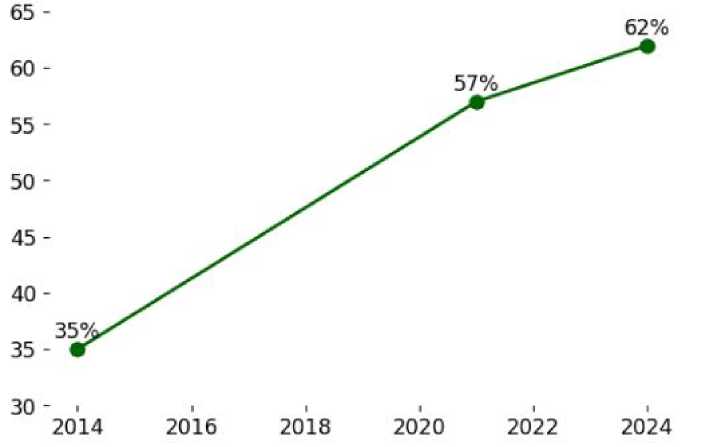
Figure 1. Dynamics of the share of adults making or receiving digital payments in developing economies (Global Findex data) [1]
Additionally, the results of the Accenture Global Banking Consumer Study 2025 (49,300 respondents across 39 countries) indicate pronounced “multibanking” behavior and the growing role of digital ecosystems: nearly three-quarters of customers maintain relationships with at least one competing bank [2]. On average, consumers use two banks and two digital wallets, while digital banks serve as a primary or secondary bank for approximately one-third of customers (and as the main bank for about 10 %).
Thus, the growth of multibanking behavior and the expansion of digital ecosystems indicate a decline in the exclusivity of relationships between customers and individual banks and an increasing importance of factors that shape the sustainability of user preferences in digital channels. Under these conditions, loyalty in the digital environment is multidimensional and includes both a behavioral component, manifested in repeated service usage, and an affective–evaluative component reflecting the level of trust, satisfaction, and willingness to recommend the product. The key groups of factors influencing the formation of these loyalty components in digital banking services are systematized in table 1.
Table 1. Factors influencing customer loyalty formation in digital banking services [3, 4]
|
Factor group |
Manifestation in the digital environment |
Potential impact on loyalty |
|
User interface quality |
Intuitive navigation, visual hierarchy, and consistent layout. |
Satisfaction and reduced frustration. |
|
System performance and stability |
Fast transaction processing, low latency, and high availability. |
Perceived reliability and trust. |
|
Transparency of operations |
Clear notifications, accurate display of balances and transactions. |
Trust strengthened. |
|
Predictability of user flows |
Consistent interaction logic, standardized confirmation mechanisms. |
Reduced cognitive load. |
|
Personalization |
Tailored recommendations, adaptive interface elements. |
Higher engagement and attachment. |
|
Accessibility for different levels of digital literacy |
Simple workflows, contextual tips, onboarding guidance. |
Broader adoption and retention. |
|
Economic incentives |
Cashback, bonuses, preferential tariffs. |
Support of behavioral loyalty. |
This systematization is supported by empirical evidence from surveys of users of digital banking services. In a study based on responses from 128 digital bank customers, it was found that a posi- tive digital service experience and brand perception have a statistically significant effect on customer loyalty, whereas trust in isolation, without a high-quality user experience, does not demon- strate a significant impact, highlighting the importance of functional and image-related components of interaction with digital products [5].
Another study demonstrates that factors such as ease of use, reliability, transaction speed, and risk reduction exert a strong influence on customer satisfaction and subsequent intentions to continue using the service, which supports the conclusion regarding the role of digital experience quality in loyalty formation [6].
Thus, the theoretical foundations of customer loyalty formation in the digital environment are based on the interrelationship between user experience quality, the level of trust, and repeated selection of a financial service. An intuitive digital interface serves not only as a technical element of the system but also as a strategic instrument for strengthening long-term customer relationships, ensuring bank sustainability under conditions of digital competition.
An intuitive digital interface as a factor in trust formation in the banking sector
An intuitive interface in digital banking channels should be considered a functional and communicative mechanism through which customer trust in the service and in the organization as a whole is formed and maintained [7]. In the digital environment, trust is largely mediated by user experience, since direct interaction with bank employees is absent for most operations. Customers evaluate service reliability through observable attributes, including the logical structure of user flows, predictability of outcomes, clarity of terminology, accuracy of financial information display, and overall application stability. Accordingly, the interface functions not only as a means of accessing products, but also as a “showcase” of the controllability and transparency of banking processes.
A critical condition for strengthening trust is the reduction of uncertainty during financial transactions. An intuitive interface minimizes ambiguity in the interpretation of controls and messages, providing users with a clear understanding of each stage of the process, from data entry to confirmation and receipt of results. Consistency of interface solutions – uniform design principles, repeatable patterns, clear visual hierarchy, and predictable navigation – reduces cognitive load and fosters a sense of control, which is directly associated with perceived security and reliability of the financial service.
Trust is further strengthened through transparency in risk- and security-related procedures. In online banking, customers are often exposed to confirmation messages, biometric authentication, one-time passwords, restrictions, and warnings. If these features are implemented in a way that is not clearly explained, they may be viewed as barriers and may cause frustration or confusion. An intuitive interface can make security features significant by providing reasons for the need for extra verification, consequences of certain actions, and options in case of errors. Such transparency will further enhance the customer’s belief that the bank is handling risks and working in the customer’s favor.
Proper handling of errors and exceptional situations is especially important, as trust is most vulnerable during system failures. Error messages should be diagnostic and action-oriented, specifying what happened, what can be done, and how to contact support. Similarly, complex financial transactions (such as transfers by details, loan requests, limit management) should be organized in a step-by-step fashion with intermediate validations and clear acknowledgement of final inputs. Well-defined control points minimize the chances of errors, reduce anxiety, and help users trust the correctness of the results.
Interface intuitiveness is closely linked to perceived fairness and ethical interaction. The users demand that the system should not force actions, conceal conditions, or make the rejection of services confusing through deceptive design options. The clear display of charges, rates, terms, fees, and operation statuses (pending, completed, declined) helps to create a perception of honesty and predictability. On the contrary, the unclear display of costs or confusing language can pose a threat of trust loss even with correct product performance.
Finally, an intuitive interface has a pronounced inclusive effect , reducing barriers for users with different levels of digital literacy and diverse behavioral patterns. Accessible controls, readability, optimal information density, crossdevice support, and the use of simple language increase the set of users for whom the service becomes self-explanatory and does not require special training. This is especially important for mass-market banking services, where trust is less about the uniqueness of functionality and more about stability and simplicity of use.
Therefore, an intuitive interface should be understood as a systemic tool for trust enhancement through uncertainty reduction, cognitive load reduction, and increased perceived control of users over their financial behavior.
Engineering support for loyalty: digital service resilience, monitoring, and incident management
In digital banking, loyalty is shaped not only by interface usability but also by operationally demonstrated service reliability: users evaluate a bank by the stability of core transactions and the predictability of system behavior under load and during changes. This dimension is increasingly captured by industry customer-experience metrics and therefore requires moving from purely user-centric explanations to engineering-measurable parameters of digital channel quality. From an operations perspective, a key requirement is the controllability of end-to-end performance at the customer device level (table 2).
Table 2. End-to-end performance controllability in digital channels and user behavioral effects
|
Performance dimension |
Control metric (examples) |
User-visible manifestation |
Behavioral effect |
|
Service responsiveness |
Response time / latency (p50/p95/p99). |
Slow confirmations, delayed screen updates. |
Repeated attempts, session abandonment. |
|
Load time |
Full load time, Time to Interactive. |
“App feels slow”, prolonged loading states |
Lower satisfaction, reduced repeat usage. |
|
UI stability |
Crash-free sessions, UI error rate, freeze incidence. |
Freezes, glitches, unexpected UI behavior. |
Increased support contacts, reduced trust. |
|
Availability |
Uptime, error rate (HTTP 5xx/4xx), failed transaction rate. |
“Service unavailable”, failed pay-ment/transfer. |
Elevated churn risk, negative ratings. |
|
Regional consistency |
Latency variance by region, edge/CDN performance. |
Slower experience in specific locations. |
Localized complaint spikes, uneven adoption. |
|
Error handling quality |
Share of actionable errors, retry success rate, status correctness. |
Clear vs unclear errors, recoverability. |
Fewer repeat attempts, lower anxiety. |
|
Observability coverage |
Logging completeness, tracing coverage, metric quality. |
Faster triage and root-cause identification. |
Shorter incident impact window. |
Achieving this level of controllability depends strongly on the development team, because optimising client-side flows and server-side APIs, standardising error handling, and implementing observability (metrics, tracing, and consistent log semantics) provide the technical basis for rapid detection and mitigation of performance degradation and functional anomalies [8]. In parallel, customer trust is materially affected by the quality of production changes and data correctness: a substantial share of user-facing issues is driven not by outright unavailability but by inconsistencies in transaction statuses, delays in data refresh, or incorrect display of financial parameters. Controlled release practices, data integrity checks, and coordinated integration changes reduce the likelihood of such discrepancies and help maintain a predictable customer experience.
The empirical importance of these engineering mechanisms is supported by industry benchmarks demonstrating that, even when nominal availability is high, major gaps persist in speed and stability of the digital experience. The 2025 Banking Website Performance Benchmark Report (Catch- point; 49 global banks) shows that only a minority of banks meet user expectations for sub-3-second full page load [9]. At the same time, composite digital-experience scores vary by more than an order of magnitude, and documentcomplete times span from under two seconds to above ten seconds. The report also highlights that high uptime alone does not guarantee a strong experience: many banks sustain very high availability levels yet underperform due to slow loading or unstable interface behavior. These findings support the need to monitor not only service “liveness,” but also the quality metrics associated with execution of critical user journeys.
The linkage between incident management and customer retention is most clearly expressed through the speed and quality of problem resolution, because exceptional situations exert the strongest influence on perceived trustworthiness of the digital channel. Evidence from the J.D. Power 2025 U.S. Retail Banking Satisfaction Study indicates that, for customers who encounter issues and contact their bank, the timeliness and “single-contact” resolution pattern – as well as the fact of successful closure – are decisive determinants of satisfaction. The study further notes that successful problem resolution is statistically associated with a substantial uplift in overall customer satisfaction, underscoring the critical role of incident response and service recovery processes for retention and loyalty (fig. 2)
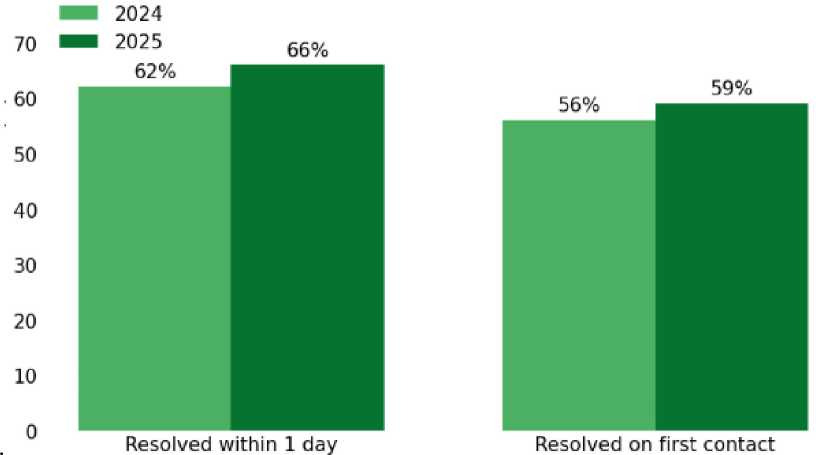
Figure 2. Problem resolution performance in U.S. retail banking: share of customers reporting resolution within one day and on the first contact [10]
J.D. Power also reports that the successful resolution of a problem corresponds to a large increase in overall satisfaction (an estimated +246 points on the 1,000-point scale) for customers whose issues were resolved.
Thus, engineering support for loyalty in digital banking can be interpreted as a coordinated system of end-to-end performance controllability at the customer device level, disciplined change and data management that prevents user-visible inconsistencies, and mature incident management and service recovery practices that minimise customer impact. Together, these mechanisms reinforce predictability, transparency, and perceived reliability – core conditions under which an intuitive interface translates into sustained usage, higher satisfaction, and long-term customer loyalty.
Operational model for loyalty-oriented engineering in digital banking
The practical implementation of engineering mechanisms that affect loyalty requires an organizational linkage between development, production support, and product business owners. The most sustainable outcomes are achieved when accountability is assigned not by isolated “systems,” but by end-to-end customer journeys, and when communication and operating procedures are oriented toward rapid restoration of controllability – from evidence-based diagnosis using logs and data to delivering fixes and verifying their impact in the production environment [11]. Within this logic, a key task is to formalize an operating model – roles, control points, and collaboration artifacts – that ensures repeatable resolution practices and reduces the share of recurring incidents (table 3).
Thus, engineering factors that influence loyalty become manageable not only through a set of metrics, but also through a robust operating model that assigns accountability by customer journeys, standardizes diagnostic and release procedures, and enforces data quality and observability controls. This organizational–technical linkage reduces the likelihood of prolonged incidents and recurring issues, accelerates recovery to normal operation, and creates conditions under which digital experience quality is sustained systematically rather than reactively.
Table 3. Operational model for ensuring digital experience quality across end-to-end customer jour- neys
|
Control domain |
Roles and responsibilities |
Core artifacts and procedures |
Effectiveness indicator (example) |
|
End-to-end journey governance |
Product owner + tech lead: prioritization of critical customer journeys. |
Journey map (auth / transfer / payment / status), journey-level SLA list. |
Lower share of incomplete transactions; stable journey metrics. |
|
Incident diagnostics and triage |
L2/L3 support: initial diagnosis, reproduction, escalation. |
Runbooks, incident templates, diagnostic checklists (logs/traces/DB). |
Shorter time to root-cause localization; fewer repeat contacts. |
|
Data quality and consistency management |
Support + data/DB owner: integrity and consistency of displayed parameters. |
Verification routines, status discrepancy controls, data correction procedures. |
Fewer status/balance inconsistencies; fewer complaints. |
|
Release and patch governance |
Release/Dev team: preparation and safe rollout of changes. |
Production readiness assessment, rollback plan, post-release verification. |
Lower regression rate; fewer post-release major incidents. |
|
Observability management |
Dev + Ops: metric coverage and diagnosability. |
Logging semantics, key metrics, tracing of critical chains. |
Faster root-cause analysis; improved detection of degradations. |
|
Business-impact communication |
Incident manager: coordination between teams and business. |
War room, status updates, responsibility matrix. |
Reduced downtime / impact duration; fewer escalations. |
Conclusion. An intuitive digital interface in banking services should be regarded as a strategic determinant of loyalty because it reduces cognitive load, increases journey predictability, and strengthens trust through clear navigation, transparent transaction statuses, and understandable security procedures. Sustained retention, however, depends on engineering reliability: stable end-to-end performance, correct presentation of financial data, consistent status semantics across the UI, backend logic, and data layers, standardized error handling, and mature observa- bility that supports rapid detection and remediation of degradations. Accordingly, loyalty-oriented practice implies designing critical journeys as short, controllable sequences with explicit confirmation and recovery points, and ensuring coherent customer communications (statuses, notifications, and security explanations). It also requires embedding experience-quality metrics into release governance and incident management, as well as formalizing collaboration between development and production support to reduce recurrence and minimize customer impact.
