
Human Remains from a Neolithic Burial at Krokhalevka-5 on the Upper Ob: Physical Type and Origin
Journal: Archaeology, Ethnology & Anthropology of Eurasia @journal-aeae-en
Section: Paleoenvironment, the stone age
Article in issue: 4 т.52, 2024.
Free access
We describe the skeletal remains of a male, aged 25–30, from the Neolithic burial 33 at Krokhalevka-5 in the Upper Ob basin, 21 km northwest of Novosibirsk, dating to the mid-5th millennium BC. Craniometric, dental metric, and nonmetric traits are analyzed. Cranial measurements are evaluated in the context of their variation in 58 individuals representing 11 local populations of the Paleolithic and Neolithic of Northern Eurasia. Data were processed using the principal component analysis in the STATISTICA 10 software. The first PC differentiates crania in terms of general size. The structure of loadings on PC2 indicates the presence of western and eastern trait combinations. The position of individuals on PC1 and PC2 reveals heterogeneity apparently caused by the conservatism of the underlying substratal populations. The Krokhalevka-5 individual is closest to those from Firsovo XI (Barnaul stretch of the Ob) and Zarechnoye-1 (Salair region). They are rather similar to the Volosovo individual from Sakhtysh-2A in Central Russia and a Kitoy individual from Fofanovo in the Trans-Baikal area. These findings point to a complex origin of the Upper Ob population on the basis of one of the evolutionarily conservative Mesolithic or Neolithic substratal components, possibly admixed with more consolidated eastern and western ones introduced by migration. Neolithic crania from Baraba contrast with those from the Upper Ob, suggesting that different substrates were involved in the population history of those regions.
Similar articles in the section Physical anthropology
Short address: https://sciup.org/145147485
IDS: 145147485 | DOI: 10.17746/1563-0110.2024.52.4.085-097
Text of the scientific article Human Remains from a Neolithic Burial at Krokhalevka-5 on the Upper Ob: Physical Type and Origin
The quantity of qualitative archaeological and, primarily, anthropological sources pertaining to the Mesolithic-Neolithic period is relatively small. Furthermore, the distribution of these sources across Northern Eurasia is uneven. On the one hand, their regional specificity reflects the processes of accumulation of people within the most favorable landscape areas in the post-glacial period. On the other hand, the discovery of new Mesolithic-Neolithic materials has consistently demonstrated their uniqueness and peculiarity, which have precluded their classification as complexes of recent periods. Moreover, the study of the anthropological population dynamics is complicated by the paucity of radiocarbon dates for Mesolithic and
Neolithic burials, which is still a relatively minor area of investigation. As demonstrated by recent practice of the Neolithic dating, burials initially perceived as contemporaneous have yielded materials from different epochs (Kiryushin et al., 2021: 26). Indeed, in some instances, burials belonging to the Mesolithic and Bronze Ages have been unearthed within the boundaries of known Neolithic settlements. In light of this, a comparative analysis of the paleoanthropological sources should be undertaken at an individual rather than intergroup level, with due consideration given to the radiocarbon dating.
The study and generalization of cranial material of the Neolithic and Bronze Age from the southern territories of Western Siberia and the Altai-Sayan highlands have provided for the identification of two main anthropological superstrata for the central regions of Northern Eurasia—the Northern and Southern Eurasian formations (Chikisheva, 2012: 180). The former geographically occupies the north of the Russian Plain and the whole West Siberian Plain, and the latter occupies the mountain-steppe territories of the southern regions of North Asia. These large anthropological groups have differences, but racially they are characterized by a protomorphic complex of traits. So, the study of the genesis of these superstrata and the reconstruction of the dynamics of the population mechanisms of their formation seem important. The territory of the Upper Ob basin is a contact zone for members of both formations, which entails a certain mosaic pattern in many anthropological and archaeological features. Nevertheless, each new well-attributed and dated complex from this region is of great importance for understanding both the time and circumstances of the formation of genetic structure of the population, and the development of specific aspects of material and spiritual culture.
Archaeological context
The individual under study was interred in burial No. 33 of the Krokhalevka-5 cemetery, located 21 km to the northwest of Novosibirsk (Kochenevsky District, Novosibirsk Region). This site is located on the first terrace above the flood plain on the right bank of the Chik-Chaus river-lake system (the territory of the Kudryashov pine wood), which is an ancient arm of the Ob River on its left bank. The burial is individual, disturbed, made in a deep pit (1.5 m from the ancient surface level). The man was buried in an extended supine position, with his head to the north
(downstream of the Ob and the nearest channel). Only the bones of the feet and (probably) the skull were found in situ . Most of the bones of the postcranial skeleton were compact, unarticulated, and haphazardly laid in the lower horizons of the northern part of the pit. The completeness analysis showed that almost all the bones, with the exception of both femurs, were present in the burial. The grave presumably contained part of a wooden boat in which a human body was placed, judging by the morphology of the lower part of the pit near the head and by the presence of wood decay on the floor in the northern half of the chamber. A unique fact, recorded mainly on the basis of late ethnographic evidence of the funerary practices of the ancient West Siberian peoples, is the use of a boat as a symbolic means of transport for the transition to the other world in Neolithic funerary rites. In the Middle Neolithic (contemporaneous to the Krokhalevka burial), similar mythological representations connected with the boat are found in the materials from the Lower Ob basin, in the form of specific miniature boat-shaped clay vessels (Oshibkina et al., 1996: 262).
The grave goods comprise only lithic artifacts (adze, arrowheads, biface). The items with these morphological and metric characteristics are typical of the Upper Ob culture of the Middle Neolithic (Molodin, 1977: 10–25). The radiocarbon date (6122 ± 42 BP, UBA-39724) obtained from human bones places the calibrated age of the complex within the last quarter of the 4th millennium BC. However, the freshwater reservoir effect on the anthropological material can be assumed with great probability; thus the burial most likely belongs to the middle of the 5th millennium BC*.
Material and methods
The materials for the palaeoanthropological study are the remains of a man who died at the age of 25–30 years. Cranial, nonmetric, and postcranial measurements were performed. The craniometric data of the deceased were evaluated in the context of the individual variability of these traits in the Mesolithic and Neolithic people of Northern Eurasia**. To include the maximum possible composition of the sample considered as a general population, we excluded from the trait’s set the nasal bridge characteristics at the level of dacryon, the simotic chord, and the forehead profile angle, because these are unknown for the majority of individuals. The study was carried out using the principal component analysis (PCA) in STATISTICA v.10.
We distributed a large amount of comparative data from Siberia, the East European Plain, and Central Asia into regions on the basis of previous anthropological studies, which state that in the Neolithic the main space of population relations for Western Siberia is located within their boundaries (Chikisheva, 2012: 59–60; Chikisheva, Pozdnyakov, 2021). The allocation of regions according to geographical distribution is rather conditional, since we rely on the data about modern landscape and climatic conditions and understand that in the Neolithic the boundaries of natural zones could have been shifted. However, the pattern of spatial distribution of paleoanthropological material is as important as the cultural and chronological ones, for understanding the peculiarities of the interrelations and interactions of populations. Thus, the statistical analysis includes the characteristics of 58 individuals, which we assigned to 11 local groups (Table 1): Upper Ob (comprises burials from the Upper Ob basin), Altai-Sayan (Altai Mountains, Krasnoyarsk-Kansk forest-steppe, and Kuznetsk Basin), West Siberian forest-steppe (Baraba forest-steppe, Middle and Pavlodar stretches of the Irtysh), Ural (Cis-Urals and Trans-Urals), Volga-Ural (Volga-Ural interfluve), East European (comprises burials in the central part of the East European Plain with pit-comb ware and the Volosovo culture), Mesolithic from the northwestern part of the East European Plain, Trans-Baikal, CisBaikal, Yakut, and Central Asian.
Morphological features of paleoanthropological material
The male remains have been well preserved, thus enabling the full range of characteristics to be ascertained, as is necessary to assess the anthropological status and determine the male’s place in the general population of individuals of the Meso-Neolithic in Northern Eurasia (Tables 2, 3).
Morphology of the skull. The cranium is generally characterized by small (sometimes bordering on average) values of length, breadth, and height, and mesomorphic proportions. With the smooth contours of the vault in the vertical and lateral norm (sphenoid and ellipsoid, respectively), the occipital contour is intermediate between roof-like and vault-like. The mastoid processes are well-developed and face forward. The nuchal lines are moderately pronounced. The occipital protuberance is poorly defined. The intercilium is moderately robust, the brow-ridge is high but not long and does not extend beyond the middle of the orbit. The cranial base and vault components show average parameters. The frontal bone is the largest segment of the sagittal arch. The frontal bone is narrow, of short length, weakly convex and inclined, which, combined with the high intercilium and weakly expressed tubercles, gives the impression of a sloping forehead. The smallest component of the sagittal arch is the parietal, which is much smaller than the occipital, with an occipitoparietal index (OPI) greater than 100. The curvature of the occipital bone is marked, but the back of the head does not seem to be protruding.
The facial cranium demonstrates average values of the main diameters, a strong horizontal flattening in a homoplatyprosoptic form, an alveolar prognathism of the vertical profile, with a general mesognathism. Orbits are wide and moderately high, mesoconchal. The nasal aperture is narrow, moderately high, leptorrhine, with a sharp lower edge and a pronounced anterior nasal spine. The nose bridge is narrow and high, the nasal dorsum has a very small simotic height and breadth, but an average value of their ratio, the nose is moderately prominent. The alveolar arch is of great length and average width; the palate is small, its ratio given by its leptostaphyline (palatal) index. The canine fossa is moderately deep. The mandible is characterized by large overall dimensions (length from angles and from condyles; condylar, angular, and anterior width) and a slightly inclined ramus. As for the body, the large height at the level of the symphysis and the mental foramen goes hand in hand with the small thickness, giving the impression of overall slenderness of the mandibular bone.
The craniological traits observed in the Krokhalevka individual, when considered in the context of the morphological complexes of Northern Eurasia, exhibit a certain correlation with the dominant features of ancient and modern groups in the East Siberian population. These features include homoplatyprosopy of facial part; moderate nasal protrusion; size, shape, and slope of the frontal bone; and relative elongation of the occipital component of the sagittal arch. Conversely, some features are more
Table 1. Individual craniological materials involved in the comparative analysis
|
No. |
Geographic region |
Locality |
Dating |
Data source |
|
1 |
2 |
3 |
4 |
5 |
|
1 |
Upper Ob region |
Krokhalevka-5, burial 33 |
Mid 5th millennium BC |
Authors’ data |
|
2 |
ʺ |
Ordynskoye-1, burial 1 |
Neolithic |
(Alekseev, 1961) |
|
3 |
ʺ |
Inya-4 |
ʺ |
(Shpakova, Mylnikova, 1998) |
|
4 |
ʺ |
Firsovo XI, burial 9 |
ʺ |
(Solodovnikov, Tur, 2017) |
|
5 |
ʺ |
Firsovo XI, burial 14, vault 1 |
ʺ |
(Ibid.) |
|
6 |
Altai-Sayan region |
Ust-Isha, burial 4 |
4th millennium BC |
(Dremov, 1986) |
|
7 |
ʺ |
Ust-Isha, burial 8 |
4th millennium BC |
(Ibid.) |
|
8 |
ʺ |
Solontsy, burial 4 |
Mid 4th millennium BC |
(Kungurova, Chikisheva, 2002) |
|
9 |
ʺ |
Solontsy, burial 3 |
Mid 4th millennium BC |
(Ibid.) |
|
10 |
ʺ |
Bazaikha, burial 1 |
3rd millennium BC |
(Alekseev, 1961) |
|
11 |
ʺ |
Bazaikha, burial 2 |
3rd millennium BC |
(Ibid.) |
|
12 |
ʺ |
Dolgoye Ozero, No. 4 |
Neolithic |
(Gerasimova, 1964) |
|
13 |
ʺ |
Perevoznoye, burial 1 |
3rd millennium BC |
(Alekseev, 1961) |
|
14 |
ʺ |
Vaskovo-4, burial 3 |
Neolithic |
(Chikisheva, 2012) |
|
15 |
ʺ |
Zarechnoye-1, kurgan 4, burial 6 |
ʺ |
(Dremov, 1997) |
|
16 |
West Siberian foreststeppe |
Protoka, burial 4B |
5th millennium BC |
(Polosmak, Chikisheva, Balueva, 1989) |
|
17 |
ʺ |
Sopka-2, burial 61F |
6th millennium BC |
(Chikisheva, 2012) |
|
18 |
ʺ |
Vengerovo-2A, complex 2, burial 1, vault 17 |
Late 6th millennium BC |
(Chikisheva, Pozdnyakov, Zubova, 2015) |
|
19 |
ʺ |
Same, burial 2, ditch |
Late 6th millennium BC |
(Ibid.) |
|
20 |
ʺ |
Omskaya site, burial 3 |
Neolithic |
(Bagashev, 2003) |
|
21 |
ʺ |
Shiderty-3 |
Second half of 4th millennium BC |
(Yablonsky, 2002) |
|
22 |
Trans-Baikal |
Pad Tokuy |
Mid 6th millennium BC |
(Vasiliev et al, 2018). |
|
23 |
ʺ |
Fofanovo, burial 6 |
Mid 6th millennium BC |
(Gerasimova, 1992) |
|
24 |
ʺ |
Fofanovo, burial 15 |
Late 4th – late 3rd millennium BC |
(Ibid.) |
|
25 |
ʺ |
Fofanovo, burial 41 |
Late 4th – late 3rd millennium BC |
ʺ |
|
26 |
ʺ |
Fofanovo, burial 2 |
Late 4th – late 3rd millennium BC |
ʺ |
|
27 |
ʺ |
Fofanovo, burial 18 |
Late 4th – late 3rd millennium BC |
ʺ |
|
28 |
ʺ |
Fofanovo, burial 5 |
Late 4th – late 3rd millennium BC |
ʺ |
|
29 |
ʺ |
Shilka |
Neolithic |
(Levin, 1953) |
|
30 |
Ural region |
Shigir peat bog, No.1-841 |
Early Neolithic |
(Bagashev, 2003) |
|
31 |
ʺ |
Same, No.162 |
ʺ |
(Debets, 1953) |
|
32 |
ʺ |
Buranovskaya Cave |
ʺ |
(Ibid.) |
|
33 |
ʺ |
Davlekanovo |
Neolithic–Chalcolithic |
(Shevchenko, 1986) |
|
34 |
Volga-Ural interfluve |
Lebyazhinka-4 |
7th millennium BC |
(Khokhlov, 2017) |
|
35 |
ʺ |
Mellyatamak III, burial 1 |
Mesolithic–Neolithic |
(Yablonsky, 1992) |
|
36 |
ʺ |
Mellyatamak III, burial 6 |
ʺ |
(Ibid.) |
|
37 |
ʺ |
Mellyatamak III, burial 11 |
ʺ |
ʺ |
Table 1 (end)
|
1 |
2 |
3 |
4 |
5 |
|
38 |
Central part of the East European Plain |
Berendeevo swamp |
First half of the 3rd millennium BC |
(Mamonova, 1969) |
|
39 |
ʺ |
Lovetskoye Ozero |
4th–3rd millennium BC |
(Neolit…, 1997) |
|
40 |
ʺ |
Sakhtysh-2, burial 19 |
4th–3rd millennium BC |
(Ibid.) |
|
41 |
ʺ |
Sakhtysh-2A, burial 22 |
4th–3rd millennium BC |
ʺ |
|
42 |
ʺ |
Sakhtysh-2A, burial 42 |
4th–3rd millennium BC |
ʺ |
|
43 |
ʺ |
Volodary, burial 1 |
Neolithic |
(Akimova, 1953) |
|
44 |
ʺ |
Sakhtysh-2, burial 12, vault А |
3rd millennium BC |
(Neolit…, 1997) |
|
45 |
ʺ |
Sakhtysh-2A, burial 9 |
3rd millennium BC |
(Ibid.) |
|
46 |
ʺ |
Sakhtysh-2A, burial 15 |
3rd millennium BC |
ʺ |
|
47 |
ʺ |
Sakhtysh-2A, burial 35 |
3rd millennium BC |
ʺ |
|
48 |
Northwestern part of the East European Plain |
Yuzhny Oleniy Ostrov, No. 5773-13 |
Mesolithic |
(Yakimov, 1960; Alekseev, Gokhman, 1984) |
|
49 |
ʺ |
Same, No. 5773-74 |
ʺ |
(Yakimov, 1960; Alekseev, Gokhman, 1984) |
|
50 |
ʺ |
Peschanitsa |
ʺ |
(Gerasimova, Pezhemsky, 2005) |
|
51 |
Cis-Baikal |
Verkholenskiy cemetery, burial 10 |
Neolithic |
(Levin, 1956) |
|
52 |
ʺ |
Same, burial 16/2 |
ʺ |
(Ibid.) |
|
53 |
ʺ |
Same, burial 22D |
ʺ |
ʺ |
|
54 |
ʺ |
Same, burial 24A |
ʺ |
ʺ |
|
55 |
ʺ |
Same, burial 29 |
ʺ |
ʺ |
|
56 |
Yakutia |
Tuoy-Khaya |
3rd millennium BC |
(Debets, 1956) |
|
57 |
Southeastern Aral Sea region |
Tumek-Kichidzhik, burial 29 |
4th–3rd millennium BC |
(Vinogradov, Itina, Yablonsky, 1986) |
Table 2. Craniometric traits of a man from Krokhalevka-5, burial 33
|
Trait * |
Value |
Trait |
Value |
|
1. Cranial length |
178.00 |
Frontal subtense (FS) |
14.80 |
|
8. Cranial breadth |
139.00 |
77. Nasomalar angle |
145.80 |
|
8 : 1. Cranial index |
78.09 |
Zygomaxillary breadth (ZB) |
101.30 |
|
17. Cranial height |
132.00 |
Subtense from subspinale to the |
|
|
5. Cranial base length |
102.00 |
zygomaxillary breadth (SS) |
17.20 |
|
9. Minimal frontal breadth |
88.00 |
Zm. Zygomaxillary angle |
142.60 |
|
Sub. 9. Transverse frontal curvature subtense |
14.40 |
DS. Dacrial subtense |
12.00 |
|
10. Maximal frontal breadth |
112.00 |
DC. Dacrial chord |
20.60 |
|
29. Frontal chord |
109.00 |
SS. Simotic subtense |
1.90 |
|
26. Frontal arch |
122.00 |
SC. Simotic chord |
5.40 |
|
27. Parietal arch |
116.00 |
FC. Canine fossa depth |
3.20 |
|
30. Parietal chord |
106.00 |
32. Frontal profile angle from nasion |
77.00 |
|
12. Occipital breadth |
108.00 |
GM\FH. Frontal profile angle from glabella |
69.00 |
|
28. Occipital arch |
120.00 |
72. General facial angle |
81.00 |
|
Sub. NB. Frontal curvature subtense |
20.00 |
73. Mid-facial angle |
85.00 |
|
31. Occipital chord |
97.00 |
74. Alveolar angle |
67.00 |
|
Sub. 31. Occipital curvature height (OCH) |
27.00 |
75. Nasal bones inclination index |
59.00 |
|
25. Sagittal arch |
358.00 |
75 (1). Nasal protrusion angle |
22.00 |
|
26 : 25. Fronto-sagittal index |
34.10 |
Cranial shape (superior view) |
Sphenoid |
|
27 : 25. Parieto-sagittal index |
32.40 |
Cranial shape in the lateral norm |
Ellipse |
|
28 : 25. Occipito-sagittal index |
33.50 |
Cranial shape in occipital norm |
Roof-vaulted |
|
Occipital-parietal index |
103.40 |
Intercilium |
4 |
|
40. Facial base length |
106.00 |
Browridges |
2 |
|
45. Bizygomatic breadth |
134.00 |
External occipital tuber |
1 |
|
48. Upper facial height |
70.00 |
Mastoid process |
3 |
|
43. Upper facial breadth |
103.50 |
Inferior margin of the piriform aperture (IMPA) |
Anthr. |
|
46. Midfacial breadth |
101.00 |
Anterior nasal spine |
4 |
|
60. Alveolar length |
57.00 |
Mandible |
|
|
61. Alveolar breadth |
62.00 |
68 (1). Mandibular length from condyles |
105.00 |
|
62. Palate length |
47.40 |
79. Mandibular ramus angle |
113.00 |
|
63. Palate breadth |
37.30 |
68. Mandibular length from angles |
81.00 |
|
63 : 62. Palatal index |
78.69 |
70. Ramus height |
61.00 |
|
51. Orbital breadth from mf. |
43.20 |
71а. Minimum ramus breadth |
39.00 |
|
51а. Orbital breadth from d. |
39.30 |
65. Condylar width |
113.00 |
|
52. Orbital height |
33.50 |
66. Angular width |
98.00 |
|
52 : 51. Orbital index |
77.55 |
67. Anterior width |
49.00 |
|
54. Nasal breadth |
22.90 |
69. Symphyseal height |
34.00 |
|
55. Nasal height |
51.40 |
69 (1). Corpus height |
31.00 |
|
54 : 55. Nasal index |
44.55 |
69 (3). Corpus breadth |
11.00 |
|
43 (1). Frontal chord (FC) |
95.90 |
Mental protrusion angle |
79.00 |
*The table includes only those traits that the preservation of the skull allowed us to measure.
Table 3. Postcranial anthropometric parameters of a man from Krokhalevka-5, burial 33
|
Trait * |
Right |
Left |
Trait |
Right |
Left |
|
Humerus |
Pelvis |
||||
|
1. Maximum length |
319 |
319 |
1. Height (total pelvic height) |
213 |
210 |
|
2. Total length |
325 |
325 |
9. Ilium height |
139 |
137 |
|
3. Upper epiphysis breadth |
49 |
49 |
10. Alar height |
103 |
100 |
|
4. Lower epiphysis breadth |
61 |
62 |
15. Ischium height |
77 |
76 |
|
5. Maximum midshaft diameter |
21 |
21 |
17. Pubic length |
76 |
77 |
|
6. Minimum midshaft diameter |
16 |
17 |
12. Ilium width |
147 |
147 |
|
7. Minimum shaft circumference |
55 |
57 |
8. Ischial spines width |
88 |
|
|
7а. Circumference of midshaft (MSC) |
58 |
60 |
23. Sagittal diameter |
112 |
|
|
6 : 5. Cross sectional index |
76.2 |
81.0 |
24. Transverse diameter |
118 |
|
|
7 : 1. Robusticity index |
17.2 |
17.9 |
2. Width (pelvic width) |
242 |
|
|
Radius |
7. Joint width |
116 |
|||
|
1. Maximum length |
258 |
258 |
1 : 2. TPH/PW |
88.0 |
86.8 |
|
2. Physiological length |
246 |
246 |
23 : 24. Lesser pelvic inlet index |
94.9 |
|
|
4. Transverse diameter |
14 |
14 |
Tibia |
||
|
5. Sagittal diameter |
9 |
9 |
1. Total length |
365 |
367 |
|
3. Minimum shaft circumference |
34 |
33 |
2. Condylo-talar length – 355 |
346 |
350 |
|
5 : 4. Cross sectional index |
64.3 |
64.3 |
1а. Maximum length |
369 |
370 |
|
3 : 2. Thickness index |
13.8 |
13.8 |
5. Upper epiphysis width |
75 |
76 |
|
Ulna |
6. Lower epiphysis breadth |
49 |
48 |
||
|
1. Maximum length |
277 |
8. Sagittal diameter at midshaft |
29 |
28 |
|
|
2. Physiological length |
248 |
8а. Sagittal diameter at nutrient |
33 |
33 |
|
|
foramen |
|||||
|
11. Sagittal diameter |
14 |
||||
|
12. Transverse diameter |
14 |
9. Transverse diameter at midshaft |
16 |
17 |
|
|
13. Upper transverse diameter |
18 |
9а. Transverse diameter at nutrient |
|||
|
foramen |
19 |
17 |
|||
|
14. Upper sagittal diameter |
22 |
||||
|
3. Minimum shaft circumference |
33 |
10. Midshaft circumference |
73 |
73 |
|
|
3 : 2. Robusticity index |
13.3 |
10b. Smallest circumference |
65 |
65 |
|
|
11 : 12. Cross sectional index |
100 |
9а: 8а. Cross sectional index |
57.6 |
51.5 |
|
|
13 : 14. Platoleny index |
81.8 |
10b : 1. Robusticity index |
17.8 |
17.7 |
|
|
Clavicula |
Fibula |
||||
|
1. Maximum length |
143 |
143 |
1. Maximal length |
360 |
362 |
|
6. Circumference at midshaft |
36 |
36 |
Body length |
||
|
6 : 1. Robusticity index |
25.2 |
25.2 |
L. Manouvrier |
166.8 |
|
|
Scapula |
K. Pearson and A. Lee |
168.8 |
|||
|
1. Scapular breadth |
155 |
155 |
A. Telkka |
169.3 |
|
|
2. Scapular length |
99 |
99 |
C. Dupertuis and J. Hadden |
170.7 |
|
|
2 : 1. Scapular index |
63.9 |
63.9 |
Average |
168.9 |
|
|
Sacrum |
|||||
|
1. Auricular surface length |
137 |
||||
|
2. Anterior height |
126 |
||||
|
5. Anterior breadth |
97 |
||||
*The table includes only those traits that the preservation of the postcranial skeleton allowed us to measure.
prevalent in the groups from Western Siberia and the European regions of Northern Eurasia: the average absolute sizes of the main diameters of the cranium and the facial part, as well as their general mesomorphic proportions; a very narrow piriform aperture with a sharp lower edge and a long anterior nasal spine. The Neolithic age of the burial suggests that the individual’s anthropological identification belongs to the non-consolidated (protomorphic) component of the polymorphic morphological space of Northern Eurasia, as reflected in the modern typology. The existence of this autochthonous substrate and its role in subsequent epochs is demonstrated in numerous studies from the past decade.
Dental traits. Hypodontia is absent, and all the teeth are present in their entirety. The degree of dental attrition is low (grade 3 for the central (medial) incisors, first premolars and first molars, and 1–2 for the other teeth). The occlusion pattern is psalidontic. Incisors, molars, and upper premolars display small antemortem enamel chippings. Caries is present on the occlusal surfaces of both upper third
molars, with a high prevalence of dental calculus across all teeth.
Maxilla. The presence of lingual shoveling has been observed on lateral incisors (grade 2) and canines (grade 1). Vestibular shoveling is absent. The incisors show weakly developed lingual cusps (grade 1), no accessory ridges; lingual fossae are observed on the laterals. On the canines, the lingual cusps are well-developed (grade 2) and distal ridges are clearly visible (grade 1–2). In the case of the first premolars, the dimensions of the buccal and distal cusps are comparable (type 2). However, in the second premolars, the ratio of these cusps is indeterminate because of significant attrition. Distal reduction is not observed in the first molars, whereas in the second molars it is a notable phenomenon, affecting both the hypoconus (3+) and the metaconus (3). Enamel extension (grade 6) was observed on the second molar. All the molars are three-rooted. Owing to enamel wear on the key teeth, specific archaic features or odontoglyphic patterns could not be recorded.
Mandible. No evidence of shoveling is apparent on the incisors, while it is only moderately present on the canines (grade 1). The right canine exhibits a distal ridge (grade 1). The morphology of the first premolar is consistent with type 1, while that of the second premolar aligns with type 4. In addition to their 5Y shape and protostylid fossa, both first molars exhibit an additional tami cusp. The morphology of the second molars exhibits the shape 4X. No enamel extension is observed. It was not possible to establish the odontoglyphic pattern and archaic complex signs of the molars, owing to the dental wear.
Thus, in the extant system of dental differentiation with a west-east gradient, the observed morphological features can be attributed to the western vector. The dental status of the individual displays no specific Eastern stock markers, which, according to A.A. Zubov (Zubov, Khaldeeva, 1993: 162–164) permits the referral of such complexes to the Western dental stock. However, it is challenging to ascertain the taxonomic status of the Krokhalevka male, given the lack of specific diagnostic features observable in the dentition.
Postcranial morphology. The preservation is excellent, although the specimen is incomplete. The femurs and left ulna were lost, which complicated the reconstruction of the individual’s body length using regression formulas*. We estimated the dimensions of the postcranial skeleton relying on the tables of postcranial metrics for males by D.V. Pezhemsky (2011: 314–318). Noteworthy is the almost perfect symmetry of the bones on both the left and right sides. The dimensions of the long bones and the indices of the midshafts of their diaphyses attest to their gracile structure. Judging by the ratios of the longitudinal dimensions of the upper limb’s segments, its length was determined by the distal type of growth. The humerus bones had average length, while the radius and ulna bones were large. This is reflected in the corresponding indices (radio-humeral – R1 : H1 – 80.9; ulna-humeral – U1 : H1 – 86.8). The tibia bones exhibit average longitudinal dimensions, and the radio-tibial index (R1 : T1) is greater (70.7), which attests to either a proximal type of growth of the lower limb, or its shortening relative to the upper limb. The body length was calculated using various formulae, namely those proposed by K. Pearson and A. Lee, A. Telkkä, C. Dupertuis and J. Hadden, and L. Manouvrier (Alekseev, 1966: 225, 226, 228, 230, 231); the obtained values ranged from 170.7 to 166.8 cm, with 168.9 cm on average. The aforementioned parameters characterize the individual’s stature as average or above average.
Comparison of the postcranial morphology of the Krokhalevka male with other members of the Neolithic population of Western Siberia (Chikisheva, Pozdnyakov, 2016: 134–135, Table 8) reveals its distinctive skeletal characteristics: a gracile skeleton, a distal growth pattern of the upper limbs, and a body length above average. In general, individuals from the West Siberian Neolithic population are characterized by a medium robust skeleton, average height, and mesomorphic proportions of limb segments. Individuals from Vengerovo-2A display both the above-average stature and elongated forearms. However, they also show the relative tibia elongation, while the Krokhalevka male (taking into account the longitudinal dimensions of his tibiae) suggests different proportions of the lower-limb segments, either mesomorphic or brachymorphic.
Statistical analysis of craniometrics
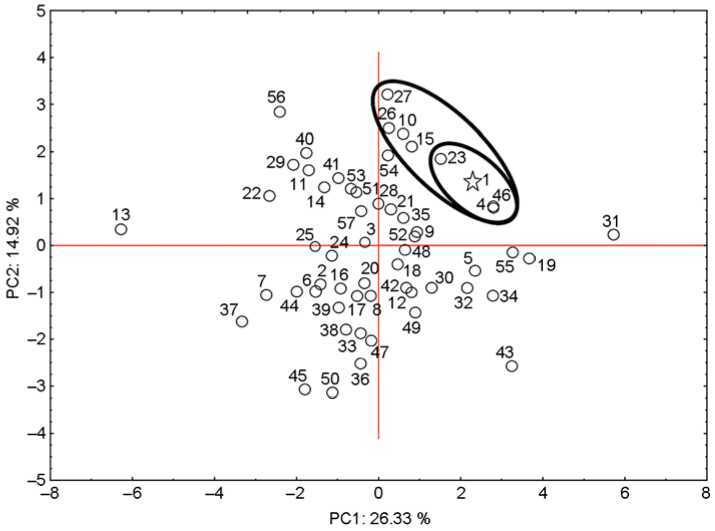
The first two principal components (PC) describe 41 % of the total variability. The highest loadings for component PC1 (26.33 %) are observed in values of cranial length and breadth, minimal frontal breadth, bizygomatic breadth, upper facial height, orbital breadth and height, and nasal breadth and height (Table 4). Thus, this component differentiates between skulls with large total dimensions, large orbits, and broad and high nasal apertures (negative area) and skulls with the opposite characteristics (positive area). The distribution of individuals along the PC1 axis does not generally correlate with the territorial grouping of the material; both the negative and positive areas encompass representatives of almost all groups (see Figure ). Single skulls from Yakutia and southeastern Aral Sea region are located in the negative area, demonstrating the robust morphology. In contrast, skull No. 162 from the Shigir peat-bog in the Middle Trans-Urals (positive area, minimum dimensions) and a skull from Perevoznoe burial 1 in the Krasnoyarsk-Kansk forest-steppe (negative area, maximum dimensions) occupy disparate positions within the PC1 coordinates.
In PC2 (14.92 %), the highest loadings fall to the values of cranial height, simotic subtense, nasal
Table 4. Loadings on the first two principal components
|
Trait |
PC1 |
PC2 |
|
1. Cranial length |
–0.75 |
–0.09 |
|
8. Cranial breadth |
–0.60 |
0.43 |
|
17. Cranial height |
–0.10 |
–0.51 |
|
9. Minimal frontal breadth |
–0.63 |
–0.08 |
|
45. Bizygomatic breadth |
–0.63 |
0.27 |
|
48. Upper facial height |
–0.56 |
–0.25 |
|
51. Orbital breadth from mf. |
–0.69 |
–0.14 |
|
52. Orbital height |
–0.44 |
0.14 |
|
54. Nasal breadth |
–0.69 |
0.18 |
|
55. Nasal height |
–0.67 |
–0.29 |
|
SS. Simotic subtense |
–0.28 |
–0.56 |
|
77. Nasomalar angle |
0.07 |
0.69 |
|
Zm. Zygomaxillary angle |
–0.29 |
0.71 |
|
72. General facial angle |
–0.40 |
0.05 |
|
75 (1). Nasal protrusion angle |
–0.05 |
–0.44 |
Note. Maximum load values are marked in bold.
Scatter plot of the first two principal components for Mesolithic and Neolithic populations of Northern Eurasia (numbers refer to Table 1).
protrusion angle (negative area), and nasomalar and zygomaxillary angles (positive area). Thus, PC2 discriminates between crania with high vault, prominent nose, and face protruding in the horizontal norm, and those with lower vault, less prominent nose, and flattened face. We may assume that PC2
is a means of differentiation between Mongoloid and Caucasoid craniometric complexes. The vast majority of its groups exhibit a complex and intricate composition. However, noteworthy is a distinct series from the Baraba forest-steppe, situated in the negative area of PC2. A contrasting position is occupied by an individual from burial 18 of the Fofanovo cemetery (positive area) and individuals from burial 9 of the Sakhtysh-2A site and from Peschanitsa (negative area).
Thus, the graphical distribution of the sample of Meso-Neolithic individuals from the territory of Northern Eurasia demonstrates primarily a great polymorphism in its anthropological composition. The polymorphism is determined not by the territorial differentiation of groups, but by a number of other factors, the most significant being the initial nonconsolidation of morphological substrate. At the same time, evidence suggests the formation of Caucasoid and Mongoloid morphological complexes, as indicated by the structure of loadings on the PC2.
The individual from Krokhalevka, located in the positive areas of PC1 and PC2, exhibits the closest proximity to the people from Upper Ob region (Firsovo XI, burial 9), associated with the East European Volosovo culture (Sakhtysh-2A, burial 15) and the Trans-Baikalian Kitoy culture (Fofanovo, burial 6). Notably, the Krokhalevka skull is situated between the samples from Eastern Siberia on the one hand, and from the southern regions of Western Siberia and the East European Plain on the other. The plot represents a set of objects grouped along the “ray”, or vector (marked by a large oval in the figure). This set includes skulls from Zarechnoye-1 (15), Bazaikha (10), and Fofanovo (26, 27).
The combination of craniometric features in the material included in this cluster indicates an eastern (“Mongoloid”) tendency. In anthropological terms, the population groups from which these individuals originate are multi-component. This is the reasonable conclusion of specialists who have studied the corresponding craniological collections. The material from Firsovo XI includes the skulls displaying Caucasoid, Mongoloid, and intermediate protomorphic Caucasoid-Mongoloid morphology (Solodovnikov, Tur, 2017: 68). A comparable complexity of anthropological composition, albeit with a more pronounced Caucasoid component, is observed in the Volosovo series from Sakhtysh, ascending to the local Mesolithic population (Alekseeva et al., 1997: 27). The craniological material from the Middle Yenisei basin, to which the skull from Bazaikha belongs, shows a Mongoloid-European intermediacy of the most important diagnostic features (Alekseev, 1961: 112). The Kitoy people from the Trans-Baikal area demonstrated archaic, evolutionarily conservative traits (Gerasimova, 1992: 110), and in the Glazkovo period they displayed enhanced Mongoloid features (Ibid.: 111). The Kitoy cranium from Fofanovo burial 6 (23) is the closest to the Krokhalevka one, and was described by M.M. Gerasimova as Mongoloid “with structural characteristics of the archaic type” (Ibid.: 99).
Thus, the results of the principal component analysis suggest the origin of the specific skull morphology of the Krokhalevka individual in terms of two theoretical approaches. The conservative approach posits that the population history in the Neolithic in Northern Eurasia was dominated by the transformation of archaic morphological complexes. In contrast, the admixture approach allows the existence of consolidated complexes—Mongoloid and Caucasoid— at the Neolithic stage; these were confined to specific areas and were subject to mixing during migration processes. In any case, among the evidence from the West Siberian forest-steppe, the closest parallels to the Krokhalevka individual are those from neighboring territories—Firsovo XI (Barnaul stretch of the Ob) and Zarechnoye-1 (Salair region).
Our analysis has shown that the materials from the Baraba forest-steppe and Irtysh basin (Protoka, Sopka-2, Omskaya site) are closely grouped in the part of the plot that is opposite to the Krokhalevka skull. At first sight, these results appear to deviate from the archaeological analogies established for the Krokhalevka burial, which indicate a westward (Baraba forest-steppe and Irtysh basin) and northward (Lower Ob) trajectory (Marchenko et al., in press). However, given the location of the Firsovo XI and Krokhalevka-5 sites in close proximity to the Ob waterway, which flows northwards, it can be postulated that some elements of spiritual culture were common to the Lower and Upper Ob Neolithic populations (mytho-ritual conception of boat). Unfortunately, at present, there are no available qualitative paleoanthropological materials to be used to form an idea of the craniological type of the Neolithic populations of the Lower Ob and Lower Irtysh regions. However, the extensive archaeological material from these areas, including evidence of burial practices, allows us to conclude that northwestern Siberia was not isolated and was rather intensely developed during the Mesolithic and all stages of the Neolithic (Klementieva, Pogodin, 2020). To date, the only anthropological data from this region are dental materials from Neolithic burials, which indicate their Eastern origin (Ibid.: 136). Furthermore, the results of our analysis demonstrate that in one individual, cranial and dental features may exhibit different vector orientations: Eastern in cranial pattern and Western in dental pattern. This suggests their potential non-consolidation in terms of the modern typology of morphological complexes, and a general diversity of evolutionarily conservative anthropological substrates in the Neolithic in Western Siberia.
With regard to the interaction between the Neolithic populations of Baraba and the Upper Ob basin, our analysis of craniometric data has revealed no evidence of such a phenomenon. The relative anthropological isolation of the Upper Ob and Baraba populations can be attributed to the peculiar character of the two regions, which resulted in distinct trajectories of population evolution. It seems reasonable to suggest that the genetic development processes in the Upper Ob basin and Baraba were relatively independent from each other, and were based on different substrates.
Conclusions
The current possibilities for anthropological study of the Neolithic population of the West Siberian foreststeppe, including the increased amount of available material since the 1990s, innovations in instrumental and comparative statistical analysis, and the formation of new theoretical approaches, allow for the extraction of significant insights even from single finds, thereby considerably clarifying the evolutionary aspect of cultural and genetic processes in the region. Our study of the anthropological features of the individual from burial 33 at the cemetery of Krokhalevka-5 has provided insights not only into the local area (Upper Ob basin), but also extended beyond it.
The combination of cranial traits of this individual, in the context of anthropological differentiation of the Neolithic population of Northern Eurasia, displays a certain trend towards the complexes prevailing in ancient and modern Eastern Siberian groups. This morphology includes homoplatyprosopy of the facial section, moderate nasal protrusion, a narrow sloping frontal bone, and relative elongation of the occipital component of the sagittal arch of the skull. The mesomorphic proportions of the cranium and facial section, in conjunction with the very narrow piriform aperture with a sharp lower edge, are more common in the groups of Western Siberia and the European part of Northern Eurasia. The Neolithic age of the burial suggests that the anthropological identification of the individual is associated with a nonconsolidated (protomorphic) component in terms of modern typology. The combination of morphological features of his dentition tends towards the Western dental stock. The Krokhalevka individual differs from representatives of the contemporaneous Neolithic Baraba population (with medium robust skeleton, average stature, and mesomorphic proportions of limb segments) by his postcranial morphology—gracile skeleton, distal type of upper limb growth, and aboveaverage body length.
Statistical principal component analysis carried out for the continuum of individual craniometric data of the North Eurasian population has allowed us to draw conclusions on the general trends of population history in the Eurasian region in the Neolithic, and on the local features of development of the anthropological composition of the Neolithic populations of the Upper Ob basin. We have identified a significant polymorphism in the population of northern Eurasia in general, caused by the initial nonconsolidation of morphological substrate. At the same time, the formation of the Caucasoid and Mongolian morphological complexes is outlined.
The specific morphology of the Krokhalevka skull can be interpreted not only as a result of the transformation of one of the archaic morphological types that lived in Northern Eurasia in the Neolithic. The existence of consolidated complexes (Mongoloid and Caucasoid), having their own geographic areas, in the Neolithic suggests their admixture during the migration processes. Irrespective of the chosen hypothesis, important is the fact that among the West Siberian Neolithic groups, the individual from Krokhalevka exhibits the greatest cranial similarity to those buried at Firsovo XI (Barnaul stretch of the Ob) and Zarechnoye-1 (Salair region). Conversely, the paleoanthropological materials from the Neolithic burials of Baraba show certain discrepancies with the above specimens. This suggests that different substrates were involved in the population history of the Upper Ob basin and Baraba.
Acknowledgement
The study was carried out under the project “Comprehensive Studies of the Ancient Cultures of Siberia and Adjacent Territories: Chronology, Technologies, Adaptation, and Cultural Ties” (FWZG-2022-0006).
