
Indigenous "traditional knowledge" in fishery and "sustainable development": international legal practice
Journal: Perm University Herald. Legal Sciences @jurvestnik-psu
Section: Международное право
Article in issue: 1 (15), 2012.
Free access
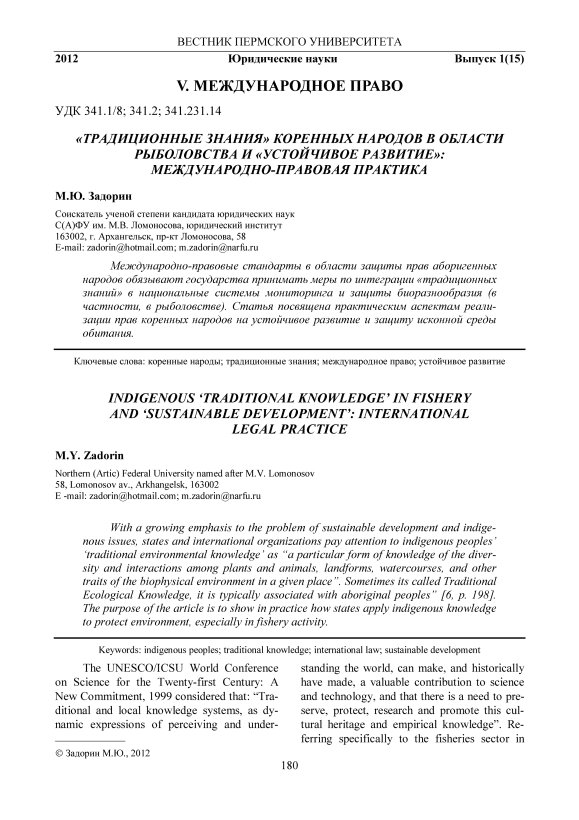
With a growing emphasis to the problem of sustainable development and indigenous issues, states and international organizations pay attention to indigenous peoples' 'traditional environmental knowledge' as a particular form of knowledge of the diversity and interactions among plants and animals, landforms, watercourses, and other traits of the biophysical environment in a given place. Sometimes its called Traditional Ecological Knowledge, it is typically associated with aboriginal peoples [6, p. 198]. The purpose of the article is to show in practice how states apply indigenous knowledge to protect environment, especially in fishery activity.
Similar articles in the section Law of international organizations
Short address: https://sciup.org/147202115
IDS: 147202115 | UDC: 341.1/8;
«Традиционные знания» коренных народов в области рыболовства и «устойчивое развитие»: международно-правовая практика
Международно-правовые стандарты в области защиты прав аборигенных народов обязывают государства принимать меры по интеграции «традиционных знаний» в национальные системы мониторинга и защиты биоразнообразия (в частности, в рыболовстве). Статья посвящена практическим аспектам реализации прав коренных народов на устойчивое развитие и защиту исконной среды обитания.
References Indigenous "traditional knowledge" in fishery and "sustainable development": international legal practice
- Ames E.P. Atlantic cod stock structure in the Gulf of Maine, Fisheries. Vol. 29. №1. 2004. P. 10-28.
- CCRF, Article 12 Fisheries Research, para. 12.12.
- Hall J., Fishing with dolphins? Affirming a traditional Aboriginal fishing story in Moreton Bay, SE Queensland. In Coleman, R.J., Covacevich, J., and Davie, P. (eds), Focus on Stradbroke: New Information on North Stradbroke Island and Surrounding Areas 1974-1984. Boolarong Press, Brisbane, 1984. P. 16-22.
- King, M.G. and Faasili, U., A network of small, community-owned Village Fisheries Reserves in Samoa, Parks 8 (2), 1998.
- Maurstad, A., Sundet, J. (1998). 'The invisible cod: Fishermen's and scientist's knowledge'. In: S. Jentoft (ed.), Commons in a cold climate: Reindeer pastoralism and coastal fi sheries. Paris, Casterton Hall, Parthenon Publishing. P. 167-85.
- Peña Devon G., 'Glossary', 'Mexican Americans and the Environment'. Tucson: The University of Arizona Press, 2005. P. 198.
- Protected Areas and Development in the Lower Mekong River Region. P.124. URL: http://www.mekong-protected-areas.org/mekong/docs/tlp-08.pdf (accessed: 12.08.2011).
- Richard J. Hamilton, The role of indigenous knowledge in depleting a limited resource -a case study of the bumphead parrotfish (bolbometopon muricatum) artisanal fishery in Roviana Lagoon, Western Province, Solomon Islands. P. 70.
- Richard J. Hamilton, ibid. P. 69.
- Ross A., and Quandamooka Land Council, Aboriginal approaches to cultural heritage management: A Quandamooka case study. Tempus 6: 1996. P. 107-112.
- Tanuja Barker and Anne Ross, Exploring Cultural Constructs: The Case of the Sea Mullet Management in Moreton Bay, South East Queensland, Australia. P. 298-299.
- The Land Code of Russia, Article 7(3).
- The FL 'On protection of environment', Article 4.
- The FL 'On the territory of traditional nature activity…', Article 1.
- The FL 'On specially protected natural territories', Article 9(4), Article 15(3), Article 24(4).
- The FL 'On the continental shelf of the Russian Federation', Article 11.
- The FL 'On the internal waters, territorial sea and contiguous zone of the Russian Federation', Article 21(3).
