
Linguapragmatic analyze of greetings in Persian and Uzbek languages
Journal: Bulletin of Science and Practice @bulletennauki
Section: Филологические науки
Article in issue: 9 т.5, 2019.
Free access
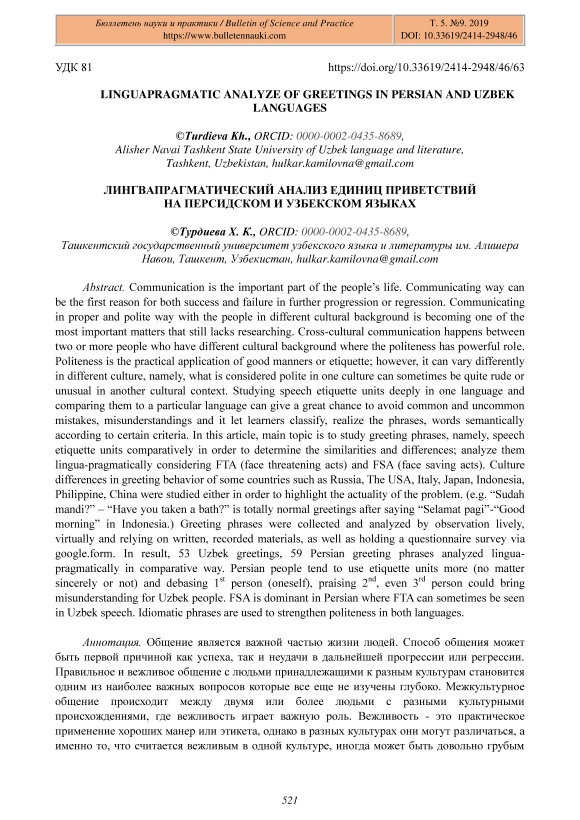
Communication is an important part of people’s life. The communicating way can be the first reason for both success and failure in further progression or regression. Communicating in a proper and polite way with the people in the different cultural background is becoming one of the most important matters that still lacks researching. Cross-cultural communication happens between two or more people who have different cultural background where the politeness has powerful role. Politeness is the practical application of good manners or etiquette; however, it can vary differently in a different culture, namely, what is considered polite in one culture can sometimes be quite rude or unusual in another cultural context. Studying speech etiquette units deeply in one language and comparing them to a particular language can give a great chance to avoid common and uncommon mistakes, misunderstandings and it let learners classify, realize the phrases, words semantically according to certain criteria...
Similar articles in the section Linguistics and languages
Short address: https://sciup.org/14115715
IDS: 14115715 | UDC: 81 | DOI: 10.33619/2414-2948/46/63
Лингвапрагматический анализ единиц приветствий на персидском и узбекском языках
Общение является важной частью жизни людей. Способ общения может быть первой причиной как успеха, так и неудачи в дальнейшей прогрессии или регрессии. Правильное и вежливое общение с людьми принадлежащими к разным культурам становится одним из наиболее важных вопросов которые все еще не изучены глубоко. Межкультурное общение происходит между двумя или более людьми с разными культурными происхождениями, где вежливость играет важную роль. Вежливость - это практическое применение хороших манер или этикета, однако в разных культурах они могут различаться, а именно то, что считается вежливым в одной культуре, иногда может быть довольно грубым или необычным в другом культурном контексте. Глубокое изучение единиц речевого этикета на одном языке и сравнение их с конкретным языком может дать отличный шанс избежать ошибок, недоразумений и позволит учащимся классифицировать, понимать фразы, слова семантически в соответствии с определенными критериями. В этой статье основной темой является сравнительное изучение фраз приветствия, единиц речевого этикета, чтобы определить сходства и различия; проанализировать лингва-прагматически, учитывая FTA и FSA...
References Linguapragmatic analyze of greetings in Persian and Uzbek languages
- Romanova N. N., Filippov A. V. Slovarʹ: kulʹtura rečevogo obščenija; etika, pragmatika, psichologija. Flinta, 2009.
- Levinson S. C. Pragmatics Cambridge University Press // Cambridge UK. 1983.
- Shammas N. A. Lingua-pragmatic politeness and translatability // Damascus University Journal. 2005. V. 21. №3. P. 4.
- Leech G. N. Principles of pragmatics. Routledge, 2016.
- Wilson D. Taped Personal Communication with Wilson, Deirdre, University College London: 14 June 1994.
- Zhu J., Bao Y. The Pragmatic Comparison of Chinese and Western "Politeness" in Cross-cultural Communication // Journal of Language Teaching
- DOI: 10.4304/jltr.1.6.848-851
- Michael Victory Interests in sinology (Chinese studies) and Hokkien research. www.quora.com
- Afghari A., Karimnia A. A contrastive study of four cultural differences in everyday conversation between English and Persian // Intercultural communication studies. 2007. V. 16. №1. P. 243.
- Jibreen M. K. The speech act of greeting: A theoretical reading // Journal of Kerbala University. 2010. V. 8. №1. P. 1-25.
- Sahragard R. A cultural script analysis of a politeness feature in Persian // 8th Pan-Pacific Association of Applied Linguistics, Japan. 2003.
- Jabbborov J. Muomala madaniyati. Muloqot, 1997. 5. 39-41. (In Uzbek)
- Mo’minov S. M. O’zbek muloqot xulqining ijtimoiy-lisoniy xususiyatlari. FFD dissertatsiyasi. Farg’ona davlat universiteti. Toshkent. 2000. (in Uzbek)
