
Economic and Social Changes: Facts, Trends, Forecast @volnc-esc-en
Journal articles - Economic and Social Changes: Facts, Trends, Forecast
All articles: 1832
Interdisciplinary intersections of research on the determinants of aging
Scientific article
The article provides a review of current research analyzing the social determinants of the aging process, which begins as early as middle age and is the result of an individual’s personal development. While scientists primarily note biological markers as its fundamental mechanisms, a trend has recently emerged toward understanding aging as a multifaceted process that includes social and psychological markers and is influenced by environmental factors that can be controlled by the will of the individual. In this regard, the issues of interdisciplinary approaches in studying aging as a bio-socio-psychological process, as well as identifying factors amenable to modeling, have gained relevance. Various classifications exist for the factors influencing the functional capacity of older adults. In most cases, they are divided into three groups: individual, social, and environmental. Factors not related to internal capabilities and health quality are usually classified as social determinants of health, which can be modified. In recent years, the idea of the possibility of constructing old age has developed, representing a set of strategies for creating and realizing an image of desired old age. This has opened a positive perspective for research and new vectors for social policy development, the goal of which is to create conditions for successful aging and healthy longevity. In the 21st century, the concept of successful aging has become an alternative to the idea of decline in old age and reflects a social demand, as the demographic shift has led to an annual increase in the number of people of retirement age. It is projected that by 2030, every sixth person in the world will be over 60 years old.
Free
Scientific article
Growing interregional disparities and the increasing dependence of many Russian regions on federal financial assistance underscore the need to assess the efficiency of the current system of intergovernmental equalization. The aim of the study is to reveal the impact of intergovernmental transfers on regional fiscal capacity and the degree of interregional asymmetry. Drawing on Federal Treasury data on the execution of consolidated regional budgets, we conduct a comprehensive assessment of the effectiveness of the transfer mechanism for 2012–2024. By distinguishing three qualitatively different stages – pre-crisis, pandemic, and post-pandemic – we trace the evolution of the equalizing effect under changing macroeconomic conditions. The methods include statistical grouping, coefficients of variation and asymmetry, Spearman’s rank correlation, and regression analysis. The findings show that intergovernmental transfers smooth interregional disparities in budget revenues (the coefficient of variation falls by a factor of 1.5–1.7), but do not lead to a lasting reduction in the gap between the most and least fiscally secure regions (the decile ratio for total revenues remains between 2.4 and 3.0). The results also reveal a temporary weakening in 2020 of the relationship between regions’ own revenues and federal financial assistance (Spearman’s coefficient dropped to 0.58) due to the expansion of anti-crisis support during the pandemic. Moreover, the interregional hierarchy of fiscal capacity remains highly stable after transfer redistribution (Spearman’s coefficient > 0.7 in most years), pointing to the persistence of existing disparities. Overall, the current model of intergovernmental regulation is highly sensitive to external shocks while offering only a limited long-term equalizing effect: it is effective tactically in smoothing the consequences of crises but remains only partially effective strategically in ensuring long-term regional convergence. The study’s practical significance lies in the possibility of using its findings to refine intergovernmental fiscal mechanisms and design policies for narrowing regional disparities.
Free
Scientific article
We consider international and Russian approaches to the definition of sustainable development. The report Our Common Future was based on a triune concept of the sustainable development - environmental, social and economic. Gradually the emphasis of sustainable development has shifted from the global problems of continents, separate states and regions to studying the sustainable development of urban environment, as currently more than half of the world’s population lives in cities. On the one hand, cities determine living standards, the improvement of which is a prerequisite for meeting basic needs for employment, housing, health care, education, and rest; on the other hand, they face problems such as lack of financial resources and jobs, increasing homelessness and poverty, widening the gap between the rich and the poor. We present an analysis of the accepted documents of the UN-Habitat on sustainable human settlements development on the Vancouver Declaration on Human Settlements (1976) to the World Cities Report 2022: Envisioning the Future of Cities. We present the European way through the European Charter. The main points and concepts of the sustainable development of big and small cities of Europe are considered from the Aalborg Charter (Denmark, 1994) to the Mannheim Message (Germany, 2020). We analyze northern city ranking, which has been implemented by the Rating agency SGM since 2013. We propose a methodology for assessing the sustainable development of northern cities on eight demographic and labor indicators; conduct a grouping of 115 cities of the Russian North on the types and indicators of the sustainable development, and mark 10 most sustainable cities and 10 - with the worst ranking. The considered theoretical provisions and practical results can be used for comparative studies and planning of territorial development. We suggest the directions for improving the sustainable development of Russia’s northern cities.
Free
International landscape of the market of Russian economic journals
Scientific article
The paper considers a new stage in the formation of the Russian market of economic journals, the stage at which an increasing number of them are accepted for coverage in international databases such as Scopus and Web of Science. In order to make an adequate assessment of the qualitative changes that have occurred in the market, we propose to introduce significant adjustments to the methodology for compiling the academic Rating of leading Russian economic journals. The adjustments affect both the subsystem of scientometric indicators where it takes into account the potential of high citations, and the subsystem of expert evaluation where it takes into account the publication's inclusion in the databases Scopus and Web of Science (WoS). We provide the results of the 4th wave of the Rating of leading Russian economic journals presented in the form of the Diamond List and the List of the second tier of journals. We analyze the shifts in the positions of the journals in comparison with previous years; we show that Russia already has 15 economic publications with international certification, among which five publications have double certification (both Scopus and WoS)...
Free
Scientific article
For most northern and Arctic territories, international migration is the only type of population movement with a positive net migration rate, which underscores the relevance of this research. The study examines international migration flows in the regions of the Russian North during the late Soviet and contemporary periods. The object of the study is 13 regions fully included in the list of Far North territories and areas equated to them. The aim is to reveal the spatial patterns of international migration in the northern regions of Russia and to assess its role in providing them with labor resources for the economy. The methodological framework includes the use of official migration statistics, census data, and scientific network methods to analyze data network structures. A network approach is applied to analyze the largest international migration flows. It is shown how migration trajectories have shifted during the transition from the development of the North in the late Soviet period to the contemporary system of international labor migration, with the Urals North and Central Asian countries playing an increasing role in migration exchange. Migration hubs and territorial clusters within migration networks are identified. The classification of migration flows allowed identifying groups of countries which have social, economic, cultural relations with the regions of the Russian North. The study highlights the special role of the Sakhalin Region and the Republic of Karelia as northern regions with the largest migration exchange with non-CIS countries. The importance of the Arkhangelsk Region in international educational migration is also noted. The study confirms the effectiveness of the network approach in analyzing international migration flows. The findings can contribute to further research on international migration and to the formulation of strategic documents for the development of the North of Russia.
Free
Interregional cooperation in the emerging Eurasian economic space
Scientific article
In 2015 the Treaty on the Eurasian Economic Union entered into force and presented a new stage of reintegration of the countries on the territory of the former USSR. The success of this project will depend not only on collaboration at the national level, but also on the degree of the EEU countries’ involvement in the integration process. The academic debate on this issue is a relevant and practically important task. The article highlights the results of the international online-conference “Interregional cooperation in the emerging Eurasian Economic Space”, conducted by the Institute of Socio-Economic Development of Territories of RAS June, 16-20 2015. It considers the issues associated with interregional trade and economic cooperation, interaction in the sphere of science and innovation and various aspects of humanitarian cooperation. It raises important problems of cross-border cooperation of the EEU states. The article makes a conclusion about the need to develop the integration process both in scope (through expanded directions of cooperation, which should not be limited only to contacts at the highest political level or trade partnership) and depth (through involvement of regions, enterprises, different social groups, individual citizens).
Free

Interregional differentiation and analysis of spatial inequality governance performance in China
Scientific article
The People’s Republic of China exhibits significant interregional differentiation across various socio-economic development indicators, including population, income level, education, and others. Researching the potential for managing spatial inequality within the framework of state regional policy necessitates the development of an approach for a comprehensive assessment of provincial socio-economic development. This approach should account for the state’s capacity to influence specific development indicators and include an analysis of the interregional disparities in the resulting evaluations over time. The aim of the work is to provide a quantitative assessment of regional policy performance across the provinces of the PRC in the context of reducing spatial inequality. The methodology is based on constructing a composite index of regional policy performance for 31 PRC provinces for the periods 2016–2019 and 2020–2023, incorporating 55 socio-economic development indicators. The indicators are grouped into eight key dimensions: Security; Healthcare; Education, Science and Innovation; Social Support; Sports and Culture; Transport; Ecology; Economic Development. The empirical findings demonstrated that eastern and central Chinese provinces exhibit higher composite index values, reflecting stronger policy performance. The Gini coefficient for the composite index decreased to 0.4 compared to 0.426 in the 2016–2019 period, indicating a reduction in spatial inequality in China as a result of implemented regional policy measures. The leaders were most distinctly separated from the main group of provinces in the dimensions of Ecology; Education, Science and Innovation; Sports and Culture; and Healthcare. The dimensions of Social Support and Transport displayed a more balanced distribution of outcomes across the national territory. During the pandemic period, disparities in Economic Development; Sports and Culture; and Healthcare decreased significantly. The analysis reveals that the regional policy performance index tends to be higher in economically advanced provinces of China and lower in larger provinces. Involvement in national-level spatial integration projects also emerges as a critical success factor in improving policy performance. The obtained results contribute to a deeper understanding of existing differentiation in regional development in China and provide valuable insights for refining the strategic design of future regional policy, as well as for developing and implementing measures to balance the level of socio-economic development across its provinces
Free

Intraregional differentiation of demographic potential in the Republic of Tatarstan
Scientific article
The issues of formation of agglomerations are more considered from the economic point of view and as an effective way of infrastructural development of territories. However, the demographic aspects of studying the potential of the regions' territories are left without attention. The purpose of the research is to determine the zones of demographic risk and stability of the Republic of Tatarstan and identify the vector of demographic development of its three agglomerations. The theoretical analysis of the concept of “agglomeration” helps consider the unification of cities and municipal districts not from the geographical and economic perspective, but as a tool for effective development of human capital. The method of rapid analysis of demographic processes in the Republic of Tatarstan developed by the Center for Family and Demography at Tatarstan Academy of Sciences is a differentiated analysis of demographic prospects of agglomerations of the Republic taking into account their initial potential. In the article, based on the agglomeration approach we differentiated intra-regional demographic potential of municipal formations of the Republic. In order to determine the zones of demographic risk in three agglomerations, we calculated the integrated rank of municipal districts according to the main demographic indicators: total fertility rate, mortality, natural growth, marriage rate, divorce rate and migration gain. The article reviews in detail birth rate as the most important category of the region's socio-demographic development. The ranking of municipal districts of the Republic of Tatarstan included in various agglomerations, according to the current demographic situation, helps identify the region's prosperous zones at the present development stage. The definition of risk zones will help adjust the social and demographic policy of municipalities, thereby ensuring sustainable demographic development of the Republic of Tatarstan as a whole.
Free
Introduction of innovation technology as a factor in environmental modernization in Russian Arctic
Scientific article
The paper considers the fundamentals of formation and realization of the modern Russian state environmental policy in the Arctic and analyzes environmental threats and challenges, including the impact of the mining and metallurgical complex on the environment. Coal industry and ferrous and nonferrous metallurgy are considered to be major producers and accumulators of waste. In the smelting of metals slags are formed, which are based on oxides. Sulfur oxides occupy one of the first places according to their negative impact on the environment. The present paper considers environmentally responsible business models in the Arctic, when the priority in management decisions is given to the issues of preserving nature and not just making profit. The main environmental issue is associated with the accumulation of waste in the places of concentration of objects of industry, transport, energy and social sphere in the confined spaces in those areas of the Arctic, where mineral deposits are exploited, raw materials are processed and transported...
Free
Investigating the Approaches to National Innovation Systems Modeling
Scientific article
The article analyzes some modern approaches to modeling national innovation systems that are presented in scientific literature. We use modern methods for analyzing bibliography and preparing literature reviews: co-occurrence, and the PRISMA (Preferred Reporting Items for Systematic Reviews and Meta-analyses) method. With the help of this approach we conduct relational analysis of documents by systematizing and arranging keywords into special semantic clusters that reflect interest in modeling national innovation systems. The research focuses on mathematical models of national innovation systems and models that use empirical quantitative data analyzed with the help of various econometric methods based on the Russian specifics of economic development. In this regard, when searching for and analyzing relevant sources, we used the filters “Russian innovation system”, “national innovation system and Russia”. We have revealed that the majority of publications focuses on such aspects as digitalization, neo-industrialization, innovation policy and technology. We identify four directions for modeling national innovation systems: macroeconomic modeling of innovation systems, modeling of growth based on the development of innovation systems, modeling of innovative activity of firms, modeling of institutional factors contributing to the development of innovation systems. The national innovation system is modeled mainly through the use of indicators related to patenting, the volume of exports and the production of innovations. Factors determining the development of national innovation systems in this context include R&D and innovation expenses, investment in technology, education, infrastructure, human resources and the quality of human capital. Conclusions on the analyzed models often do not coincide regarding the role of the state in financing innovations, the role of various elements of the institutional structure of the economy, such as intellectual property rights and mechanisms for their protection, as well as the role of political factors. On the other hand, the conclusions are consistent in terms of the impact of innovation on economic growth and development: we note a positive correlation with indicators reflecting the development of national innovation systems.
Free
Investigation of food supply in the Vologda region
Scientific article
The article proposes approaches to assessing the physical and economic access to food, and an assessment of the average food consumption in the Vologda region, taking into account the differentiation according to income. Trends in food consumption in urban and rural households are considered. The results of the population's effective demand for basic foodstuffs study are given.
Free
Scientific article
Many domestic scientific publications are devoted recently to innovative character of the development of the Russian economy and its regions. Innovative processes in the regions are associated frequently with the basic priorities of their social and economic development. This innovation assessment should have a strong basis. The subject of the article is the study of the major features of the social and economic development in one of the Russian regions against the background of the innovative processes in this region.
Free
Investment activity in the Russian economy: activation problems and directions
Scientific article
The big challenges facing Russia require ensuring high-quality economic growth which makes it necessary to search for investment resources. However, financial crises, foreign policy pressure, coupled with the export-raw materials model of the Russian economy, do not allow achieving necessary growth investment rates in fixed assets. The purpose of the research is to find and scientifically substantiate ways to enhance investment activity in the Russian Federation. For this purpose, the authors have evaluated parameters of investment activity, have analyzed the sources of financial resources for investment, and have developed specific recommendations to increase investment activity in the Russian economy. The results of the study revealed a number of problems: strengthening of sectoral and territorial disparities, growing dependence on imports of investment goods, deterioration of technological development parameters, reduction of the share of Research and Development and Research and Technological Development in GDP, and reduction of debt financing opportunities. As ways to boost investment activity, the authors propose monetary policy adjustments, expansion of fiscal and tax incentives to support investment and RTD, and development of value chains aimed at smoothing resource allocation imbalances including investment ones. The scientific novelty of the research is in development applied directions for increasing investment activity in the modern Russian economy. The methodological basis is the theory of social reproduction and national accounting. The information base of the research consists of statistical data and materials of the Federal State Statistics Service, the Unified Interdepartmental Information and Statistical Service, input-output tables, the Bank of Russia, the Higher School of Economics, normative legal acts and program documents of the Russian Federation and its subjects, publications of Russian and foreign authors in various periodicals, monographs. Further scientific research will be related to the study of institutional factors of investment activity activation and forecasting the results of implementing the proposed recommendations.
Free

Investment and innovative vector of agroleasing
Scientific article
The article describes the capabilities of agroleasing as a form of state support for innovative development of baking and grain processing industry through fiscal subsidies for the purchase of new equipment. The benefits of leasing finance schemes of investing in innovative projects compared to commercial bank lending are shown by means of specific calculations.
Free
Investment and trade attractiveness as the factors in economic development of the regions
Scientific article
The article discusses performance indicators of trade and investment attractiveness of the regions that comprise the Siberian Federal District; it also considers the consequences of the 2008 global financial crisis and the emerging trends of economic development. Investment attractiveness of the territory is defined by a set of its socio-economic development indicators. The level of investment attractiveness is the most important condition for investment activities and it promotes the quality of life. The authors identify a number of factors that determine the level of infrastructure development and the formation of favorable business climate in the business environment. The article provides a detailed analysis of the growth rates and the volume of investment in fixed capital, which are the main evaluation indicators of investment attractiveness. The attraction of investment contributes to the development of trade relations, services and social sphere. The analysis of trade attractiveness makes it possible to rank the regions of the Siberian Federal District according to the indices of trade attractiveness, which will enable to use available resources most efficiently under the conditions of tough competition and to consider projects that enhance the attractiveness of business entities.
Free

Investment process financing in Russian business: assessment, trends, problems
Scientific article
In modern conditions the provision of investment process financing is the most important task of state economic policy aimed at achieving sustainable growth and dynamic development of the Russian economy in general. This problem solution requires further theoretical consideration and development of appropriate methodological, methodical and practical recommendations. Financing of investment activity development should be based on the systemic approach, which considers this process as an element of the financial support system of the state innovation development. It is necessary to conduct research in order to expand the financial component of this support, encourage the investment process development, enhance financial relations in the sphere of forming and using the intellectual property objects and develop a complex of measures to study the innovations implementation possibilities. Although economic science pays a lot of attention to various aspects of the issue, there is currently no research work, devoted to the study of sources of the investment process financing...
Free

Investment process in the region: the new century - old problems
Scientific article
The article deals with the investment process in the Vologda oblast, its peculiarities and problems in comparison with the North-West federal district and Russia. The ways to overcome the low investmentactivity with the increasing role of the government regulation in the region are determined.
Free
Scientific article
In the changing global geopolitical and geo-economic conditions, the issues related to sustainable growth of the national economy, promoting its pronounced development dynamics and providing it with high technology are among the most important directions for Russia's modern economic policy. The priority tasks of national development require an inflow of large-scale investments in the economy, but the question of their rational distribution remains open, so that the attention of investors is directed mainly toward resource-based activities. At the same time, knowledge-intensive industries, which should be at the forefront of new industrialization, are experiencing a clear lack of investment and are in a state of stagnation. In particular, the above is true for a group of Russia's old industrial regions, in which the described situation is even more serious and leads to de-industrialization against the background of insufficient amount of investment at hand. In this regard, the goal of the paper is to analyze investment processes and assess their impact on the changes in the structure of industrial production on the example of old industrial regions of the Northwestern Federal District. We have chosen this object for our study due to the fact that these subjects of Russia occupy one of the worst positions among all old industrial territories according to a number of economic and social parameters. Scientific novelty of our work consists in the need to reveal modern patterns of socio-economic processes and identify structural deformations in the economy. The findings of our study reflect the current state of investment processes and the nature of structural transformations in the old industrial regions of the Northwestern Federal District, taking place against the background of strengthening resource-based industries. Practical significance of the findings is determined by the fact that they contribute to a better understanding of the current socio-economic situation of the sample under consideration and are useful for further study of the specifics of these territories and the problems they face.
Free

Investments of banks in securities: the essence and development trends under current conditions
Scientific article
The implementation of modern banking activities involves the realization of investments. Investment is a complex discussion economic category, characterized by a number of features. The types and forms of investment are manifold and can be transformed with account of the state of the economy and the level of development of industrial relations. The faster growth of the financial sector in the economy has stipulated the development of financial investment. Banks as financial and lending institutions actively make financial investments in securities. Banks' investment in securities pursues a number of purposes which determine the selection of securities for investment and their quality. The article identified the targets of bank investments in securities and their development trends under current conditions on the basis of the analysis of the actual data for 2010-2014. Negative revaluation and the actual decrease in the value of corporate securities of Russian issuers reduce their commercial appeal...
Free
Scientific article
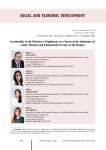
One of the reasons for the imbalance of labor markets and educational services is that applicants choose the universities and the specialties that are unclaimed in the present and future labor market. The article presents the results of an empirical study on identifying behavioral patterns of applicants when choosing a direction of study and higher education institution (2021, N = 4228), which was conducted among 10th and 11th graders of the Republic of Bashkortostan. We considered the results of the survey broken down by three territorial blocks: the capital (urban district of Ufa); urban area - 8 urban districts; rural area - 54 municipal districts. The analysis revealed three irrational patterns of behavior among applicants: 1) choosing “easy” humanities and economic specialties as the subject of the Unified State Exam (USE), not allowing to enter the desired in-demand specialty; 2) desire to enter a “promising specialty” not related to the choice of the USE; 3) applying for specialties not related to the choice of the USE subject and the desire of the entrant. During the study we found that the irrationality of an applicant’s behavior in a difficult situation associated with the multiparameter choice of training program and higher education organization becomes one of the causes of imbalance in the labor and educational services market in the region. We determined that further research on the behavior of applicants should be conducted in the following directions: modeling and forecasting behavior of applicants (development of a comprehensive agent-based model of the educational system of the region, allowing for computational experiments to assess the impact of various mechanisms of state influence on the behavior of agents (applicants), and the development of practice-oriented and interactive methods of vocational guidance among school students, especially in rural areas.
Free
