
Clay-Plaster “Masks” from Mound-Vault Skalnaya 5, Khakassia
Journal: Archaeology, Ethnology & Anthropology of Eurasia @journal-aeae-en
Section: The metal ages and medieval period
Article in issue: 4 т.52, 2024.
Free access
Findings of excavations at the burial mound-vault Skalnaya 5 of the Tes stage in Khakassia are presented. The article focuses on ritual aspects of clay-plaster coatings of human crania and their semantics. The coating was applied to cervical vertebrae and trepanned skulls. It consisted of a single type of local clay; sculptural portraits were modeled of plaster (with two main layers and a finishing layer), and pigments were made of ocher with various shades, cinnabar, and charcoal. The masks, apparently made by various artisans, represented unique faces with ethnic features. Female masks had more elaborate paintings (one or several trefoils) than male ones which were uniformly red. Wooden structures, certain details of the funerary rite, and the technology of clay-plaster coatings reveal high similarity among the burial mounds at Skalnaya 5, Noviye Mochagi near Kaly, and Lisiy near Sabinka, possibly because they were contemporaneous (first to third centuries AD). Trefoil designs are paralleled by those on two female masks from Kamenka III burials, suggesting that these women belonged to a single ethnic group. Nomadic pastoralists of Southern Siberia did not make sculptural representations of painted plaster, suggesting that the tradition was introduced from the west. But conceptual resemblance is found only among Egyptian plaster funerary masks of the Roman Age.
Similar articles in the section Archaeology
Short address: https://sciup.org/145147473
IDS: 145147473 | DOI: 10.17746/1563-0110.2024.52.4.106-116
Text of the scientific article Clay-Plaster “Masks” from Mound-Vault Skalnaya 5, Khakassia
The study of burial “masks” began in 1883, when A.V. Adrianov excavated a Tashtyk vault near the town of Minusinsk (Tagarsky Island) (1902–1924: 2). A number of works by E.B. Vadetskaya (1986a, b; 2004a, b; 2006; 2007a, b; 2009; Vadetskaya, Gavrilenko, 2002, 2006; Vadetskaya, Protasov, 2003) are distinguished among the dozens of different publications on this cultural phenomenon. Vadetskaya’s opinion changed with the accumulation of new data, resulting in the conclusion that the custom of making mummies wrapped in grass and/or covered with birch bark, with sticks for attaching the bones, and with trepanation of the skull (in the 2nd– 1st centuries BC) appeared initially in the Late Tagar burial tradition. Clay and plaster were not used in the rituals. “The remains of such mummies were discovered both in single burial mounds and in enclosures containing two or three collective graves… Presumably, some birch bark mummies were painted red, especially the face, since traces of paint sometimes survived on the bridge of the nose and in the eye sockets, or on the back of the head or upper jaw” (Vadetskaya, 2006: 344–345). In the 1st–2nd centuries, there appeared burial mound-vaults with collective secondary burials, where the skulls of the deceased (“imitations” of people) were coated with clay, and plaster facial coverings were painted (Ibid.: 345). These developments were found in the Tes burial tradition. Later, starting in the 3rd century, “masks of burial dolls” as a part of inhumation or cremation rituals were made in
the Tashtyk culture*. However, it must be admitted that today there is no clear concept regarding the reasons for the emergence or the mechanism of development of various burial rituals with the imitation of people (their parts or only the heads of the deceased) with clay-plaster painted “masks”, which existed for a long period of time among the nomadic pastoralists living in the Khakass-Minusinsk steppe. The primary obstacle is the small number of studied Tes collective burials, their large-scale looting (destruction) in ancient times, as well as difficulties in excavating and recording the evidence. Thus, the results of studying mound-vault Skalnaya 5 in the Askizsky District of the Republic of Khakassia in 2021 (Bogdanov, Timoshchenko, Ivanova, 2021: 883–885), where clay-plaster “masks” were discovered, are of extreme importance.
Description of the complex
The Skalnaya 5 burial mound was located on a huge burial field to the northwest of Mount Uytag, and had an unusual architectural structure. The carriers of the Tes culture decided to make a collective vault inside the enclosure (19.5 × 20.5 m) of a large Saragashen burial mound (Fig. 1, 1 , 2 )**. They built a log structure with a multilayered wooden ceiling at the level of the top of the earlier earthen “mound” on the place of the previous burial. In addition, the Tes builders set up several massive slabs vertically at each wall of the enclosure, wedging them with large stones (Fig. 1, 3 ). The earthen “mound” was increased in height by five or six layers of claysod blocks throughout the entire inner area. The whole structure might have been originally pyramidal in shape. To prevent it from spreading, the mound builders made additional walls of slabs laid horizontally in several layers around the perimeter (Fig. 1, 2 ).
The burial structure has survived despite two large-scale robber’s invasions and burning of the chamber from the inside (Fig. 2)***. The ten-layered structure of logs joined with a saddle notch was covered with a heavy log ceiling along the west–east line (Fig. 2, 4 ). Thinner logs were laid on top of it in a lattice of four layers (Fig. 2, 2 ). There were no traces of birch bark coverings. On the
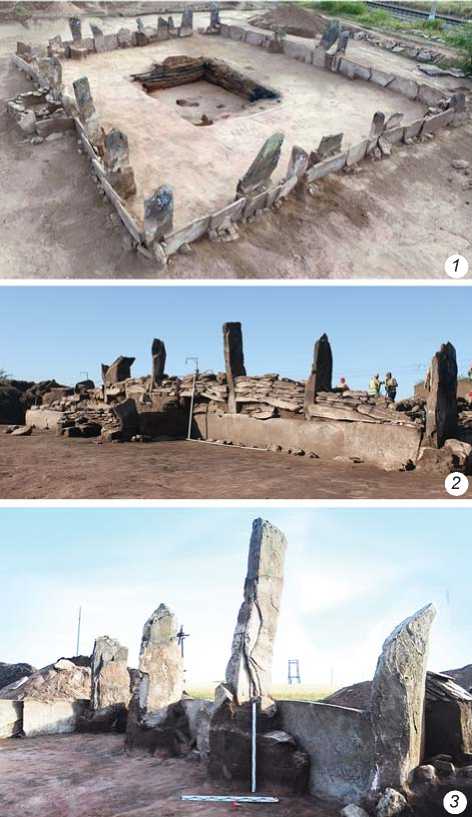
Fig. 1 . Mound-vault Skalnaya 5.
1 – view of the enclosure from the northwest; 2 – stonework of the western wall and entrance to the enclosure; 3 – view of the steles in the center of the wall, set up by the Tes people in the earthen “mound” of a Saragashen burial mound.
eastern side, an opening (under the ceiling) at least 1 m wide was made for the entrance. A passage of two steps lined with stone tiles led down to the entrance. According to stratigraphic observations, the passage remained open for quite a long time.
Three support logs were set parallel to each other along the western wall on the inside, at a distance of 0.4– 0.5 m from each other, at the level of the fourth layer of logs (counting from the bottom) (Fig. 2, 3 ). The functional purpose of this structure is difficult to determine. It might have been a “utility area”, since it contained an iron bit with mouthpieces, fragments of clay pottery, and remains of heavily burnt felt coverings on the floor under the support logs along the wall. However, the dead could probably have been placed on the logs to prepare them for further stages of the burial rite. Air permeability of
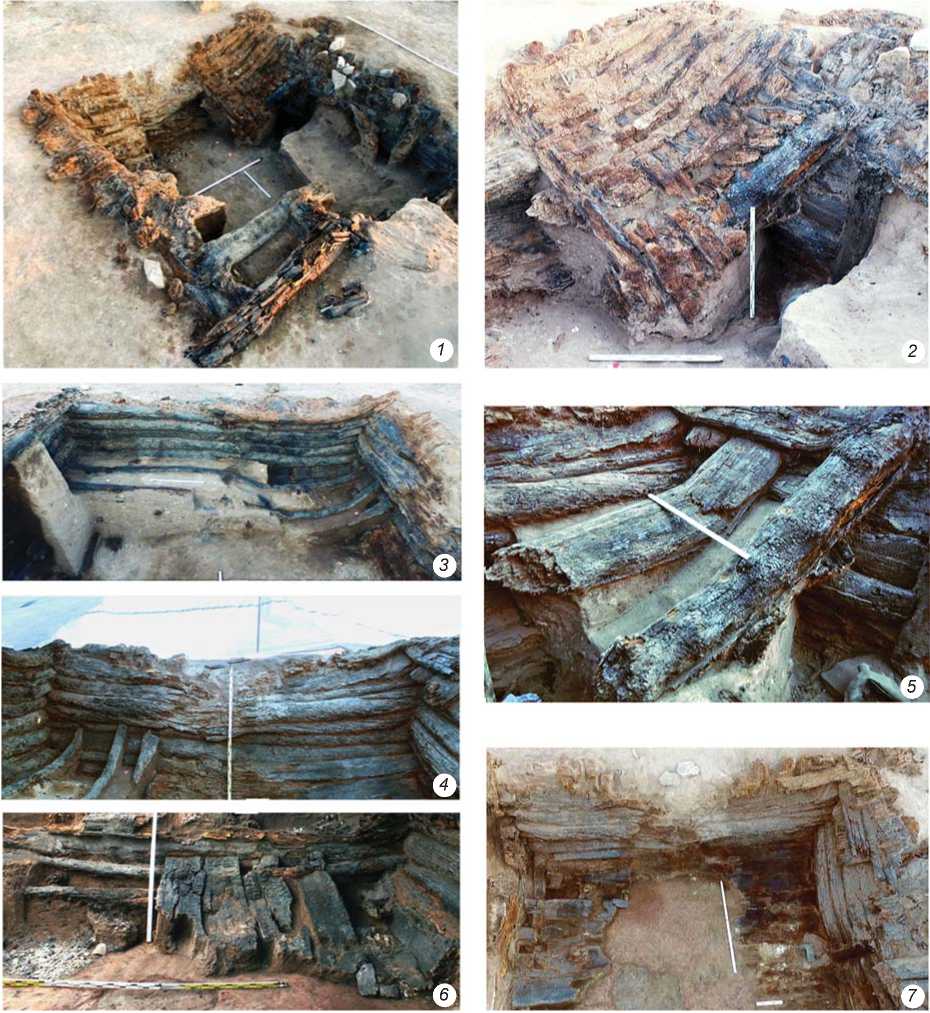
Fig. 2 . Remains of wooden structure in mound-vault Skalnaya 5.
1 – view of the wooden structure from the northwest at the level of the cover destroyed by robbers; 2 – fragment of four-layered cover made of logs; 3 – support logs along the western wall of the cribwork; 4 – southern wall of the cribwork; 5 – ceiling beams; 6 – remains of funerary shelves in the southwestern corner; 7 – remains of planks along the southern wall of the cribwork (traces of the robbers’ entrance are in the center).
the room (the entrance to the tomb remained open) could have contributed to transformation of the corpse into skeletal remains in a natural way. Plank funerary shelves (45–60 cm wide and 3–5 cm thick) were made along the northern and southern walls at the level of one layer of logs below the structure described above (Fig. 2, 6 , 7 ). The floor in the vault was made of tightly laid rough logs, oriented along the west–east line.
Specific features of the burial rite and goods
The vault was obviously used for quite a long time. At first, the dead (“imitations”) were laid quite close to each other directly on the floor along the transverse walls, leaving a free passage in the center. After some time, wide funerary shelves were built on both sides of the passage for newly buried persons. The final action of the ritual was setting fire to the vault from the inside and closing the entrance. The wooden vault and its contents did not completely burn because of the lack of oxygen. Unfortunately, many aspects of the burial rites and their sequence cannot be established. At some point (for ritual purposes? during robbery?), people entered the tomb and dragged all the dead from the shelves into the center of the chamber, breaking most of the clay-plaster coverings of the skulls. Several centuries later, robbers broke into the vault twice. The log ceiling might have collapsed after the first robbery, destroying the interior of the vault. Subsequently, robbers seriously damaged the entire central part of the burial chamber: most of the human bones were found in a fragmented state at different depths of grave filling and in discharged soil. In situ, the original situation survived only in three corners of the log structure under the fallen planks of the funerary shelves. The finds in these three corners allow us to partially reconstruct the burial rite, which changed over the time that the vault functioned.
The remains of over 40 adults survived on the floor under the shelves, including one anatomically complete skeleton. The rest of the remains were represented only
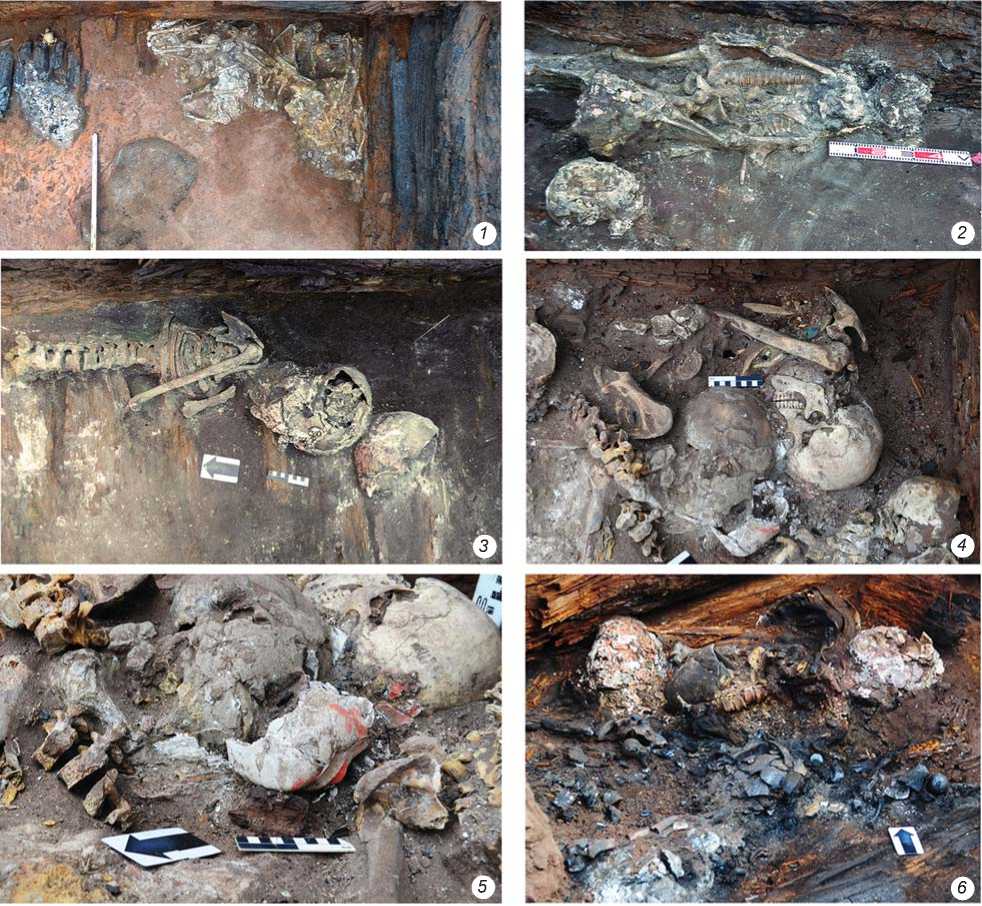
Fig. 3 . Human remains in mound-vault Skalnaya 5.
1 – view of the accumulation of skeletons in the southwestern corner of the cribwork (traces of the robbers’ pit are in the center); 2 – skeleton with burial goods near the southern wall of the cribwork; 3 – fragment of the skeletal remains of a person with a “mask” on the skull; 4 – fragment of accumulation of bone remains in the southeastern corner of the cribwork (a skull with clay coating and fallen plaster coating is in the foreground); 5 – plaster coating fallen off the clay coating of a female skull (No. 21) in situ ; 6 – skulls (No. 1–3) and burial goods in situ in the northwestern corner of the vault.
by parts of skeletons joined together (Fig. 3). These were mainly fragments of the spine with the skull or part of the chest, sometimes only leg bones joined with the pelvis (Fig. 3, 1–4). Almost all of them were discovered in the chamber in a disorderly arrangement, packed one on top of the other. A layer consisting of a mass of burnt brown grass survived in several places under some long bones and beside them. Burnt thin sticks of various lengths were found along with human remains in the northeastern corner of the cribwork (Fig. 3, 6). All of the skulls (except for two children’s skulls) were trepanned in the temporal part, filled with a mixture of grass, and had painted clay-plaster portrait “masks” (Fig. 3, 5, 6; 4–6). During the functioning of the vault (transferring the dead onto the floor) and subsequent destruction, most of the masks crumbled and were unable to be restored.
The burial goods included votive items standard for the Tes culture (bronze mirror-disks, belt buckles and rings), spoon-shaped pendants and tubular beads, fragments of iron items, paste beads, jar-shaped pottery, as well as wooden and birch bark utensils.
5 cm
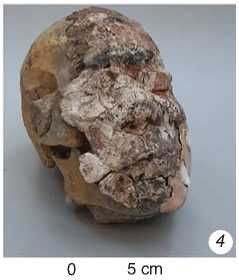
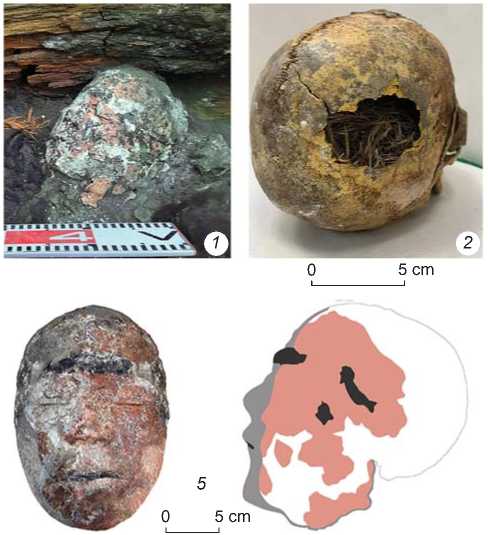
Fig. 4 . Male skull (No. 2) with clay-plaster covering from mound-vault Skalnaya 5.
1 – before restoration; 2 – traces of trepanation (grass stuffing is visible inside); 3 , 4 – after restoration; 5 – visual reconstruction of the facial part and profile with areas of painting marked.
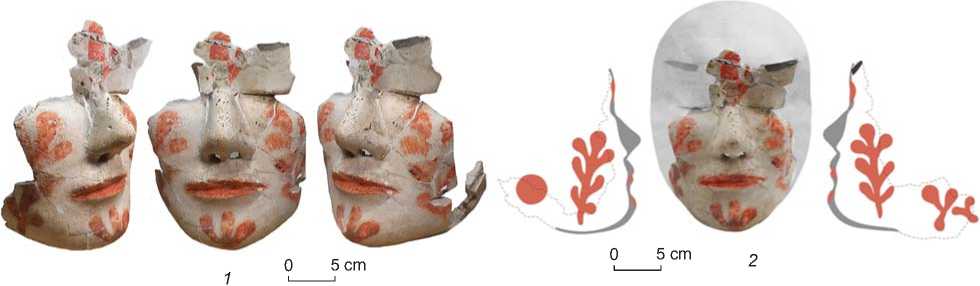
Fig. 5 . Fragments of plaster coverings with painting from mound-vault Skalnaya 5.
1 – from female skull No. 21 after restoration work; 2 – artistic reconstruction of the facial part and profiles with areas of painting marked; 3, 5 – fragments (cheeks area) of plaster coverings No. 15 and 17; 4 – fragment from the robbers’ spoil heap.
0 5 cm 0 5 cm
0 5 cm 0 5 cm 6 0 5 cm 0 5 cm
I____________________________________________I I_________________________________________________________I II 7
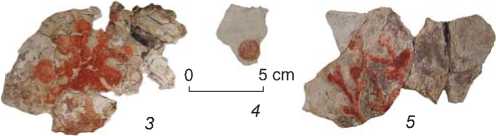
Fig. 6 . Clay-plaster coverings from mound-vault Skalnaya 5.
1 – remains of flattened covering from skull No. 11; 2 – remains of burnt plaster covering from skull No. 1; 3–5 – fragments (from the robbers’ pit); 6 – fragment of plaster covering from skull No. 12; 7 – trepanned skull (No. 7) with fragments of clay and plaster.
Problems of interpretation of ritual activities and definitions
Analysis of the evidence shows that in the Skalnaya 5 burial mound-vault, remains of people were buried with traces of manipulation to their corpses. The presence of trepanation holes and grass stuffing of the skulls (see Fig. 4, 2 ; 6, 7 ) suggest the first stage of preparing the deceased for the burial. Following other scholars (K. Goroshchenko, A.M. Talgren, S.V. Kiselev), Vadetskaya believed that “the corpse was temporarily and shallowly buried somewhere for a certain period of time unknown to us (but not less than a year)” (Vadetskaya, Protasov, 2003: 45–46) and “by the time the mask was made, it was already a partially naturally dried skeleton; the clay coating was already made on the bare skull” (Vadetskaya, 2004b: 309). According to M.N. Pshenitsyna and N.Y. Kuzmin, special people carried out all manipulations with the deceased (trepanation of the skull, removal of soft tissues, and coating with clay) immediately after death explicitly for the burial (Pshenitsyna, 1975: 47; Kuzmin, Varlamov, 1988: 148– 154; Kuzmin, 2011: 172–179).
Only imprints of skull bones, teeth, and cervical vertebrae, and not a single imprint of skin, hair, gums, or eyes were present on the inner surface of the clay coatings in our evidence. Therefore, it is difficult to say for certain whether the bodies of the deceased were mummified when they were placed into Skalnaya 5. We can only state with certainty that imitations of the deceased were made from skeletal remains of varying degrees of preservation and completeness. In one case, it could have been an almost complete corpse of the deceased (but not a skeleton freed from muscles and tendons); in other cases (in the presence of wooden sticks and layers of a mass of burnt grass along the long bones of legs and arms), only individual bones of the skeleton. Twigs of coniferous trees for attaching the heads, threaded through only the last three or four cervical vertebrae, were a distinctive feature. Judging by the imprints on the clay, the stick was wrapped with a rag secured with a hair rope in its upper part for firm attachment to the skull. According to Vadetskaya, the facts indicate that “the mummies had to sit somewhere, be put on display for viewing, before being placed in the grave” (1986a: 96). Kuzmin believed that “the mannequins in the burial could have been set up vertically, placed in a sitting position (additional support was needed for that) or laid lying on their backs” (2011: 179). However, there may be another explanation, which will be presented below.
To work with the evidence more appropriately, we should first discuss the definitions. It seems not entirely correct to use the terms “mummy”, “doll”, “dollmannequin”, or “mummy-mannequin” regarding the Tes material evidence. It is more appropriate to speak
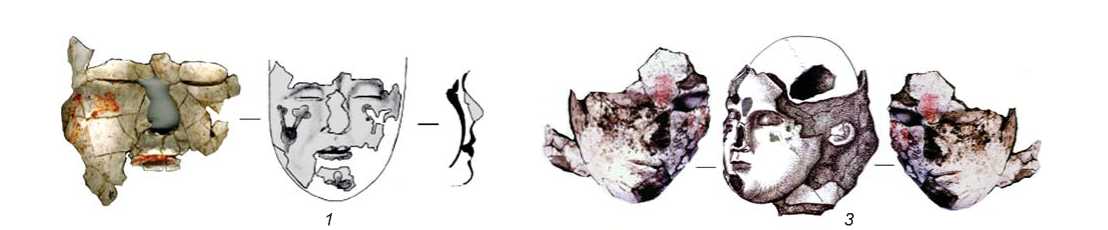
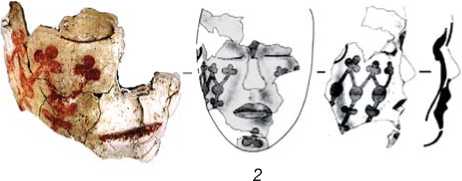
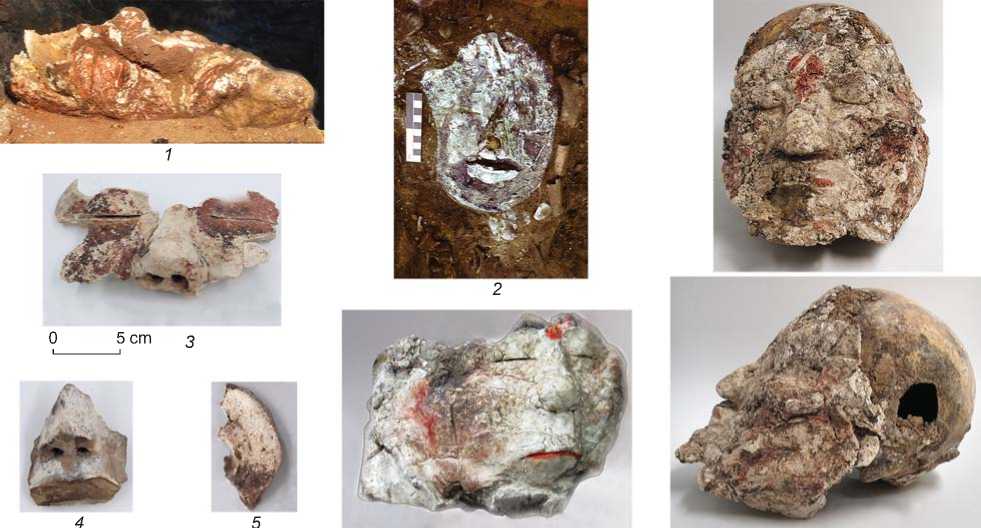
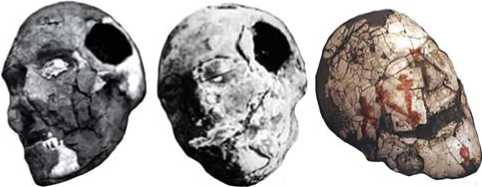
Fig. 7 . Photographs and drawings of female “masks” ( 1 , 2 ), skulls with clay/plaster coverings ( 3–6 ) (after (Vadetskaya, Protasov, 2003: Fig. 6, 78, 79; Vadetskaya, Gavrilenko, 2006: Fig. 4; Vadetskaya 2009: Fig. 24)).
1–5 – the Noviye Mochagi burial mound; 6 – grave 71B at the Kamenka III burial ground.
4 56
about production of an imitation of a deceased person for the funerary rite, giving it individual features. This individuality was clearly reflected in the sculptural image of a human face, which has been called a “mask” in the historical literature since the 19th century (Goroshchenko, 1899) up to the present day (Vadetskaya, 2009). This term is commonly used and is understandable to a wide circle of scholars. However, if this term is to be applied, it should be done with a certain degree of conventionality (using quotation marks). In terms of the semantics and manufacturing technique, clay-plaster sculptural images of human faces do not correspond to either the ethnographic or modern cultural definition of “mask”.
The manufacturing technology of clay-plaster coatings from Skalnaya 5
Two critical points should be made immediately. Currently, extremely few complete “masks” that would give a complete idea of the object of study are known to have survived in the Tes mound-vaults (Fig. 7). For example, Vadetskaya noted that “only parts of clay-coated skulls or fragments can usually be extracted from the grave” (Vadetskaya, Protasov, 2003: 36). Unfortunately, this type of finds from burial mounds near the village of Tes, Lake Kyzyl-Kul, the town of Chernogorsk, and burial mounds of Tepsei XVI, Barsuchikha I, and Lisiy near the villages of Sabinka, Noviye Mochagi, Tas-Khyl, and Togr-Tag (Pshenitsyna, 1975: 45; 1979: 83; Vadetskaya, 1986a: 86; 2004b: 308; Pavlov P.G., 1987; Kuzmin, 2011: 52) is supported by rather scant field photographic evidence (in publications), while professional drawings of the “portraits” are absent. The problem is aggravated by “depassportization of evidence”, which occurred over time, and destruction of the skulls with “masks” (Kuzmin, 2011: 172).
The second important point is that in our case all conclusions are supported by both field observations and the data of natural sciences, and the opinions of professional restorers*.
The frames for clay-plaster sculptural “portraits” from Skalnaya 5 were trepanned human skulls. They were generously coated (except for the occipital part) with layers of gray (local) clay with a small admixture of lime, which was added, according to E.Y. Mednikova, as a binder and to destroy the remaining organic matter (2003a: 257). The modeling process took place in several stages: in some cases, alternation of layers/pieces can be seen on the fractures. As a result, the trepanation hole, sinuses, empty eye sockets, and oral cavity were tightly sealed with hardened mass. At this point, the lower jaw was pressed against the upper jaw and was tied with a rope of hair. Judging by distinctive imprints, the cervical vertebrae were also covered with a thick layer of clay on all sides.
After some time, a mass of plaster with sand and plant additives was applied in two layers to the front of the resulting relatively smooth clay “blank” using a direct modeling method without any intermediate layer of fabric or leather. The stages of production are quite visible, since each new layer was applied to a slightly dried previous layer. During hardening of the plaster mass, accompanied by a slight increase in volume, the chin, lips, and brow ridges were modeled and surfaces (eyelids, nose, and lips) were finished to give volume and expressiveness to the resulting image. The closed eyes were shown with thin cut lines. The nose and possibly ears were molded separately (only one specimen made in a stylized manner was found in the grave’s filling; see Fig. 6, 5 ). The total thickness of the plaster coating was 3–8 mm (thinner on the forehead). After that, the “finishing” layer without additives was applied to the layers of “coarse” plaster. An interesting isolated fact is very careful production, with smoothening and even polishing (with fabric?), of the female facial covering on skull No. 21 (see Fig. 5, 1 ).
Painting was done using a brush on a completely dry coating. In the male version, the entire white surface was painted red. A wide band was drawn along the eyebrows with a black-brown brushstroke, and a thin black band was painted along the eyelids. The temporal sections were possibly marked with dots or lines. In female sculptural portraits, the lips were painted bright red. Decoration with plant motifs of a trefoil shoot on a long stem was painted in red on the cheeks, either individually (see Fig. 5, 1–3 ) or in rows in a zigzag pattern (see Fig. 5, 5 ). “Leaves” and “bases of sprouts” were represented by circles. The chin was decorated with a similar trefoil. The bridge of the nose was marked with a wide, teardrop-shaped spot. In two cases, individual circles appeared on the cheeks (see Fig. 5, 2 , 4 ). The pigments were ocher of different shades (red, orange, red-brown, or brown), cinnabar, and charcoal (black). In almost all cases, layers of cinnabar were discovered on top of the layers of ocher.
Discussion
The evidence from the Skalnaya 5 burial mound confirmed some earlier conclusions of other scholars which were based on data in the area of the natural sciences (Kuznetsov, 1906; Tallgren, 1921; Kulkova, 1975; Pshenitsyna, 1975; Egorkov, 2003; Mednikova E.Y., 2003b; Vadetskaya, Gavrilenko, 2006), and have made it possible to identify the main techniques and technologies for producing clay-plaster coverings at the early stages of the Tes burial tradition. However, the
Skalnaya 5 evidence, once again, pinpointed issues and unanswered questions concerning the Tes culture.
-
1. What caused the abrupt, radical changes in beliefs about the afterlife and the “road” leading to another world among the nomadic pastoralists from the Minusinsk Basin? The carriers of the Tagar culture believed that life after death was similar to reality, where meat as food was needed, and full-size household items determined the status of the deceased. In contrast, the Tes collective tombs contained no remains of funeral food; burial goods and the deceased were represented by imitations. The ritual of re-burial after exhibition (?) became significantly more sophisticated.
-
2. How did skillful sculptors, who masterfully worked with plaster, appear in the nomadic environment, given a lack of tradition in the use of such a material? This should be viewed against the background of the very primitive everyday life of the Tes people (crude handmade dishes, simplified casting of metal products, very stylized and inexpressively pecked petroglyphic compositions).
-
3. Why were the Tes clay-plaster sculptural portraits produced? What was the semantics of the colored painting on them? Drawing numerous parallels (making masks and dolls as “receptacles of the soul” and/or substitutes for the dead) from ethnography or the ancient history of peoples of the world (Pshenitsyna, 1975: 48; Kuzmin, 2011: 227– 229) is a dead end, given specific aspects of the production of the items under discussion.
Herein, we will suggest several ideas with relation to these issues. Most scholars recognize the discrepancy between the “mask” and the real prototype, as well as individuality in conveying portrait features of a man’s or woman’s face. Yet, the manner of rendering individual features and degree of stylization certainly reflect the skill level of individual sculptors. Given that the clayplaster coverings were made on a bare skull, the artisan had to hold a certain image in his mind in order to embody it. Moreover, this image was closer to reality than to mythology and abstraction. The person’s face was shown as being calm, peaceful, with closed eyes (see Fig. 4–7). In this sense, Kuzmin was absolutely right when he wrote that “the technique of applying layers of clay-plaster with subsequent mechanical modeling is comparable to the method of restoring soft tissues of the skull in reconstructions using the method of M.M. Gerasimov” (2011: 236). Thus, in each specific case, we are dealing with the creative process and cultural phenomenon of the Tes period. We do not know the foreground: whether there were some ethnic and social motives, aesthetic function (aestheticization of death when the dead became attractive in appearance), or “religious and magical” beliefs. The first assumption is supported by the accentuated display of the Caucasoid or Mongoloid features, while the recreated appearance in clay-plaster could have been absolutely opposed to the real face (see (Vadetskaya, 2009: 119) to learn more about this). Further, note that persons both with and without “masks” were buried in almost all studied Tes tombs. This makes it possible to speak about some special group of people in the Tes society, whose representatives were considered important to be buried together, although they died at different times and in different places. The second assumption is supported by the red pigment cover of the lips and black eyelids of female “masks”, complete painting of male “masks” with a blood color, and insertion of bluish beads imitating pupils into the eye sockets (about insertions, see (Kuzmin, 2011: 176)).
However, the artisans from the Minusinsk Basin and generally from Southern Siberia of the Scytho-Sarmatian period practiced only artistic casting and masterful woodcarving. Unlike these techniques, clay-plaster modeling is the process of building up a sculptural portrait, which is created gradually from within. Speaking about the first centuries of our era, the artisans who worked with plastic materials lived to the east, south, and west of the region under discussion. S.V. Kiselev was the first to suggest turning to Roman portrait sculpture (busts) and the “ritual of masks” associated with the funerary rite and the cult of ancestors (1949: 252). He found particularly important the surviving written evidence “about plaster and wax portrait masks that covered the face of the deceased person or his burial mannequin in collocatio during burial or burning at the stake” (Ibid.). However, noteworthy are more obvious parallels in the evidence of
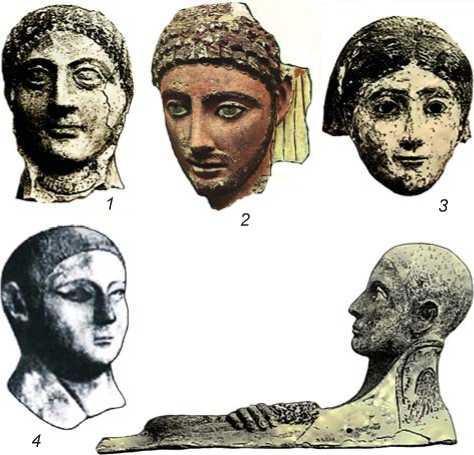
Fig. 8 . Egyptian funerary sculptural (plaster) portraits of the Roman Age (after (Muravieva, 2007: Ill. 4, 5; Edgar, 1905: Pl. XXX)).
Hellenized Egypt of the Roman Age—sculptural painted plaster portraits made for the funerary rite (Fig. 8). These were individualized, but significantly different from the original faces of the deceased. The famous scholar of Egyptian portrait art V.V. Pavlov believed that from the late 1st to early 2nd century, the mask lying horizontally on the same level with the mummy began to be raised up until it finally took a vertical position, turning into a separate head or portrait bust (1967: 20). If we take this into account, we can imagine why massive clay coating of the neck, as well as the rod inserted through the cervical vertebrae, were needed for those buried in the Tes vault, and how the head with clay-plaster coating was located relative to the “body” (Fig. 8, 5 ). Another very interesting feature was the color division of male and female Egyptian plaster portraits (Muravieva, 2008: 17). The former were completely painted red (Fig. 8, 2 ), while the latter had the natural white-yellow color of the plaster (Pavlov V.V., 1967: Fig. 13). On Egyptian masks, the eyes were abundantly blue, which was “a symbol of luxury, wealth, and nobility”. Likewise, in the Tes “masks” (Noviye Mochagi), the inserts in the eyes were also made of bluish glass. According to the British archaeologist F. Petrie, at the time of Roman Egypt, mummies were not buried immediately after mummification, but were kept for quite a long time, perhaps two or three generations, in the atriums of houses (Ibid.: 21). Thus, we may see a certain conceptual similarity with the Egyptian evidence of the Roman Age. It is not known for certain how such burial practices with the production of plaster portrait images of faces could have reached the Khakass-Minusinsk steppe.
A separate and absolutely unresolved problem for scholars is the mysterious painting on the female Tes “masks”. This painting is fundamentally different from the Tashtyk spiral geometric ornamentation. At present, the “pattern” of trefoils and dots has been found on female plaster coverings from the mound-vaults of Skalnaya 5 (see Fig. 5; 6, 6, 7) and Noviye Mochagi (see Fig. 7, 1–3) (Vadetskaya, Gavrilenko, 2006: 64, fig. 4, 11; Mednikova M.B., 2001: 219) and the Tagar-Tashtyk flat-grave burial ground of Kamenka III (see Fig. 7, 6) (Pshenitsyna, 1975: 46, fig. 2). Importantly, the distance between the first two sites does not exceed 100 km. N.Y. Kuzmin may be right that the evidence from Noviye Mochagi and Kamenka confirms the contemporaneity of the sites, while “the existence of similar types of coloring makes it possible to raise the question of the ethnic relationship of a group of women” (2011: 183). Most scholars believe that the plant motifs that we see is not of local origin, and represents a tattoo on the face of the deceased (see, e.g., (Kiselev, 1951: 449; Kyzlasov, 1960: 148)). Yet even if the trefoil is a stylized image of the lotus (Kuzmin, 2011: 182), we do not find even remote parallels to it either in the Tagar-Tashtyk materials or in the adjacent territories. Regarding the similarity of cultural stereotypes, one may agree with some points in the concept of Kuzmin “on the Okunev code in the semantics of the Tes-Tashtyk coloring” (Ibid.: 181–187). Indeed, the image of the “third eye” as a teardrop-shaped spot, emphasis on the chin, and eyebrow line on the Tes “portraits” are reminiscent of the decoration of “faces” on the Okunev sculptures. It is especially important that the comparison concerns sculptural works. However, in the Bronze Age, it was pecked on stone, while in the Tes period, it was molded from clay/plaster. Yet, in both cases, we are dealing with attributes of material and spiritual culture, acting, figuratively speaking, as intermediaries between living people and the other world (the world of the spirits). Marking the “third eye” in the center of the forehead, the “sign of the ajna chakra” (Machinsky, 1997: 273), clearly gave the deceased person the ability to reach the world of the dead.
Conclusions
-
1. Human imitations (apparently, clothed) were made for the secondary burial in mound-vault Skalnaya 5 using bone remains of varying degrees of decomposition and/ or skeletal bones of different completeness. Most likely, the “body” was laid horizontally, and the skull with the clay-plaster coating was set up vertically with the front towards the legs.
-
2. A clay-plaster coating was applied to the cervical vertebrae and bare trepanned skull; fabric (leather) overlays were not used. A single type of local clay with addition of a natural preservative (lime) was used. Sculptural portraits were created only from plaster (two main layers and one finishing layer) and were of two types: male portraits were completely red, and female portraits were white with red plant motifs. Pigments included ocher of various shades, cinnabar, and charcoal. No traces of ancient restoration of coatings or renewal of old painting have been observed on the samples studied from Skalnaya 5.
-
3. Clay-plaster sculptural portraits from mound-vault Skalnaya 5 were created by different artisans, but with a common desire to convey a unique, specific image with ethnic components in each case. It is not clear why female portraits had more sophisticated coloring (plant motifs) than the male portraits. All known Tes “masks” have a conceptual similarity with the Egyptian evidence of the Roman Age—painted plaster portrait sculptures made for the funerary rite.
-
4. Great similarity in the coloring of clay-plaster coatings was found among the evidence from the burial mounds of Skalnaya 5, Noviye Mochagi, and burials 71B and 92 at the Kamenka III flat-grave burial ground. Apparently, this similarity resulted either from contemporaneity of the complexes within the 1st– 3rd centuries, or from kin relationships.
Acknowledgment
