
Multidisciplinary study on Quang Chieu Lantern Pagoda of Ly dynasty in Vietnam and wall paintings of Mogao Grottoes in Dunhuang
Journal: Bulletin of Novosibirsk State University. Series: History and Philology @historyphilology
Section: История и источниковедение Китая
Article in issue: 4 т.25, 2026.
Free access
This study explores the 12th century Quang Chieu Lantern Pagoda of the Ly Dynasty. By integrating inscriptions, official historical records and Buddhist sutras, this article analyzes Buddhist symbol meaning of the pagoda. The research results show that the architecture of Quang Chieu is a form that simulates what has been described in the Medicine Master Buddha Sutra, so it can be called the Bhaiṣajyaguru Maṇḍala, or the Medicine Master Buddha Sutra Transformation (Dược sư kinh biến 藥師經變 Yaoshi jingbian). The practice of the Bhaiṣajyaguru ritual, the use of the Medicine Master Buddha Sutra in particular, Mogao grottoes wall paintings in Dunhuang and the circulation of the Sinitic Tripitaka in show that the Dai Viet kingdom during the Ly-Tran Dynasties existed as an inseparable part of the Sinographic Cosmopolis.
Similar articles in the section General history
Short address: https://sciup.org/147254130
IDS: 147254130 | UDC: 94(3)+24-5 | DOI: 10.25205/1818-7919-2026-25-4-70-78
Междисциплинарное исследование пагоды-фонаря Куангтьеу династии Ли во Вьетнаме и настенные росписи гротов Могао в Дуньхуане
Изучается пагода-фонарь Куангтьеу династии Ли XII в. Объединяя эпиграфику, официальные исторические записи и буддийские сутры, автор анализирует значение буддийских символов пагоды. Результаты исследования показывают, что архитектура Куангтьеу представляет собой форму, которая имитирует то, что было описано в Сутре Будды Наставника Медицины, поэтому ее можно назвать Мандалой Бхайшаджьягуру, или Трансформацией Сутры Будды Наставника Медицины (Dược sư kinh biến 藥師經變 Яоши цзиньбянь). Практика ритуала Бхайшаджьягуру, в частности использование Сутры Будды Наставника Медицины, и распространение китайской Трипитаки, а также росписи гротов Могао в Дуньхуане показывают, что королевство Дайвьет во времена династий Ли-Чан существовало как неотъемлемая часть Синографического Космополиса.
Text of the scientific article Multidisciplinary study on Quang Chieu Lantern Pagoda of Ly dynasty in Vietnam and wall paintings of Mogao Grottoes in Dunhuang
,
,
The Quang Chieu Lantern Ritual (QCL Ritual) was a prominent Buddhist event during the Ly Dynasty, centered around the Quang Chieu Lantern Pagoda (QCL Pagoda) at the Thang Long Imperial Citadel. The seven-day ritual, held intermittently under various Ly rulers aimed to bless the king, safeguard public health, and promote peace and prosperity of the kingdom. Efforts to revive the ritual have generated scholarly interest. In 2008, a conference organized by the Ha Noi’s government discussed reconstructing the festival for the 1,000th anniversary of Thang Long-Ha Noi. Scholars debated aspects such as Bui Quang Thang’s hypothesis that the QCL Pagoda rotated mechanically like a “den Keo Quan” (revolving lantern), with seven circular levels, decreasing in size. They emphasized that its reconstruction should be based on archaeological evidence 1. However, in 2010, the Hanoi government could not hold this festival because there were no direct historical and archaeological documents about the QCL Pagoda. Recent studies have further explored the architectural and historical significance of the QCL Pagoda. In 2013, the author of this article proposed that the lantern was a mandala structure with a central tower for hanging lanterns [Tran Trong Duong, 2013, p. 128].
The only academic study on the symbol of the QCL Pagoda is an article by Ha Van Tan published in 2000. Ha Van Tan argued that Tantric Buddhism influenced the ritual, and the QCL Pagoda was a transformation of Dhāraṇī for Extinguishing the Flaming Pretan Mouths (佛說救拔焰口 餓鬼陀羅尼經) translated by monk Bu Kong 不空 (705–774) during the Tang Dynasty [Ha Van Tan, 2000, pp. 31–36]. He only paid attention to the seven Buddhas worshipped in the seven subsidiary stupas, but forgot that the QCL Pagoda was the centre of the ritual. This article refutes the above argument of Ha Van Tan, arguing that the QCL Ritual is not a food offering ritual to worship hungry ghosts according to the model of Dhāraṇī for Extinguishing the Flaming Pretan Mouths Sutra, but this is a ritual to worship Medicine Master Buddha (藥師佛, hence forth: MMB). This is a type of lantern ritual taking place around the “Dien Menh Dang” 延命燈 (another name for the QCL Pagoda) with the purpose of eliminating diseases and wars, praying for longevity, praying for favourable weather, good crops, and peace and security. The ideological foundation of this architectural complex is a number of sutras about MMB, such as: Abhiseka Sutra (佛說灌頂經), The Sutra of Merits and Virtues of the Past Original Vows of Medicine Master Vaidurya Light Tathagata (佛說藥師如來本愿經, hence forth: MMB Sutra). The QCL Pagoda is a form of transformation of Buddhist thought through architecture, sculpture, and MMB Ritual practice. The entire architectural plan of the Dharma assembly (including the QCL Pagoda in the centre, two bell towers on both sides, seven auxiliary towers, and the Bao Thanh Palace) is in the form of a mandala as described in the MMB Sutra. The architecture, statues, and ceremony are called the trans- formation of MMB Sutra (Dược Sư kinh biến 藥師經變). This is a typical example of the connection between Dai Viet culture and the MMB belief in China, as well as in Japan in the 6th– 10th centuries [Yui Suzuki, 2012, pp. 7–28].
The QCL Ritual was a prominent Buddhist ritual performed within the architectural complex of the lamp pagoda located in the Thang Long Imperial Citadel during the Ly Dynasty (1010–1225) and Tran Dynasty (1225–1400). This Buddhist festival lasted for seven days and nights, with participation from the kings, royal family, mandarins and the people. Historical records refer to this ritual by various names (see table below), but they all consistently use the term “Quang Chieu 廣昭 ”.
The “Viet Su Luoc” (“Brief History of Viet”) notes: “In the first lunar month of 1110, the QLC Ritual was held outside Dai Hung Gate” 2. In 1116, another QLC Ritual took place outside Dai Hung Gate, during which a wooden statue of a monk was carved to ring the bell 3. The Sung Thien Dien Linh Pagoda Stele Inscription of the Fourth Emperor of the Ly Family of the Kingdom of Dai Viet (carved in 1121, henceforth referred to as the 1121 inscription ) 4 states: “Building the QLC Pagoda, facing the yard in front of Doan Mon Gate (southern gate)” [Tran Trong Duong 2013, pp. 53–75, 301–371]. In 1120, the QLC Ritual was once again held 5. In the spring of 1126, a QLC Ritual was organized for seven days and nights, during which prisoners in the Protectorate of Thang Long were granted amnesty” 6. Later that year, in October, King Ly Nhan Tong (1066–1128) hosted the QLC Ritual at the Long Tri courtyard and issued an edict permitting Champa envoys to witness the event 7. In 1133, King Ly Than Tong (1116–1138) organized the lighting of the Dien Menh lamp at Dai Minh Palace 8. In 1165, King Ly Anh Tong (1136–1175) ordered the construction of the Quang Chieu Dien Menh Latern Pagoda 9. In 1195, King Ly Cao Tong (1173–1210) presided over a QLC Ritual at Dai Hung Gate 10. During the Tran Dynasty, this Buddhist ritual continued to be held by the royal court. Le Trac described the festival: “On the night of the 15th day of the first lunar month, a lamp was placed in the middle of a large courtyard called the QLC. Tens of thousands of lamps were lit, shining brightly in the sky and on the ground. Monks walked around the lantern, chanting Buddhist sutras (padakkhiṇakaraṇa), while officials performed worship, a ceremony referred to as “trieu dang 朝燈 ” 11.
The above historical documents provide us with several insights:
-
1. The name of the festival is “Quang Chieu dang hoi 廣昭燈會 ” (Sources No. 1-3-4-5-6-9), also known as the Trieu Dang ceremony ( 朝燈 ) (No.10).
-
2. The name of the ritual also reflects the central architecture feature, a type of lantern 燈 (No. 2–10), called “dang dai” 燈臺 (No. 3–8) or lantern tower ( 燈樓 ).
-
3. Another name for the lantern is Dien Menh Dang 延命燈 (No.7–8) or Quang Chieu Dien Menh Dang Dai 廣照延命燈臺 13.
-
4. The earliest mention of the ritual in the Ly Dynasty dates back to 1110. However, earlier records of the ruler “viewing lanterns” traced back to 992, although it remains unclear whether these refer to the MMB lantern or another type of lantern ritual. The form of the QCL gradually evolved over time. In 1110, the first festival likely featured only the central lantern tower. By 1116, following King Ly Nhan Tong’s directive, two bell towers were added to either side of the central tower. In 1118, seven stupas ( 七寳㙮 ) were inaugurated 14. By 1126, the elderly and ill King Ly Nhan Tong ordered the construction of a QCL platform in the Long Tri Courtyard. The QLC ceremony was held for the last time under the Ly Dynasty in 1196. During the Tran Dynasty, there was only one recorded instance of this ritual.
Table 1
Табл. 1
|
No. |
Year |
Historical events |
Historical documents |
|
0 |
992 |
King Le Long Dinh watched lantern 12 |
Viet Su Luoc |
|
1 |
1110 |
Quang Chieu Lantern Ritual 廣昭燈會 |
Viet Su Luoc |
|
2 |
1116 |
Quang Chieu Lantern 廣照燈 |
Viet Su Luoc |
|
3 |
1110-1120 |
Quang Chieu Lantern Pagoda 廣照燈臺 |
The 1121 inscription |
|
4 |
1120 |
Quang Chieu Lantern Ritual 廣昭燈會 |
Dai Viet Su Ki Toan Thu |
|
5 |
1126 |
Quang Chieu Lantern Ritual 廣昭燈會 |
Dai Viet Su Ki Toan Thu |
|
6 |
1126 |
Quang Chieu Lantern Ritual 廣昭燈會 |
Dai Viet Su Ki Toan Thu |
|
7 |
1133 |
Dien Menh Lantern 延命燈 |
Viet Su Luoc |
|
8 |
1165 |
Quang Chieu Dien Menh Lantern Pagoda 廣照延 命燈臺 |
Viet Su Luoc |
|
9 |
1195 |
Quang Chieu Lantern Ritual 廣昭燈會 |
Viet Su Luoc |
|
10 |
Tran Dynasty |
Quang Chieu Lantern 廣照燈 / Trieu Dang 朝燈 ceremony |
An Nam Chi Luoc and Viet Kieu Thu |
Chronology of Quang Chieu Lantern Ritual in Ly and Tran Dynasties
Хронология ритуалов с фонарями Куангтьеу при династиях Ли и Чан
Lantern festivals appeared for the last time in historical records during the 16th century. Hoang Si Khai (1520 –?, Dr. 1544), in his poem Tu Thoi Khuc Vinh, described a festival in the Thang Long Imperial Citadel featuring “a star-shaped fire tree” that shone brightly across a thousand windows and doors. The phrase “star-shaped fire tree” translates from “tinh kieu hoa thu” (星橋火樹), referring to a lantern ritual held on the 15th day of the first lunar month during the reign of Tang Ruizong 唐睿宗 (662–716). In this ritual, the central lantern was 20 feet tall, with ten thousand lanterns hanging from it [Bui Duy Tan, 2000, p. 1041] 15. This historical detail provides an important basis for conducting comparative studies of Dai Viet’s lantern festivals and the lantern culture of the Tang and Song dynasties. Zhang Yue 張說 (667–731) once described the Lantern Festival in Chang’an during the Tang court’s New Year celebrations, mentioning images of “dragon mouths hold fire trees, a thousand lanterns aflame. At the Imperial Palace on the 15th, we enjoy the Spring Terrace. [...] Western region lantern wheels, a thousand shadows converge” [Cao Yin, Peng Dingqiu, 1960, p. 982; Hartman, 1995, pp. 14–15; Sha Wutian, 2016, pp. 19–41]. This evidence further supports the assertion that Sinitic culture in general, and Buddhist culture during the Sui and Tang Dynasties in particular, profoundly influenced Dai Viet culture for centuries, encompassing the canons of the Three Teachings, state models, and royal rituals [Tran Trong Duong, 2023, pp. 1–26].
The historical documents describe various QCL Pagodas and Rituals that occurred in different locations. These lanterns were typically placed in the middle courtyard of Doan Mon (Dai Hung) Gate or Long Tri Yard. In one instance, records mention a lantern ceremony at Dai Minh Palace. Archaeological excavations have revealed several architectural foundations with pivot structures in different locations within Thang Long [Do Duc Tue, Mai Thuy Linh, 2021, pp. 50–52]. However, this article focuses on the artifacts at Doan Mon as documented in the 1121 inscription and new archaeological data from an excavation at Vuon Hong between 2012–2014.
The name “Quang Chieu” reflects the nature of Medicine Master Buddha (Bhai ṣ ajyaguru) – a Buddha who radiates light throughout the world ( 自身光明普照十方 ). The second important term, “Dien Menh Dang” ( 延命燈 ), clearly describes the function of the lantern ceremony, which is to cure diseases and prolong life. This type of lamp is also called “Tuc Menh Dang” ( 續命燈 ), and it is used alongside “Tuc Menh Phan” ( 續命幡 ) in the MMB worship ceremony.
The Abhiseka Sutra ( 佛說灌頂經 ), translated into Chinese by Śrīmitra 帛尸梨蜜多羅 (317– 420), records a ritual method involving life-prolonging banners and lamps ( 續命幡燈法 ) as below: “I now advise the monks to fast for seven days and seven nights with one mind, to uphold the eight prohibitions, to practice the path according to the six periods of the day, to recite this sutra 49 times, to light seven-tiered lamps, and to hang five-coloured divine banners to prolong life.” ( 我今當勸請 眾僧,七日七夜,齋戒一心,受持八禁,六時行道,四十九遍讀是經典,勸然七層之燈,亦 勸懸五色續命神幡 ) [Śrīmitra, 1988, p. 535b]. By combining historical documents with Buddhist canons, this article argues that the QCL Pagoda in the Ly–Tran Dynasties represents an architectural transformation of the MMB Sutra . The ritual of offering lamps to MMB was performed for seven days and seven nights ( 七日七夜 ) in Thang Long in 1126 [Ngo Si Lien, 1998, p. 24a]. The 1121 inscription also mentions that the QCL Pagoda had seven floors, each floor round like a wheel 中標 一幹,外設七層。虯弓出而捧金蓮 ; 縫紗籠而獲蘭焰 16. These pieces of evidence not only confirm the presence of MMB worship in Ly–Tran Dynasties but also allow us to trace the origins of the QCL Pagoda / Ritual back to the Abhiseka Sutra and the MMB Sutra .
The Sutra of Merits and Virtues of the Past Original Vows of Medicine Master Vaidurya Light Tathagata (佛說藥師如來本願經) translated by Xuan Zang 玄奘 (602–664), includes the following description: “[The MMB Pagoda] consists of 49 lamps, with seven placed in front of each of the seven MMB statues. Each lamp is as large as a wheel and burns continously for 49 days and nights without being extinguished” 17. At the centre of the MMB ritual at Thang Long Imperial Citadel stood a single lantern pagoda with 49 lamps arranged across seven floors (7 lamps per floor), resembling the murals of the Tang Dynasty’s MMB transformation at Mogao-Dunhuang Cave 220 (fig. 1, 1, 2) [Ning Qiang, 2004, pp. 33, 135–136; Sha Wutian, 2016, pp. 19–41].
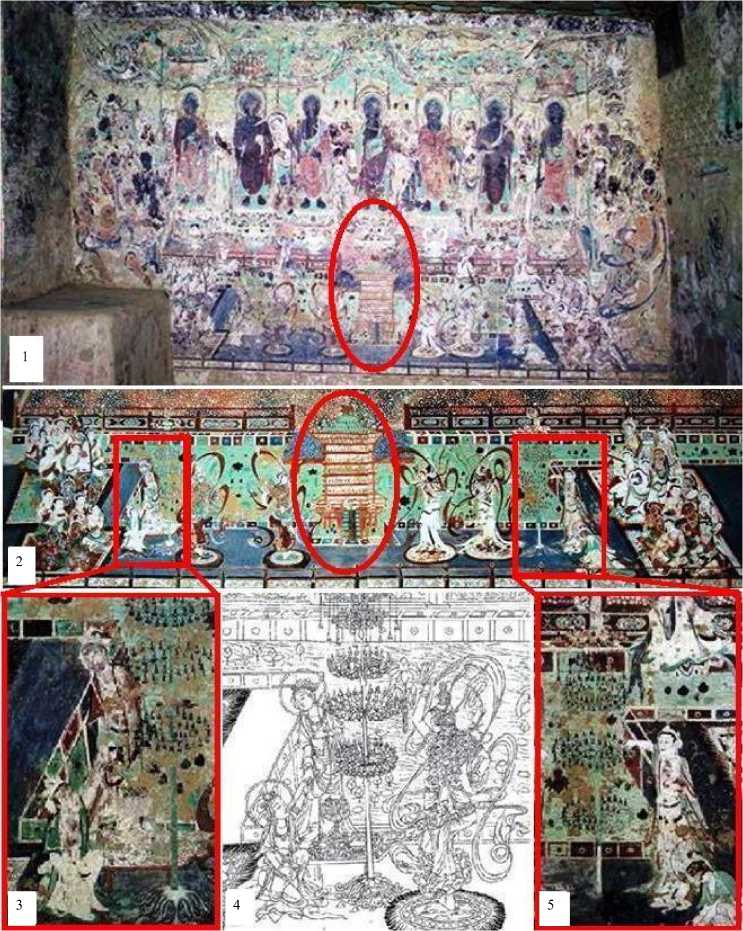
Mogao Cave 220, Dunhuang, 642 AD, Courtesy of the Dunhuang Academy:
1 – tableaux of the seven Bhai ṣ ajyaguru Buddhas of Medicine Master Buddha Sutra : main chamber, north wall, Mogao Cave 220, 2 – the tableau of the lantern Pagoda in Medicine Master Buddha Ritual, Mogao Cave 220 . Replica painted by Shi Weixiang, 3 – the right lantern wheel, 4 – the right lantern wheel re-painted by He Zhizhao and Wan Gengyu, 5 – the left lantern wheel. As per: 1 – [Sha Wutian, 2016, p. 20, fig. 1; Ning Qiang, 2004, p. 35, pl. 3], 2 – [Sha Wutian, 2016, p. 21, fig. 2], 3 – 5 – [Sha Wutian, 2016, p. 21, fig. 4 a, b, c])
Пещера 220 в Могао, Дуньхуан, 642 г. н.э. (с разрешения Академии Дуньхуана):
1 – панно семи Будд Бхайшаджьягуру из Сутры Будды – наставника в медицине: главная камера, северная стена, пещера 220 в Могао; 2 – панно пагоды с фонарями в ритуале Будды – наставника в медицине, пещера 220 в Мо-гао . Копия росписи, выполненная Ши Вэйсянем; 3 – правое колесо с фонарями; 4 – прорисовка правого колеса с фонарями, выполненная Хэ Чжичжао и Ван Гэнъюем; 5 – левое колесо с фонарями. По: 1 – [Sha Wutian, 2016, с. 20, рис. 1; Ning Qiang, 2004, с. 35, илл. 3]; 2 – [Sha Wutian, 2016, с. 21, рис. 2]; 3 – 5 – [Sha Wutian, 2016, с. 21, рис. 4 a, b, c])
This indicates that the MMB belief in Dai Viet originated from the MMB cult of the Tang Dynasty and earlier. As Shi Zhiru observes: “Configured as seven tiers of seven, the forty-nine lamps are arranged as a laddered altar of lights. Calling for forty-nine lights decked with forty-nine-foot-long banners, the instructions deliberately accentuate the numerical symbolism of forty-nine. This structure also visually concretizes the antarābhava or intermediate existence in the ritual space” [Shi Zhiru, 2020, p. 95]. The QCL Pagoda (or Quang Chieu Dien Menh Pagoda), the centrepiece of the MMB worship ritual aimed at prolonging life, is an example of architectural transformation inspired by the MMB Sutra . This tower could reach heights of over 14 metres, as described in the sutra. The 1121 inscription also mentions that the QCL Pagoda had a large central pillar and could rotate like a wheel. Murals from the Tang Dynasty depict two main types of lamps: the lantern tower at the centre of the MMB ritual and the two lamp trees (fig. 1, 3 – 5 ).
In Dai Viet during the 12th and 13th centuries, the MMB ritual was often performed in the spring (on the full moon of the first or second lunar month) or on other occasions such as the eighth or ninth lunar months. Official records only mention a few instances, but this was likely an annual ritual held by the royal court for the king and his officials to pray for peace and prosperity. This ritual resembles the lantern ceremony held to worship the MMB in the capital city of Chang’an during the 5th and 6th centuries [Sha Wutian, 2016, p. 107]. The lantern worship ceremony was organized by the Ly and Tran Dynasties, with participants including the emperor, the royal family, and mandarins. The QCL Pagoda were placed in the Imperial City in three different locations: (1) Dai Hung-Doan Mon Gate, (2) Dai Minh Palace, and (3) Long Tri Courtyard. The purpose of the MMB worship ceremony was to pray for peace in the kingdom, favourable weather, bountiful harvests, and the absence of epidemics.
During the ceremony, the kings pardoned prisoners to show mercy to the wicked. They believed that releasing prisoners demonstrated the king’s virtue of loving life, and at the same time, reflected his philosophy of “benevolent governance”. This virtue brought about blessings and prosperity, and enemies from all directions dared not invade 18. Here, we observe that the pardon of criminals was a combination of Confucian political ethics and the Buddhist concept of reward (fubao 福報 ). In 1126, King Ly Nhan Tong (1066–1128) released prisoners in the capital Thang Long to carry out the teachings of the MMB Sutra 19 . We also know about the continuous amnesty event for several years (before and after 1150) to help Do Anh Vu (1113–1159) escape from prison and return to his position as Grand Chancellor to assist King Ly Anh Tong. This was likely a political tactic of Queen Mother Linh Chieu to help her lover escape from prison 20. The above historical events suggest that the QCL ceremony is held annually, like the Buddha Bathing Ceremony and Ullambana Ceremony. The main purpose of the MMB worship ceremony was to pray for the king’s health and to prolong the kingdom’s life, but sometimes it was also used as a political tactic or for diplomatic purposes.
With the identification of the Quang Chieu lantern being used for longevity and healing rituals, the author argues that the Dien Menh lantern is the centre of a Medicine Master ritual. The ceremony, the lantern tower architecture, the Seven MMB statues, and the lamp system are based on what is described in the MMB Sutra by Master Xuan Zang. Therefore, it can be concluded that the Quang Chieu lantern tower is a ritual-architectural transmission of the MMB Sutra ( 藥師經變 , or Bhaiṣajyaguru mandala).
This study is a combination of four main historical sources, including official history, Sinitic inscriptions, and Buddhist canon. Official historical sources show that the Quang Chieu Lantern Pagoda is a type of lantern used to pray for health and longevity, so it is also called the Dien Menh Dang. Compared with the Medicine Master Buddha Sutra , it is a type of architecture imitating the Dharma assembly to worship the Bhaiṣajyaguru Buddha. The 1121 inscription describes the Quang Chieu Lantern Pagoda platform as an architectural complex with the seven-lantern tower in the centre, two bell pavillions on both sides, and the Bao Thanh Palace with seven seven-treasure stupas and Buddhist statues inside the stupas. This study ultimately concludes that the architecture of the Quang Chieu Lantern Pagoda is a type of Bhaiṣajyaguru Transformation architecture (“Duoc Su kinh bien” or “Duoc Su mandala” in Vietnamese). The reconstruction of the stupa and rituals is an interdisciplinary study, and further comparative research is needed with the Bhai ṣ ajyaguru belief in East Asia during the Ly–Tran Dynasties as well as the Tang–Song Dynasties.
