
International Journal of Information Technology and Computer Science @ijitcs
Journal articles - International Journal of Information Technology and Computer Science
All articles: 1317
Quality of Service Enhancement of Wireless Sensor Network Using Symmetric Key Cryptographic Schemes
Scientific article
A Wireless Sensor Network is a combination of spatially distributed independent nodes deployed in dense environment, communicating wirelessly over limited bandwidth and frequency. Security and Qos is the major concern in wireless sensor network due to its wireless communication nature and constraints like low computation capability, less memory, bounded energy resources, susceptibility to physical capture or damages and the use of insecure wireless communication channels. These constraints make security along with the QoS, a challenge in wireless sensor network. The cryptographic schemes increases the level of security and make it secure against critical attacks but also has a significant impact on the QoS of wireless sensor network. In this paper, the different cryptographic schemes based on asymmetric key and symmetric key cryptography are evaluated. The symmetric key cryptography schemes require less time for processing, less power and also require less storage space as compared to asymmetric key cryptographic schemes, results in less impact on the QoS of wireless sensor network. In this paper, the QoS of wireless sensor network along with cryptographic schemes will be evaluated on the basis of metrics like throughput, jitter, end-to-end delay, total packet received and energy consumption.
Free
Quantitative Analysis of RFID based Vehicle Toll Collection System using UML and SPN
Scientific article
This paper focuses on the quantitative analysis of RFID based vehicle toll collection system. Since we conduct the quantitative analysis long before the implementation of the infrastructure, the approach is realized by the UML and SPN to capture the system dynamics and carry out multiple performance tests of the possible infrastructure. Thus, the performance tests ensure the installation of correct number of RFID vehicle toll collection booth in the entrance of a bridge or a highway so that the traffic congestion can be kept as minimal as possible as well as financial viability can be confirmed. We analyze the response time and throughput to know the maximum limit for the diverse number of arrival vehicles that is served by the different number of toll booths. This finally gives us a better understanding of the number of units necessary for toll collection to decrease the traffic congestion in a budget constraint manner.
Free
Quantum-dot Controlled Electronic Block Triggering a Quantum Computation Procedure
Scientific article
The works devoted to an issue of quantum computer design have been analyzed. The main problems related to creation of the quantum computer are discussed. A fundamentally new approach to solving the problem of creating a truly quantum computer based on the “up to bottom” strategy has been proposed and justified. The strategy can be implemented by preliminary visualization of the quantum states of qubits using nanotriggers formed from two-dimensional material, in particular, graphene. This refers to the visualization (materialization) of all, including entangled, states, which mainly determine the theoretically possible large mathematical resource of a quantum computer. A block-diagram of the electronic device based on “a priory” quantum states of q-bits is proposed. It is shown that for implementation of quantum computation procedure, each materialized (visualized) Shor's cell should correspond to an element of the electronic scheme. The device includes a block containing at least 1010 nanotriggers that perform a role of q-bits of quantum computation, which are created using graphene nanoribbons and controlled by a special element. The latter represents a self-organizing quantum dot having two essentially different states in terms of magnetic properties. This quantum dot is prepared on the basis of a compound, the molecules of which are characterized by the intramolular rearrangement. The nanotriggers are employed to form reversible logic blocks or gates. Each gate contains three triggers to perform logical operations. The offered device is an additional electronic unit that is embedded in a digital computer, which makes it possible to implement the computational process in accordance with the requirements of the provisions of quantum physics.
Free
Quantum-dot cellular automata based fragile watermarking method for tamper detection using chaos
Scientific article
Fragile watermarking techniques have been widely used in the literature for tampered areas localization and image authentication. In this study, a novel quantum-dot cellular automata based fragile watermarking method for tampered area localization using chaotic piecewise map is proposed. Watermark generation, embedding, extraction and tampered area localization phases are consisted of the proposed quantum dot cellular automata and chaos based fragile watermarking method. In the watermark generation phase, quantum dot cellular automata and piecewise map which is a chaotic map are utilized. A block based method is utilized as authentication values embedding and extraction phases. To detect tampered areas, generated watermark and extracted watermark are compared. Also, block counters are used to tamper detection. In order to evaluate this method, capacity, imperceptibility and image authentication ability were utilized as performance metrics and the results of these metrics clearly illustrated that the presented method is suitable for image authentication and tamper detection.
Free
Quantum–inspired Methods for Training Machine Learning Models
Scientific article
Machine learning model training, which ultimately optimizes a model’s cost function is usually a time- consuming and computationally intensive process on classical computers. This has been more intense due to the in- creased demand for large-scale data analysis, requiring unconventional computing paradigms like quantum computing to enhance training efficiency. Adiabatic quantum computers have excelled at solving optimization problems, which require the quadratic unconstrained binary optimization (QUBO) format of the problem of interest. In this study, the squared error minimization in the multiple linear regression model is reformulated as a QUBO problem enabling it to be solved using D-wave adiabatic quantum computers. Same formulation was used to obtain a solution using gate-based algorithms such as quantum approximate optimization algorithm (QAOA) and sampling variational quantum eigensolver (VQE) im- plemented via IBM Qiskit. The results obtained through these approaches in the context of runtime and mean squared error(MSE) were analyzed and compared to the classical approaches. Our experimental results indicate a runtime ad- vantage in the D-wave annealing approach over the classical Scikit learn regression approach. The time advantage can be observed when N>524288 compared to Sklearn Linear Regression and when N>65536 compared to Sklearn SGDRegressor. Support vector machine induced neural networks, where the margin-based entropy loss is converted into a QUBO with Lagrangian approach is also focused in this study concerning the applicability for nonlinear models.
Free
Query Recommendation by Coupling Personalization with Clustering for Search Engine
Scientific article
In the present world internet and web search engines have become an important part in one's day-to-day life. For a user query, more than few thousand web pages are retrieved but most of them are irrelevant. A major problem in search engine is that the user queries are usually short and ambiguous, and they are not sufficient to satisfy the precise user needs. Also listing more number of results according to user make them worry about searching the desired results and it takes large amount of time to search from the huge list of results. To overcome all the problems, an effective approach is developed by capturing the users' click through and bookmarking data to provide personalized query recommendation. For retrieving the results, Google API is used. Experimental results show that the proposed method is providing better query recommendation results than the existing query suggestion methods.
Free
RBNS Encoded Energy Efficient Routing Protocol for Wireless Sensor Network
Scientific article
Self Organizing Wireless Sensor Networks (WSN) is an emergent and challenging technology that is applicable to various real life scenarios. Different routing protocols in the WSN have been proposed over the years. In this type of network the major concern is the energy constraint sensor nodes that operate on limited battery power. Hence energy efficient routing algorithm in WSN need to be developed in order to address the battery power constraint of the sensor nodes. Minimizing the communication overhead during the data transmission and reception can considerably reduce the energy requirement of the sensor nodes. Redundant Binary Number System (RBNS) is one of the energy efficient techniques that can reduce the communication overhead by reducing the number of 1’s required to communicate in a data packet. In our proposed work the RBNS communication technique is applied with an existing popular routing protocol in WSN to achieve an energy efficient routing protocol. The algorithm has been successfully implemented in a simulated environment and the result that has obtained demonstrates the significant enhancement of network lifetime of the sensor network.
Free
RDF link generation by exploring related links on the web of data
Scientific article
Interlinking RDF resources is a vital aspect of the Semantic Web technology. It is the basis of Linked Data that provides interlinked datasets on the web. One of the principles of Linked Data is interlinking resources from different data sources on the web. Data interlinking is a critical and challenging problem that every Linked Data generation applications face. Various approaches have been evolved for resolving this problem, but, for more massive datasets, it becomes almost indefinite time while linking similar or related resources. Linking RDF resources is like the problem of entity matching, record matching or duplicate resource detection. More or less they attempt to point to the same problem, but the RDF link generation is the task of finding related resources on the web. In this article, we present an approach for generating RDF links using the similarity measure between two RDF resources and by exploring associated relationships of the matched resources. The idea is to find related resources and link them with an RDF resource that is being generated.
Free
RFID Based Toll Deduction System
Scientific article
In this research paper we examine RFID based toll deduction system and how to make more efficient and perfect. The vehicle will be equipped with a radio frequency (RF) tag which will detect RF Reader located in on toll plaza. The amount will then automatically deduct from the bank account. This research paper can be considered scalable to implement in motor vehicles used today.
Free
Scientific article
Almost estimators are designed for the white observation noise. In the estimation problems, rather than the white observation noise, there might be actual cases where the observation noise is colored. This paper, from the viewpoint of the innovation theory, based on the recursive least-squares (RLS) Wiener fixed-point smoother and filter for the colored observation noise, newly proposes the RLS Wiener fixed-interval smoothing algorithm in linear discrete-time wide-sense stationary stochastic systems. The observation y(k) is given as the sum of the signal z(k)=Hx(k) and the colored observation noise (v_c)(k). The RLS Wiener fixed-interval smoother uses the following information: (a) the system matrix for the state vector x(k); (b) the observation matrix H; (c) the variance of the state vector; (d) the system matrix for the colored observation noise (v_c)(k); (e) the variance of the colored observation noise; (f) the input noise variance in the state equation for the colored observation noise.
Free

Scientific article
Vehicular Ad hoc Network (VANET) is formed to share information on a temporary basis between the vehicular nodes in a wireless medium. The routing information is used to discover the vehicles and the route has to be maintained to transfer the data. It may lead to link failure or breakage in the communication, if there is high network mobility and constrained topology arrangement. In case of failure, it may cause loss of data and delay in the network. So, to avoid breakage, the routing information is stored in traditional protocols like CBAODV and CS-CBAODV. Instead of storing routing information in client side, the idea of storing data in the remote side is taken into consideration to backup permanently. This remote server manages the data in client server which is to be delivered to vehicular node. After analyzing related protocols and simulators, a new reactive based routing protocol is designed in this research work and it is named as RS-CBAODV is used to handle routing information between vehicular node, Client side node (RST i.e. Road Side Terminals) and also in Remote side storage node. To analysis the performance of the proposed protocol, MOVE and NS2 simulator is used to compare both CS-CBAODV and RS-CBAODV protocols.
Free
Scientific article
This study presents the RSKD ensemble classifier, developed with ensemble feature selection techniques, to address high-dimensional, low-sample-size cancer datasets. Ensemble classifiers are advantageous in such scenarios, offering better classification accuracy than traditional methods by combining multiple models. This combination enhances predictive performance on high-dimensional datasets. However, stability—a key factor for consistent performance on unseen data—often involves a tradeoff with accuracy. Ensemble methods, due to their generalization capabilities, exhibit higher stability, with feature selection stability measured using a consistency index, averaging 65–70%. The RSKD classifier integrates ensemble feature selection methods SU-R and ChS-R, which enhance feature selection stability and classification accuracy. Its performance was evaluated on seven high-dimensional, low-sample-size datasets and compared against state-of-the-art classifiers, including Adaboost, GradientBoost, REPTree, asBagging_FSS, SRKNN, MF-GE, and eAdaBoost with DSC. The RSKD ensemble classifier achieved an accuracy improvement of 7.69% to 12.35% over these methods. Among the feature selection approaches, SU-R combined with RSKD outperformed ChS-R, demonstrating superior results in cancer prediction tasks. The findings of this study underscore the potential of RSKD for achieving generalized, robust performance on challenging datasets. By leveraging ensemble classifiers and ensemble feature selection techniques, researchers can address the inherent difficulties of high-dimensional, low-sample-size datasets, enhancing both accuracy and stability. This work provides a valuable foundation for developing diverse, heterogeneous ensemble approaches for cancer prediction and similar applications.
Free
Rainfall Events Evaluation Using Adaptive Neural-Fuzzy Inference System
Scientific article
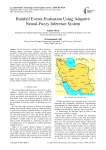
We are interested in rainfall events evaluation by applying adaptive neural-fuzzy inference System. Four parameters: Temperature, relative humidity, total cloud cover and due point are the input variables for our model, each has 121 membership functions. The data is six years METAR data for Mashhad city [2007-2012]. Different models for Mashhad city stations were constructed depending on the available data sets. Among the overall 25 possibilities one model with one hundred twenty one fuzzy IF-THEN rules has chosen. The output variable is 0 (no rainfall event) or 1 (rainfall event). With comparing trained data with actual data, we could evaluate rainfall events about 90.5 percent. The results are in high agreement with the recorded data for the station with increasing in values towards the real time rain events. All implementation are done with MATLAB.
Free
Random Connection Based Scale-free Networks
Scientific article
Scale-free phenomenon has opened up a new network model as a special form of degree distribution. Preferential connection and growth constitutive are generally considered as the tow key factors in the formation of scale-free network. However, some network model with completely random connections instead of preferential connection can also generate scale-free networks, such as the protein interaction network in a cell. The article constructed such a random connection way: select an arbitrary neighbor vertex of a random vertex to add side. Through our simulation shows this model absolutely has the characteristics of scale-free networks. And the power-law distribution index [1+β^(-1)] of the new model is related to m which is the number of add edges every time. When m is sufficiently large, [1+β^(-1)] tends to quickly stable and the final size is 3. Then we use the Mean field theory analyzed theoretically, and get an analytic solution of degree distribution. Our study reveals that random connections without preferential strategy can also generate scale-free network.
Free

Random Handwritten CAPTCHA: Web Security with a Difference
Scientific article
It is hard to believe a web form without a CAPTCHA. The web survival in this cut-throat competition is impossible without the mechanisms for blocking spam-boats. The spam-boats have now been made intelligent enough to break through machine printed CAPTCHAs. Handwritten CAPTCHA image can be one solution. In this paper handwritten CAPTCHA images have been used to enhance the web security. Introduction of randomness at various stages is proven to increase the recognition complexity for the spam boats, whereas the ease of recognition of handwritten words by human beings eventually increases the usefulness of such CAPTCHA. The technique used to produce colored image of handwritten letters also has randomness associated with it. The proposed CAPTCHA images contain alphanumeric content, one word with letters and a number with handwritten numerals. CAPTCHA images developed using proposed technique have been tested across various OCRs and online available resources as well.
Free
Ranking of Machine Learning Algorithms Used in Disease Prediction: A Review-based Approach
Scientific article
There are remarkable improvements in the healthcare sector particularly in patient care, maintaining and protecting the data, and saving administrative and operating costs, etc. Among the various functions in the healthcare sector, disease diagnosis is considered as the foremost function because it saves a life at the correct time. Early detection of diseases helps in disease prevention, letting the patients get vigorous and effective treatment and saving their lives. Several techniques were suggested by the researchers for disease prediction. Many literatures have been witnessed on disease prediction. This article reviews several articles systematically and compares various machine learning (ML) algorithms for disease prediction, including the Random Forest (RF), Naive Bayes (NB), Decision Tree (DT), Support Vector Machine (SVM), and Logistic Regression (LR) algorithms. A thorough analysis is presented based on the number of publications year-wise, disease-wise, and also based on the performance metrics. This review thoroughly analyzes and compares various ML techniques applied in disease prediction, focusing on classification algorithms commonly employed in healthcare applications. From the systematic review, a multi objective optimization method named Grey Relational Analysis (GRA) is used to rank the ML algorithms using their performance metrics. The results of this paper help the researchers to have an insight into the disease prediction domain. Also, the performance of various ML algorithms aids the researchers to choose a better methodology to predict a disease.
Free
Rapid earthquake alarm system and real-time automated action: application of multi-agent hardware
Scientific article
Earthquake is the most dangerous natural disaster in the whole era of human being life. Scientist efforts for predicting earthquake have no prolific result, so far. The earth complexity and geology structures are the main obstacles of these efforts. The importance of time at the occurrence of the earthquake has resulted in using powerful systems for real-time alarming and therefore lessening the casualties of the earthquake. In this paper we have designed a rapid earthquake alarm system and we have implemented it in parallel processing and continuous processing. We have tried to apply hardware intelligent agents for real-time and parallel processing of data and data fusion of sensors. By applying this technology, the performance of rapid earthquake alarm system will be improved. Through this improvement, the rapid and automated action of rapid earthquake alarm system can lead to reducing the effect of earthquake.
Free
Scientific article
The prevalence of automobile accidents as a major cause of violent deaths around the world has prompted researchers to develop an automated method for detecting them. The effectiveness of medical response to accident scenes and the chances of survival are influenced by the human element, underscoring the need for an automated system. With the widespread use of video surveillance and advanced traffic systems, researchers have proposed a model to automatically detect traffic accidents on video. The proposed approach assumes that visual elements occurring in a temporal sequence correspond to traffic accidents. The model architecture consists of two phases: visual feature extraction and temporal pattern detection. Convolution and recurrent layers are employed during training to learn visual and temporal features from scratch as well as from publicly available datasets. The proposed accident detection and alerting system using Convolution Neural Network models with Rectified Linear Unit and Softmax activation functions is an effective tool for detecting different types of accidents in real-time. The system of accident detection, integrated with the alerting mechanism for prompt medical assistance achieved high accuracy and recall rates.
Free
Real Time Efficient Scheduling Algorithm for Load Balancing in Fog Computing Environment
Scientific article
Cloud computing is the new era technology, which is entirely dependent on the internet to maintain large applications, where data is shared over one platform to provide better services to clients belonging to a different organization. It ensures maximum utilization of computational resources by making availability of data, software and infrastructure with lower cost in a secure, reliable and flexible manner. Though cloud computing offers many advantages, but it suffers from certain limitation too, that during load balancing of data in cloud data centers the internet faces problems of network congestion, less bandwidth utilization, fault tolerance and security etc. To get rid out of this issue new computing model called Fog Computing is introduced which easily transfer sensitive data without delaying to distributed devices. Fog is similar to the cloud only difference lies in the fact that it is located more close to end users to process and give response to the client in less time. Secondly, it is beneficial to the real time streaming applications, sensor networks, Internet of things which need high speed and reliable internet connectivity. Our proposed architecture introduced a new scheduling policy for load balancing in Fog Computing environment, which complete real tasks within deadline, increase throughput and network utilization, maintaining data consistency with less complexity to meet the present day demand of end users.
Free
Real Time Handwritten Marathi Numerals Recognition Using Neural Network
Scientific article
Character recognition is an important task in biometrics. This paper uses neural network for real time handwritten Marathi numerals recognition. We have taken 150 online Marathi numerals written in different styles by 10 different persons. Out of these, 50 numerals were used for training purpose and another 100 numerals were used for recognition purpose. The numerals undergo the preprocessing steps using image processing techniques and after character digitization it is further subjected to the multilayer backward propagation neural network for recognition purpose. The proposed research work gives recognition accuracy from 97% and to 100% for the different resolution of input vector.
Free
